
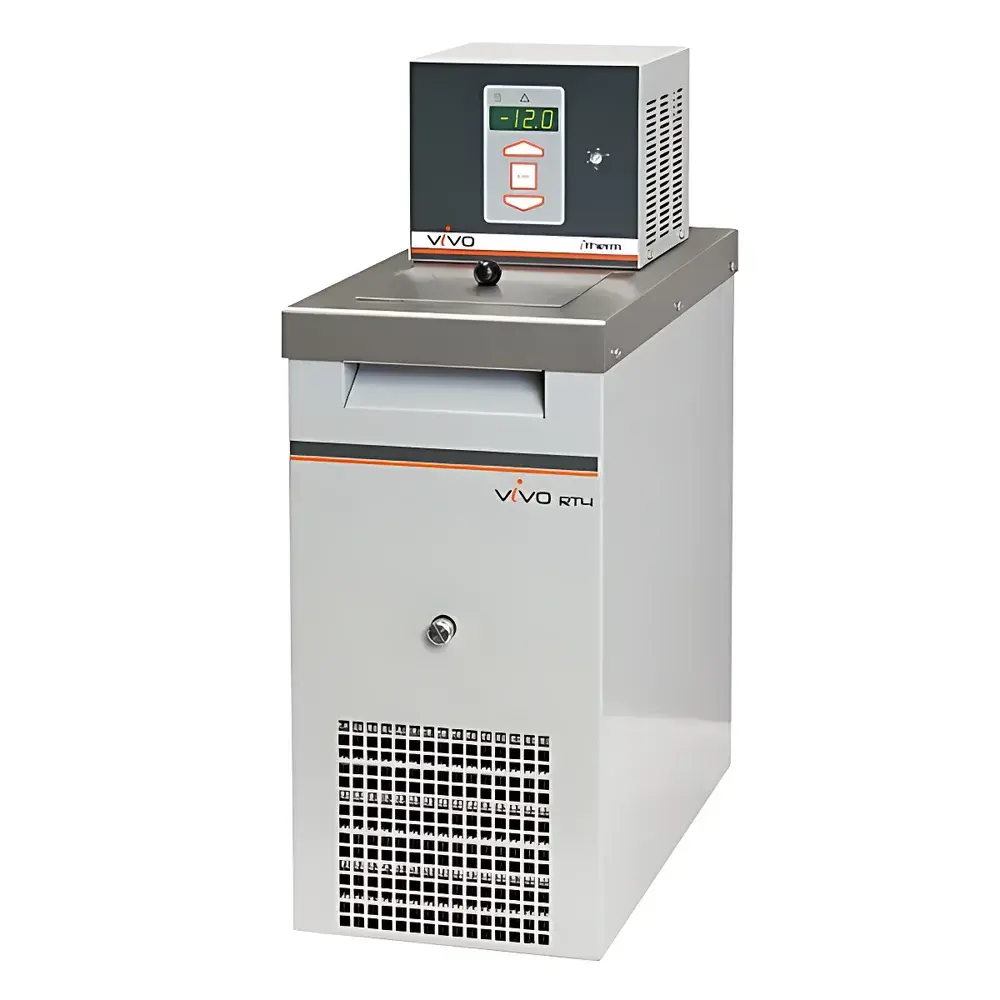
JULABO VIVO RT4P Refrigerated/Heating Circulating Bath
| Brand | JULABO |
|---|---|
| Origin | Germany |
| Model | RT4P |
| Temperature Range | −30 to +100 °C |
| Temperature Stability | ±0.05 °C |
| Bath Volume | 4–6 L |
| Heating Power | 1.5 kW |
| Pump Flow Rate | 10 L/min |
| Max. Pump Pressure | 0.23 bar |
| Bath Opening × Depth | 12 × 11 × 15 cm (W × L × D) |
| Refrigerant | R134a |
| Cooling Capacity (at 20 °C ambient) | 480 W @ −30 °C, 460 W @ −20 °C, 440 W @ −10 °C, 400 W @ 0 °C, 340 W @ +10 °C |
Overview
The JULABO VIVO RT4P is a compact, high-precision refrigerated/heating circulating bath engineered for stable thermal control in laboratory applications requiring both heating and cooling within a single unit. It operates on the principle of forced liquid circulation—using a built-in centrifugal pump to circulate temperature-controlled fluid through an internal bath or, optionally, an external system via dedicated inlet/outlet ports. Its core architecture integrates a dual-mode thermoelectric and compressor-based cooling system with a 1.5 kW resistive heating element, enabling seamless transition between heating and active cooling across its full operating range of −30 °C to +100 °C. The unit employs PID-controlled feedback regulation with real-time deviation compensation, ensuring long-term stability of ±0.05 °C under static load conditions—a performance level aligned with ISO/IEC 17025-compliant calibration workflows and ASTM E2251-21 thermal uniformity requirements for bath-based instrumentation.
Key Features
- Active Cooling Control technology ensures continuous refrigeration availability across the entire temperature span; no pre-cooling delay or thermal inertia lag when transitioning from heating to sub-zero operation.
- Stainless steel heating coil resists corrosion and minimizes scale formation—even during prolonged use with water-glycol mixtures or deionized water at elevated temperatures.
- Front-access drain valve enables rapid, spill-free bath fluid replacement without disassembling the unit—critical for maintaining contamination control in QC/QA labs handling multiple sample types.
- Dual operating modes: Standby mode reduces power consumption during idle periods while preserving setpoint readiness; Auto-Start mode initiates temperature ramping upon power restoration—supporting unattended overnight experiments.
- Integrated float-level sensor triggers audible and visual alarms and automatically interrupts power if fluid volume falls below operational minimum, preventing dry-run damage to the heater and pump.
- Low-noise design (<52 dB(A) at 1 m) and optimized airflow pathways ensure compatibility with vibration-sensitive instruments such as analytical balances, microscopes, or optical interferometers.
Sample Compatibility & Compliance
The RT4P accommodates a wide range of bath-compatible media—including water, 30–50% aqueous glycol solutions, silicone oils (up to 100 cSt), and low-volatility heat transfer fluids—with its chemically resistant stainless steel tank and sealed circulation path. Its open-bath configuration (12 × 11 cm aperture, 15 cm depth) supports immersion of reaction vessels up to 1 L, probe-based sensors, or small-scale jacketed reactors. All electrical and thermal safety systems comply with IEC 61010-1:2010 (Safety Requirements for Electrical Equipment for Measurement, Control, and Laboratory Use) and carry CE marking. The unit meets UL 61010-1 recognition criteria for North American markets and conforms to RoHS 2011/65/EU directives. While not inherently 21 CFR Part 11 compliant, audit-ready data logging (via optional JULABO WinPC software) supports GLP/GMP traceability when paired with validated external recording systems.
Software & Data Management
The RT4P operates autonomously via its intuitive three-button interface but integrates seamlessly with JULABO’s WinPC software suite (Windows OS only) for remote monitoring, programmable multi-step ramps, and time-stamped data export (.csv). When connected via RS232 or optional USB-to-RS232 adapter, the software records temperature, pump status, alarm events, and system faults at user-defined intervals (1 s to 60 min resolution). Exported logs include device serial number, firmware version, and operator ID fields—enabling alignment with laboratory information management systems (LIMS) for audit trail generation. Firmware updates are performed offline using SD card or PC connection, preserving instrument uptime during routine maintenance cycles.
Applications
- Calibration of temperature-sensitive sensors (RTDs, thermistors, infrared cameras) against NIST-traceable references in metrology labs.
- Thermal conditioning of HPLC columns, viscometers, or density meters requiring precise bath immersion.
- Controlled-rate heating/cooling of enzymatic assays, polymerization reactions, or crystallization studies where thermal history impacts kinetic outcomes.
- Stabilization of laser diodes, photomultiplier tubes, or CCD detectors in spectroscopy and imaging platforms.
- Supporting ASTM D2570 (viscosity-temperature relationship), ISO 3104 (petroleum products), and USP environmental chamber qualification protocols.
FAQ
Can the RT4P support external recirculation to a jacketed reactor?
No—the RT4P is configured for internal circulation only. For external loop applications, consider the JULABO VIVO RT6 (22–26 L capacity) or the F25-HE/HB series, which feature higher-pressure pumps and dual-flow regulation.
Is R134a refrigerant compatible with long-term use in academic research environments?
Yes—R134a is non-ozone-depleting (ODP = 0), exhibits low global warming potential (GWP = 1430), and is widely accepted under EU F-Gas Regulation No. 517/2014 for laboratory equipment with annual charge <3 kg.
Does the ±0.05 °C stability specification apply across the full −30 °C to +100 °C range?
Yes—this value reflects steady-state thermal uniformity measured at the center of the bath volume after 30 minutes of stabilization, per JULABO internal test protocol VIVO-TP-002 rev. 3.
What maintenance intervals are recommended for optimal pump longevity?
Inspect and clean the pump impeller and intake filter every 6 months; replace the circulation fluid annually or after 2000 hours of operation—whichever occurs first.
Can the unit be operated in a fume hood?
Yes, provided ambient temperature remains between +15 °C and +32 °C and relative humidity does not exceed 80% RH non-condensing; ensure ≥10 cm clearance around rear ventilation grilles.



