
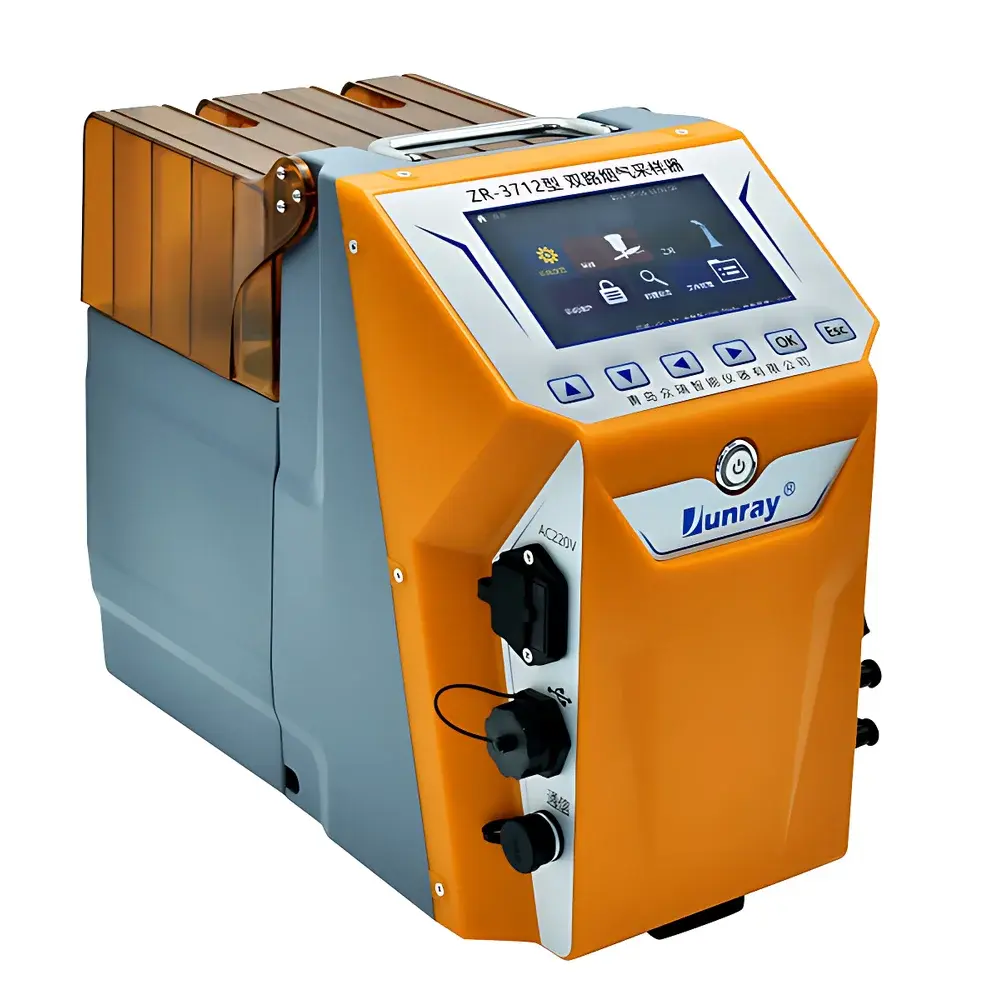
Junray ZR-3712 Dual-Channel Flue Gas Sampler
| Brand | Junray |
|---|---|
| Origin | Shandong, China |
| Manufacturer Type | OEM Manufacturer |
| Country of Origin | China |
| Model | ZR-3712 |
| Instrument Type | Flue Gas Sampler |
| Sample Type | Flue Gas |
| Flow Accuracy | ±2.0% |
| Sampling Flow Rate | 0.2–1.5 L/min |
| Flue Gas Velocity Range | 0.2–1.5 L/min |
| Moisture Content Measurement Range | 0–85% |
Overview
The Junray ZR-3712 Dual-Channel Flue Gas Sampler is an engineered field-deployable instrument designed for regulatory-compliant sampling of gaseous pollutants and particulate matter from stationary emission sources using the solution absorption method. It operates on the principle of controlled volumetric aspiration through two independent sampling channels, enabling simultaneous or sequential collection of flue gas samples under both negative-pressure (e.g., downstream of induced-draft fans) and positive-pressure (e.g., upstream of air pollution control devices) duct conditions. The system integrates a precision electronic mass flow controller with temperature and pressure compensation to maintain stable volumetric flow rates across varying stack thermodynamic conditions—critical for accurate quantification per EPA Method 5, ISO 12141, and GB/T 16157-1996. Its architecture supports isokinetic sampling when paired with optional pitot tube and thermocouple modules, ensuring representative capture of particulate-laden streams without bias due to velocity gradients.
Key Features
- Dual independent sampling channels with fully isolated flow paths, allowing parallel sampling for redundancy, cross-validation, or multi-analyte capture (e.g., SO₂ in one channel, NOₓ in another)
- High-stability electronic thermal-mass flow sensors calibrated for high-humidity flue gas environments (up to 85% RH), featuring corrosion-resistant wetted materials (316L stainless steel and PTFE-lined components)
- Rechargeable lithium-ion battery pack delivering ≥8 hours of continuous operation at 1.0 L/min per channel, validated under ambient temperatures from –10°C to +50°C
- 5.0-inch capacitive touch display with intuitive GUI supporting real-time monitoring of flow rate, accumulated volume, elapsed time, battery status, and leak-test results
- Programmable sampling modes: timed sampling, volume-controlled sampling, and constant-flow sampling with automatic cut-off upon target volume achievement
- Integrated automatic system leak-check function compliant with HJ/T 47–1999 requirements, executing pre- and post-sampling pressure decay tests with pass/fail reporting
- USB 2.0 interface for bulk data export (CSV format); optional Bluetooth 5.0 module for wireless pairing with portable thermal printers (e.g., Zebra ZQ520)
Sample Compatibility & Compliance
The ZR-3712 is validated for use with standard impingers (e.g., midget impingers, silica gel traps, KCl-coated filters) and adsorption tubes (e.g., Tenax TA, Carbopack B) specified in Chinese national standards GB/T 16157–1996 and HJ/T 47–1999. It meets mechanical and metrological requirements outlined in HJ/T 375–2007 (Environmental Air Samplers) and JJG 956–2013 (Verification Regulation for Atmospheric Samplers). All flow measurements are traceable to NIM (National Institute of Metrology, China) standards. The device’s flow accuracy (±2.0% of reading) satisfies the performance criteria for Class II samplers under ISO 5800:2020 (Air Quality — Specifications for Sampling Equipment). Optional GPS and 4G LTE modules enable geotagged audit trails aligned with GLP documentation practices.
Software & Data Management
On-device firmware stores up to 10,000 sampling records with timestamps, flow logs, and diagnostic flags. Data export via USB yields timestamped CSV files containing: sample ID, start/stop time, average flow rate per channel, total sampled volume, ambient temperature/pressure (if external sensor connected), battery voltage, and leak-test outcomes. The embedded data structure conforms to the minimum metadata schema required by China’s National Emission Monitoring Platform (NEMP). No proprietary software is required for data ingestion; exported files integrate natively with LIMS platforms supporting ASTM E1467 or ISO/IEC 17025-compliant workflows. Audit-trail functionality includes immutable event logging for all parameter changes and system resets—supporting FDA 21 CFR Part 11 readiness when deployed in QA/QC environments.
Applications
- Regulatory stack testing for coal-fired power plants, cement kilns, and waste incinerators under China’s GB 13223 and GB 18485 emission standards
- Method validation studies requiring dual-channel intercomparison (e.g., comparing absorption efficiency between different reagent solutions)
- Source apportionment campaigns where co-sampled gases (e.g., HCl + HF) must be preserved separately to prevent cross-reactivity
- Field verification of CEMS (Continuous Emission Monitoring Systems) performance per HJ 75–2017
- Research-grade flue gas characterization in pilot-scale carbon capture units, where moisture-tolerant flow stability is essential
FAQ
Does the ZR-3712 support isokinetic sampling?
Yes—when used with optional pitot tube, thermocouple, and differential pressure sensor modules, the instrument calculates and maintains isokinetic flow ratios in real time per GB/T 16157–1996 Annex A.
Can it operate in high-moisture flue gas (>60% RH)?
Yes—the flow sensors and internal gas path are constructed with hydrophobic PTFE membranes and corrosion-resistant alloys, validated for uninterrupted operation at up to 85% relative humidity.
Is calibration certificate included with shipment?
Each unit ships with a factory calibration report traceable to NIM standards, covering flow accuracy, timer deviation, and leak-test threshold verification.
What data security protocols apply to remote transmission via 4G?
The optional 4G module uses TLS 1.2 encryption for data-in-transit and supports configurable APN authentication; no user credentials or raw sample data are stored on the module itself.
How is battery life affected during low-temperature operation?
At –10°C, runtime decreases by approximately 25% versus 25°C baseline; the device automatically adjusts heater duty cycle to maintain sensor thermal stability without compromising flow accuracy.
Related Products







