
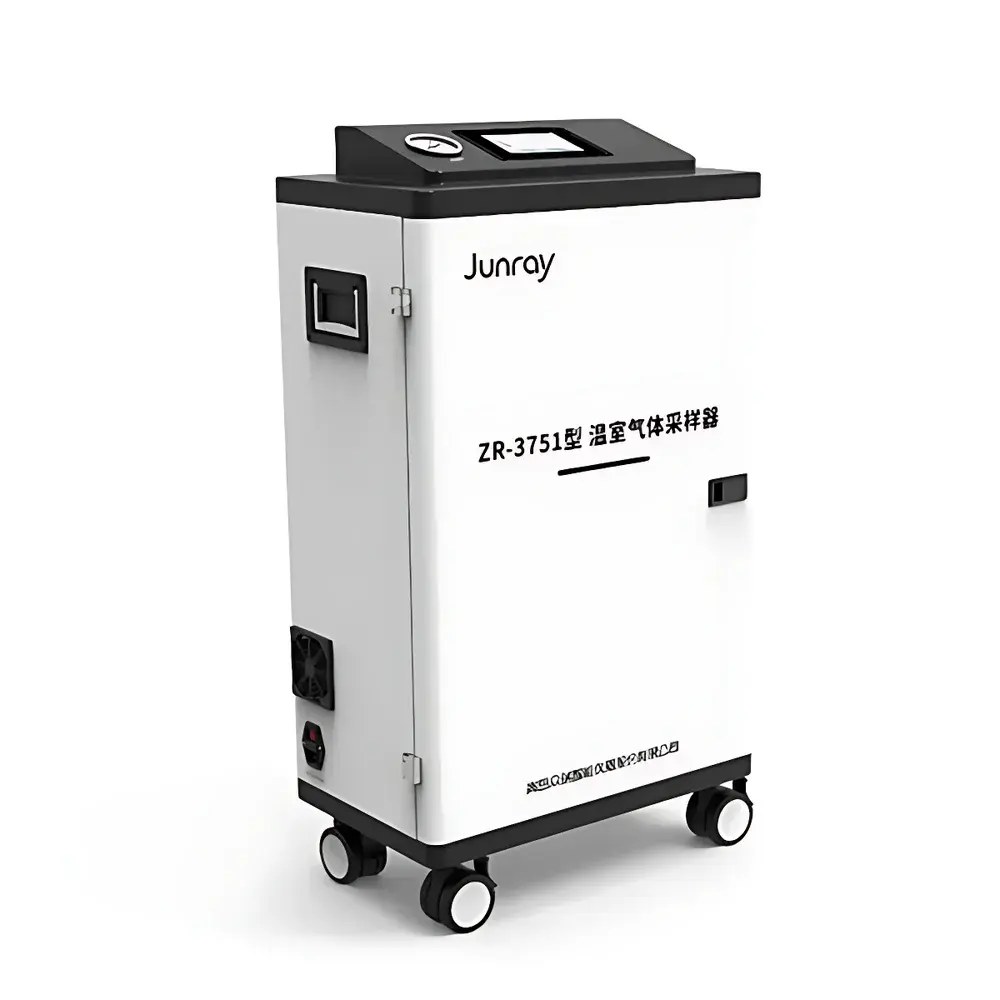
Junray ZR-3751 Greenhouse Gas Sampling System
| Brand | Junray |
|---|---|
| Model | ZR-3751 |
| Origin | Shandong, China |
| Manufacturer Type | OEM Manufacturer |
| Instrument Category | Domestic |
| Sampling Method | Glass Vial / Stainless Steel Canister |
| Target Gases | CO₂, CH₄, N₂O, HFCs, PFCs, SF₆, CFCs, Halons |
| Compliance Standards | QX/T 164–2012, QX/T 213–2013, QX/T 214–2013, Environmental Air CO₂ Manual Monitoring Technical Guidelines (Trial), Urban Carbon Monitoring QC/QA Guidelines (Trial), Urban GHG Monitoring Site Layout Technical Guidelines (1st Ed.) |
| Automation Level | Fully Automated Leak Check, Purge & Fill Sequence |
| Pressure Monitoring | High-Precision Integrated Pressure Sensor |
| Connectivity | Embedded GPRS + Bluetooth Module |
| Container Interface | Stainless Steel Quick-Connect Fittings for Dual Vessel Compatibility (Glass Vials & Electropolished Canisters) |
| Data Management | Query, Export (CSV/Excel), Print, Firmware Upgrade via Local or Remote Interface |
| Optional Integration | External Automatic Weather Station (AWS) |
Overview
The Junray ZR-3751 Greenhouse Gas Sampling System is a field-deployable, automated atmospheric sampling platform engineered for high-fidelity collection of long-lived greenhouse gases (GHGs) in ambient air. It operates on a pressure-driven, inert gas displacement principle—utilizing an oil-free, chemically inert diaphragm pump to transfer pre-dried ambient air into evacuated sampling vessels under controlled pressure conditions. This methodology ensures minimal adsorption, oxidation, or catalytic interference during transfer—critical for preserving the integrity of trace-level GHG species such as CO₂, CH₄, N₂O, SF₆, HFCs (e.g., HFC-134a, HFC-125), PFCs (e.g., CF₄, C₂F₆), CFCs (e.g., CFC-11, CFC-12), and halons (e.g., Halon-1301). Designed specifically for compliance with Chinese meteorological and environmental monitoring protocols—including QX/T 164–2012 and QX/T 214–2013—the ZR-3751 supports both glass vial and electropolished stainless steel canister sampling workflows, enabling seamless integration into national carbon monitoring networks, urban GHG observatories, and calibration laboratory reference programs.
Key Features
- Fully automated sampling sequence: integrated leak detection, multi-cycle purge with field-matched ambient air, and precision pressurization to user-defined target pressure (typically 1.1–1.3 atm absolute)
- Dual-vessel compatibility: standardized stainless steel quick-connect fittings accommodate 12 mL–900 mL borosilicate glass vials and 0.5–6 L electropolished stainless steel canisters (passivated per ASTM A967)
- In-situ moisture removal: integrated Nafion™ or chilled mirror dew point control ensures sample dew point ≤ –40 °C prior to filling—preventing condensation-induced fractionation or wall adsorption
- Real-time pressure monitoring: high-stability piezoresistive sensor (±0.1% FS accuracy) continuously logs system pressure throughout fill cycle for audit-ready traceability
- Embedded intelligence: onboard microcontroller manages timing, valve sequencing, and error handling; supports firmware updates via USB or over-the-air (GPRS)
- Wireless interoperability: Bluetooth 5.0 enables local configuration and real-time status display on mobile devices; GPRS module supports remote command execution and diagnostic telemetry
- Instrument lifecycle management: integrated RFID/NFC tag interfaces with Junray’s Lab Asset Tracking Platform for calibration history, maintenance scheduling, and chain-of-custody documentation
Sample Compatibility & Compliance
The ZR-3751 is validated for use with EPA TO-15–compatible sampling media and aligns with internationally recognized preconcentration and analytical requirements for GC-ECD, GC-FID, and GC-MS analysis. Its procedural design satisfies the technical criteria outlined in QX/T 213–2013 (glass vial cleaning/preconditioning) and QX/T 214–2013 (canister passivation and blank verification). All wetted surfaces contact only fluoropolymer (PTFE, PFA) or electropolished 316L stainless steel—ensuring negligible memory effects for reactive halocarbons. The system meets GLP-aligned data integrity requirements: timestamps, operator ID, vessel serial number, ambient temperature/pressure (when paired with optional AWS), and fill pressure are automatically embedded in each sample metadata record. Full audit trail generation supports ISO/IEC 17025–compliant laboratories conducting GHG certification or regulatory reporting.
Software & Data Management
The ZR-3751 runs on a proprietary embedded OS with a responsive touchscreen HMI (800 × 480 resolution) supporting multilingual UI (English, Chinese). Sample metadata—including GPS coordinates (via optional GNSS module), local time, barometric pressure, fill duration, final pressure, and leak test delta-P—is stored in a tamper-evident SQLite database. Data export options include CSV (for direct import into CRDS/GC software), Excel-compatible .xlsx, and PDF reports with digital signature fields. Bluetooth-enabled thermal printers (e.g., Zebra ZQ520) generate on-site chain-of-custody labels compliant with ISO 17025 Annex A. Remote access via secure MQTT broker allows centralized fleet monitoring across regional monitoring stations—enabling synchronized calibration schedules and predictive maintenance alerts.
Applications
- Urban and rural background GHG monitoring networks requiring standardized, manually triggered or time-scheduled sampling
- Validation campaigns for satellite-based GHG retrievals (e.g., OCO-2, GOSAT, Sentinel-5P) through coordinated ground-truth sampling
- Source attribution studies at landfills, wastewater treatment plants, and agricultural sites using isotopic or compound-specific analysis
- Reference cylinder preparation for calibration gas standards used in cavity ring-down spectroscopy (CRDS) and laser absorption analyzers
- Long-term trend analysis under China’s National Emissions Trading Scheme (CN-ETS) and provincial carbon accounting frameworks
- Field intercomparison exercises between mobile labs, tall-tower observatories, and aircraft-based platforms
FAQ
What types of sampling containers are supported?
The ZR-3751 accepts both borosilicate glass vials (12–900 mL) and electropolished stainless steel canisters (0.5–6 L) using standardized Swagelok®-compatible quick-connect fittings.
Is the system compatible with international GHG measurement protocols?
Yes—it adheres to core principles of WMO GAW and NOAA ESRL methodologies, and its procedural outputs meet data quality objectives defined in the WMO Global Atmosphere Watch Handbook for GHG Measurements.
How is moisture removed from the sampled air?
A thermoelectrically cooled condenser or Nafion™ membrane dryer reduces sample dew point to ≤ –40 °C before entry into the sampling vessel—verified by integrated dew point sensor.
Can the instrument operate unattended for extended periods?
With external power (12–24 V DC) and cellular coverage, the ZR-3751 supports scheduled autonomous sampling up to 30 days, with low-power sleep mode between cycles.
Does the system support electronic signatures for regulatory reporting?
Metadata records include timestamped digital signatures; when integrated with Junray’s LIMS extension, full 21 CFR Part 11–compliant electronic records are achievable.
Related Products







