
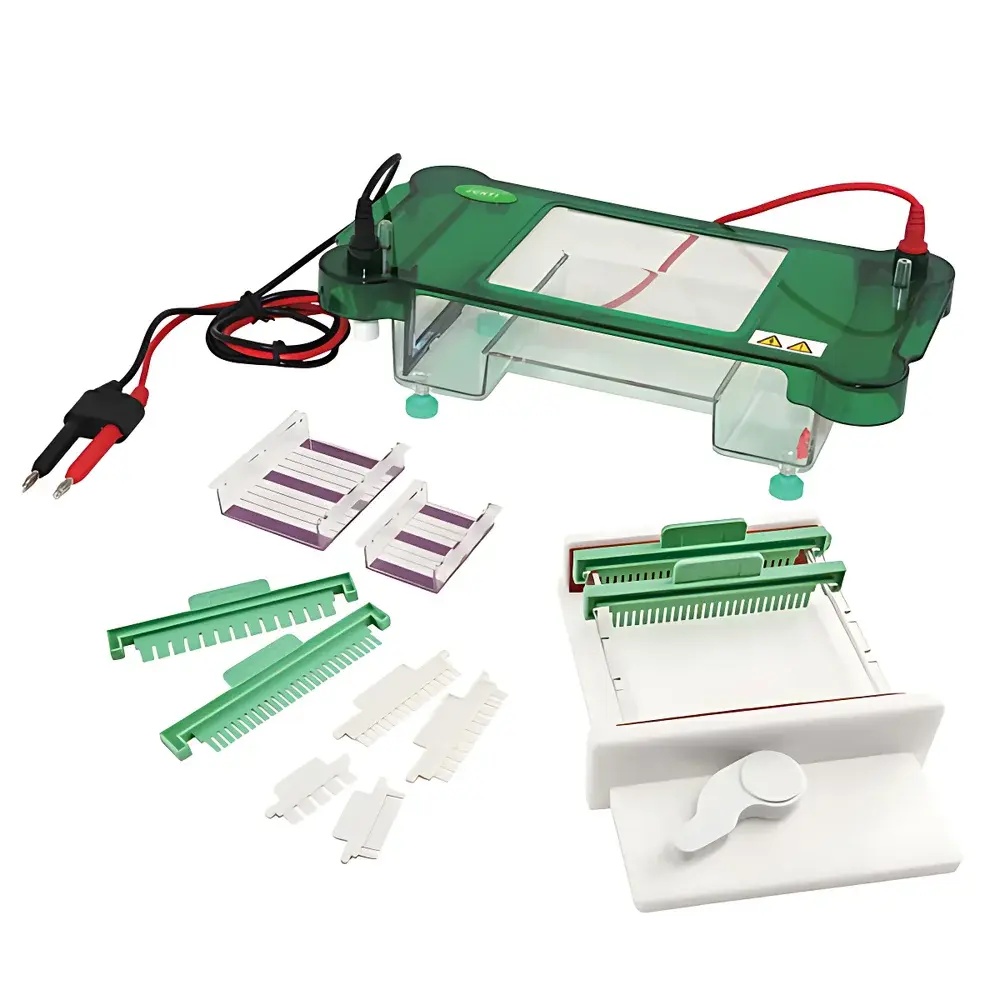
Junyi JY-SPFT Horizontal Electrophoresis System
| Brand | Junyi |
|---|---|
| Origin | Beijing, China |
| Manufacturer Type | Authorized Distributor |
| Product Category | Domestic |
| Model | JY-SPFT |
| Instrument Type | Nucleic Acid Electrophoresis Apparatus |
| Primary Component | Horizontal Electrophoresis Tank |
| Gel Dimensions (W×L) | 130×130 mm, 78×100 mm, 48×75 mm |
| Sample Capacity | Up to 104 wells |
| Buffer Volume | ~600 mL |
| External Dimensions (L×W×H) | 305×152×80 mm |
| Net Weight | 1.7 kg |
| Safety Feature | Automatic Power Cutoff Upon Lid Opening |
| Gel Casting | Pre-sterilized, No-Prep Comb System |
| Leveling Mechanism | Integrated Adjustable Feet |
| Electrode Assembly | Removable Platinum-Coated Stainless Steel Electrodes |
| Construction Material | High-Transparency Imported Polycarbonate (PC), One-Piece Injection Molded |
Overview
The Junyi JY-SPFT Horizontal Electrophoresis System is a precision-engineered platform designed for routine and high-throughput nucleic acid separation in molecular biology laboratories. Based on the fundamental principle of electrophoretic mobility—where charged biomolecules migrate through a porous matrix (e.g., agarose or polyacrylamide gels) under an applied electric field—the JY-SPFT enables reliable DNA fragment resolution by size. Its horizontal configuration supports standard slab-gel electrophoresis, optimized for visualizing PCR products, restriction digests, plasmid preparations, and DNA ladders. The system adheres to core biophysical design criteria: uniform field distribution across gel beds, minimal Joule heating accumulation, and reproducible migration kinetics—critical for accurate molecular weight estimation and comparative band intensity analysis.
Key Features
- Triple-format gel tray compatibility (130×130 mm, 78×100 mm, and 48×75 mm) accommodates diverse experimental scales—from screening to high-resolution mapping.
- Integrated safety architecture: lid-mounted microswitch ensures immediate power interruption upon opening, eliminating risk of accidental exposure to live electrodes—a requirement aligned with IEC 61010-1 laboratory equipment safety standards.
- One-piece injection-molded polycarbonate body offers >92% optical transmittance at 254 nm and 302 nm, facilitating direct UV visualization without gel extraction; resistant to common electrophoresis buffers (TAE, TBE, SB) and ethanol-based cleaning agents.
- Ergonomic gel tray with dual-function surface: matte black background enhances pipetting accuracy during loading, while embedded fluorescent calibration scale (1 cm intervals, UV-excitable ink) permits real-time spatial referencing during imaging.
- Tool-free leveling system with four adjustable silicone-tipped feet ensures consistent buffer depth and field homogeneity—even on non-ideal benchtop surfaces.
- Modular electrode assembly features corrosion-resistant platinum-coated stainless steel rods mounted on detachable carriers, enabling rapid replacement without disassembling the main tank or draining buffer.
Sample Compatibility & Compliance
The JY-SPFT supports standard agarose concentrations (0.7–3.0%) and native/polyacrylamide gels (up to 20%) for DNA fragments ranging from 50 bp to 20 kbp. Compatible with ethidium bromide, SYBR® Safe, GelRed®, and other industry-standard nucleic acid stains. All materials comply with RoHS Directive 2011/65/EU for hazardous substance restrictions. While not certified for GLP/GMP environments out-of-the-box, its mechanical repeatability (±0.3 mm gel thickness tolerance, ±0.5 mm well positioning accuracy) supports method validation per ISO/IEC 17025:2017 Annex A.4 for testing laboratories.
Software & Data Management
As a hardware-only electrophoresis platform, the JY-SPFT does not include embedded firmware or proprietary software. It functions as a passive, analog-compatible component within established lab workflows—interfacing seamlessly with third-party power supplies (e.g., Bio-Rad PowerPac™, Thermo Fisher Owl™ series) and digital imaging systems (e.g., Azure Biosystems cSeries, UVP ChemStudio). Raw gel images exported in TIFF or PNG formats integrate directly into open-source analysis tools (ImageJ/Fiji, GeneTools) or commercial suites (TotalLab Quant, AlphaView SA) supporting annotation, molecular weight calibration, and relative quantification per MIQE guidelines.
Applications
- Routine DNA sizing and purity assessment in cloning, CRISPR verification, and qPCR template QC.
- Genotyping via RFLP, AFLP, and SSR profiling in plant and microbial genetics labs.
- Quality control of synthetic oligonucleotides and next-generation sequencing library prep intermediates.
- Teaching applications in undergraduate biochemistry and molecular biology curricula—validated for student use under ANSI Z535.4-compliant labeling protocols.
- Preparative electrophoresis for excision and purification of specific bands using low-UV transilluminators.
FAQ
What power supply is required for the JY-SPFT?
The system operates with standard DC power supplies delivering 0–300 V and 0–500 mA output; voltage selection depends on gel concentration and run duration (e.g., 80–120 V for 1% agarose, 10–20 cm migration).
Can the JY-SPFT be used for RNA electrophoresis?
Yes—when paired with denaturing buffers (e.g., formaldehyde/MOPS or glyoxal/DMSO) and RNase-free handling protocols; however, extended run times require active cooling to prevent RNA degradation.
Is the gel comb pre-calibrated for consistent well depth?
All included combs are manufactured to ISO 2768-mK general tolerances; 1.0 mm and 1.5 mm thickness variants are laser-etched with batch-specific traceability codes for audit readiness.
Does the unit support temperature monitoring during runs?
No integrated sensor is provided; external digital thermometers (e.g., Fisher Scientific Traceable®) may be immersed in buffer for real-time thermal profiling where required by SOPs.
How is buffer leakage prevented during transport or storage?
The lid features dual silicone gasket channels and a positive-latch mechanism rated for ≥10,000 open/close cycles; validated for static buffer retention at 4 °C over 72 hours.
Related Products






