
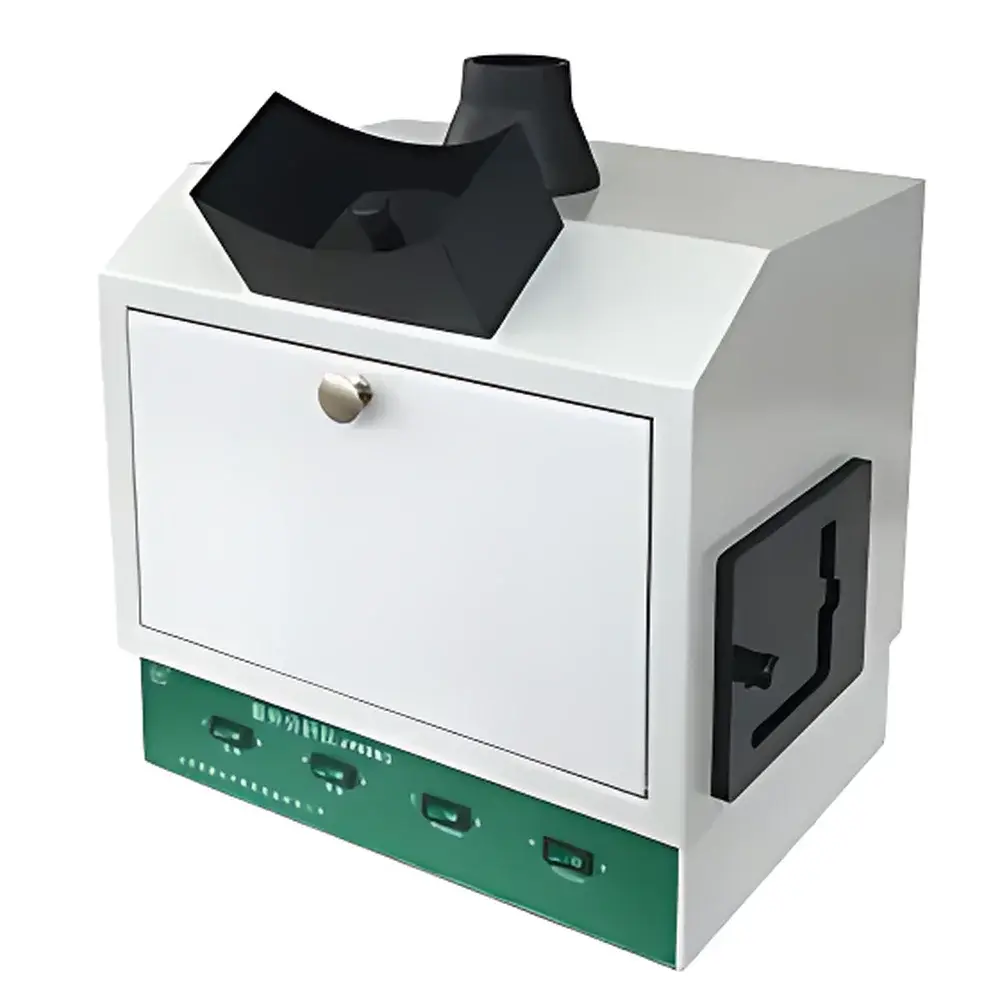
Junyi JY02G Darkroom-Style UV/Blue Light Transilluminator and Gel Cutter
| Brand | Junyi |
|---|---|
| Origin | Beijing, China |
| Model | JY02G |
| Instrument Type | Darkroom-style |
| Wavelengths | 254 nm (reflective), 302 nm (transmissive), 365 nm (reflective) |
| CCD Resolution | 1.4 MP |
| Transilluminator Active Area | 200 × 150 mm |
| UV Lamp Power | 8 W @ 302 nm (transmissive), 11 W @ 254 nm & 365 nm (reflective) |
| Dimensions (L×W×H) | 435 × 295 × 490 mm |
| Net Weight | 18.5 kg |
| UV Filter Glass | Quartz-based |
| Lamp Type | Quartz UV tubes |
| Gel Cutting Port | Integrated ergonomic access port |
Overview
The Junyi JY02G is a dedicated darkroom-style transilluminator engineered for high-fidelity visualization, documentation, and precise excision of nucleic acid and protein electrophoretic gels. It operates on the principle of ultraviolet-induced fluorescence—where ethidium bromide (EtBr), SYBR Safe, or other DNA-binding fluorophores absorb UV photons at specific wavelengths (254 nm, 302 nm, and 365 nm) and re-emit visible light, enabling detection of sub-nanogram DNA bands. Unlike open-bench UV boxes, the JY02G’s fully enclosed darkroom architecture eliminates ambient light interference and provides built-in operator protection via interlocked door switches and UV-absorbing acrylic shielding compliant with IEC 62471 photobiological safety guidelines. Its dual-mode optical design supports both transmissive illumination (for gel slab analysis) and reflective UV excitation (for membrane-based assays such as Southern/Northern blots), making it suitable for routine molecular biology workflows in academic core facilities, QC laboratories, and diagnostic R&D environments.
Key Features
- Integrated 1.4-megapixel scientific-grade CCD imaging system with programmable exposure control, delivering high signal-to-noise ratio capture of faint bands without saturation—even under low-dose UV exposure.
- Triple-wavelength UV source configuration: 302 nm transilluminator (8 W) optimized for standard EtBr-stained agarose and polyacrylamide gels; 254 nm and 365 nm reflective lamps (11 W each) for alternative dyes (e.g., SYPRO Ruby, Deep Purple) and UV-visualized membranes.
- Optically uniform quartz UV lamp array combined with precision-ground UV-transmitting filter glass ensures consistent illumination across the full 200 × 150 mm active area—critical for quantitative band intensity comparison and reproducible image acquisition.
- Ergonomic gel-cutting port with adjustable stainless-steel blade guide and removable protective shield enables rapid, contamination-controlled excision of target bands directly inside the darkroom, minimizing UV exposure time and cross-sample carryover.
- Robust aluminum alloy chassis with vibration-damped base and sealed electronic compartment enhances long-term operational stability and resistance to laboratory humidity and chemical vapor exposure.
Sample Compatibility & Compliance
The JY02G accommodates standard horizontal electrophoresis gels (up to 15 cm × 20 cm), mini-blots (including PVDF and nitrocellulose membranes), and thin-layer chromatography (TLC) plates. It supports common nucleic acid stains (EtBr, GelRed, GelGreen), protein fluorescent dyes (SYPRO Orange, Coomassie Fluor Orange), and chemiluminescent substrates when used with optional lens-based imaging adapters. The system meets CE marking requirements for electrical safety (EN 61010-1) and UV radiation containment (EN 62471, Risk Group 2). While not FDA-cleared as a medical device, its design aligns with GLP-compliant documentation practices—including timestamped image metadata, user-defined annotation fields, and non-destructive RAW file export—facilitating audit readiness for ISO/IEC 17025-accredited testing labs.
Software & Data Management
The JY02G operates via standalone firmware with intuitive touchscreen navigation and real-time histogram-based exposure preview. Image data are saved in lossless TIFF format with embedded EXIF metadata (wavelength used, exposure time, gain setting, date/time stamp, operator ID). Optional PC software (compatible with Windows 10/11 and macOS 12+) provides advanced tools including lane profiling, molecular weight calibration using ladder references, background subtraction algorithms, and batch export to PDF or PNG with customizable scale bars and annotations. All image files support hash-based integrity verification and may be integrated into LIMS via standardized folder-watch protocols—ensuring traceability per 21 CFR Part 11 principles when paired with institutional electronic signature policies.
Applications
- Routine visualization and documentation of agarose and SDS-PAGE gels post-electrophoresis.
- Quantitative band intensity analysis for semi-quantitative gene expression studies (e.g., RT-PCR product validation).
- Target band isolation for downstream cloning, sequencing library preparation, or mass spectrometry sample recovery.
- Verification of restriction digest efficiency, PCR amplification specificity, and CRISPR editing outcomes.
- Fluorescence-based detection of proteins on Western blots using UV-excitable dyes—eliminating the need for secondary antibody incubation in certain screening workflows.
FAQ
What safety certifications does the JY02G hold?
It complies with EN 61010-1 (electrical safety) and EN 62471 (UV photobiological safety, Risk Group 2), with interlocked door cut-off and UV-blocking acrylic construction.
Can the JY02G be used with SYBR Gold or other next-generation nucleic acid stains?
Yes—its 302 nm transilluminator and 365 nm reflector are compatible with SYBR Gold, GelGreen, and other commercially available UV-excitable dyes.
Is the CCD sensor cooled to reduce thermal noise?
No—the 1.4 MP sensor operates at ambient temperature, optimized for short-exposure gel imaging where cooling is not required for adequate SNR.
Does the system support time-lapse or multi-channel overlay imaging?
No—it is designed for single-wavelength, static-gel acquisition; multi-channel functionality requires external modular imaging platforms.
What maintenance is required for the UV lamps?
Quartz UV tubes maintain >90% output intensity for ≥2,000 hours; replacement is recommended after 1.5–2 years of typical lab use (8 hrs/day, 5 days/week).
Related Products




