
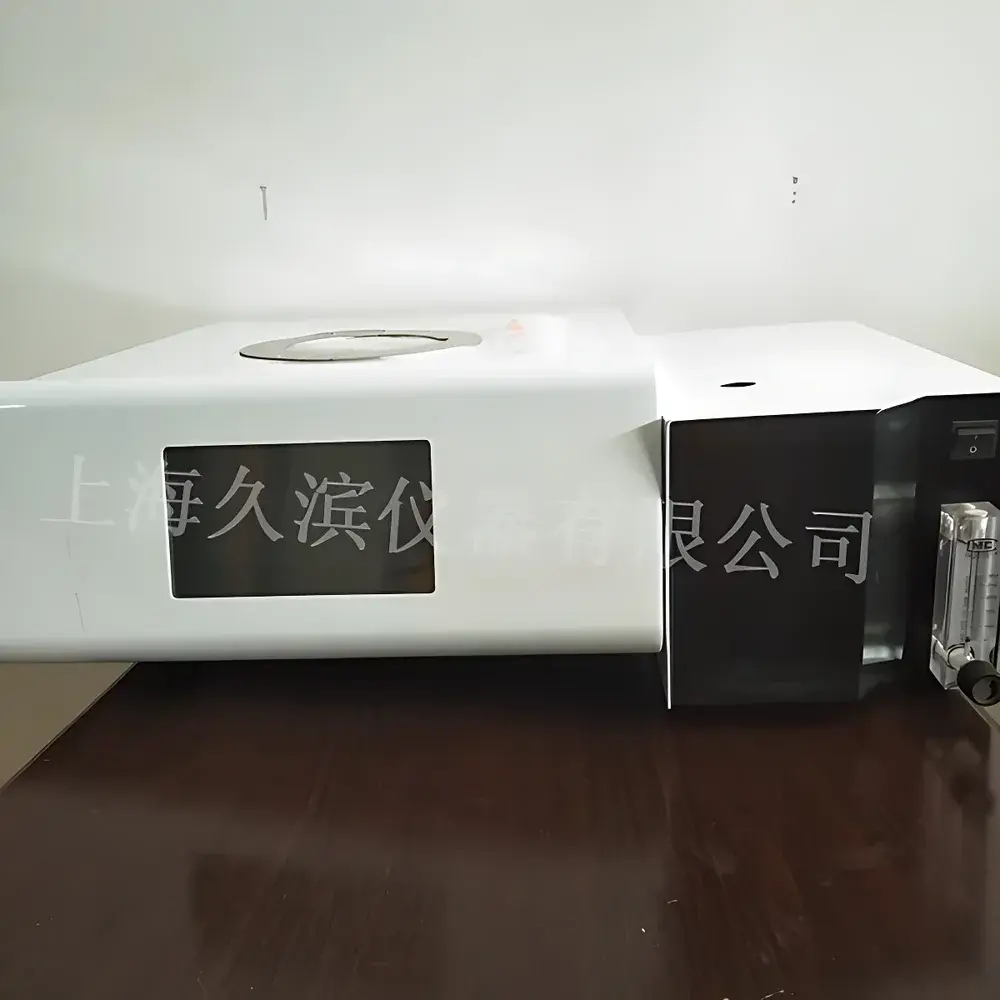
JUZEN JB-STA-200 Simultaneous Thermal Analyzer (TGA-DSC)
| Brand | JUZEN |
|---|---|
| Model | JB-STA-200 |
| Origin | Shanghai, China |
| Type | Benchtop Simultaneous Thermogravimetric Analyzer with Differential Scanning Calorimetry |
| Temperature Range | Ambient to 1100 °C |
| Heating Rate | 0.1–100 °C/min |
| Mass Resolution | 0.1 µg |
| DSC Sensitivity | <0.1 µW |
| Atmosphere Control | Dual-gas (N₂/air) with mass flow controller |
| Sample Capacity | Up to 200 mg |
| Compliance | ASTM E1131, ISO 11358, ISO 17516, USP <41>, GLP-ready data logging |
Overview
The JUZEN JB-STA-200 Simultaneous Thermal Analyzer is an integrated benchtop instrument engineered for precision-coupled thermogravimetric analysis (TGA) and differential scanning calorimetry (DSC) measurements. It operates on the principle of simultaneous detection of mass change (via high-sensitivity microbalance) and heat flow (via symmetrical twin-furnace DSC sensor) under controlled thermal ramping or isothermal conditions. Designed for rigorous materials characterization in academic research laboratories, quality control environments, and industrial R&D settings, the JB-STA-200 delivers synchronized thermal event resolution—enabling accurate identification of decomposition onset temperatures, oxidative stability thresholds, phase transitions (melting, crystallization, glass transition), and enthalpy quantification—all within a single run. Its robust mechanical architecture minimizes thermal lag and buoyancy artifacts, while the dual-gas atmosphere system supports inert, oxidative, and reducing atmospheres per ASTM E1131 and ISO 11358 protocols.
Key Features
- Simultaneous TGA-DSC measurement with real-time mass and heat flow correlation
- High-resolution microbalance (0.1 µg mass resolution) coupled with low-drift DSC sensor (<0.1 µW sensitivity)
- Programmable temperature control from ambient to 1100 °C, with heating rates adjustable from 0.1 to 100 °C/min
- Dual independent gas channels with digital mass flow controllers for precise N₂, air, O₂, or Ar atmosphere switching
- Modular crucible system compatible with standard alumina, platinum, and sealed stainless-steel pans
- Integrated cooling accessory option (mechanical or liquid nitrogen) for sub-ambient DSC capability down to –50 °C
- GLP-compliant data acquisition with timestamped audit trail, user access levels, and electronic signature support per FDA 21 CFR Part 11 requirements
Sample Compatibility & Compliance
The JB-STA-200 accommodates solid powders, granules, films, fibers, and small-part molded components typical of polymer science, pharmaceutical excipients, battery electrode materials, and inorganic fillers. Sample mass range spans 0.5–200 mg, optimized for signal-to-noise ratio without compromising thermal homogeneity. Instrument validation adheres to ISO 17516 (TGA performance verification) and ISO 11358 (polymer thermal degradation analysis). For regulated industries—including pharmaceuticals (USP ), medical device materials, and automotive composites—the system supports IQ/OQ documentation packages and meets baseline requirements for GMP-aligned thermal stability testing per ICH Q1A(R2).
Software & Data Management
Control and analysis are executed via JUZEN STAware™ v4.x software—a Windows-based platform supporting method scripting, multi-step temperature programs, and automated peak deconvolution. Raw data files (.jzd) are stored in vendor-neutral HDF5 format with embedded metadata (operator ID, calibration date, gas flow logs). Quantitative reporting includes derivative thermogravimetry (DTG), residual mass %, specific heat capacity (Cp) estimation, and kinetic modeling (e.g., Kissinger, Ozawa-Flynn-Wall) using built-in Arrhenius modules. All audit trails, calibration records, and user actions are retained for ≥36 months, satisfying long-term traceability mandates under GLP and internal QA policies.
Applications
- Thermal degradation kinetics of engineering plastics (e.g., PEEK, PA66, PC) under accelerated aging conditions
- Oxidative induction time (OIT) assessment of polyolefins per ASTM D3895
- Residual solvent quantification and polymorph screening in active pharmaceutical ingredients (APIs)
- Carbon black content determination in rubber compounds via controlled-air combustion
- Decomposition profiling of cathode materials (e.g., NMC, LFP) for lithium-ion battery safety evaluation
- Hydration/dehydration behavior of clays, zeolites, and MOFs in catalysis research
- Thermal stability benchmarking of flame-retardant additives in wire & cable insulation
FAQ
What sample types are suitable for analysis on the JB-STA-200?
Solid-state samples including polymers, ceramics, pharmaceuticals, metals, and composites—provided they do not volatilize explosively or corrode platinum/alumina crucibles below 1100 °C.
Does the instrument support purge gas switching during a single run?
Yes—dual independent mass flow controllers allow automatic atmosphere switching (e.g., N₂ → air) at user-defined temperature points, critical for oxidation onset studies.
Is the software compliant with FDA 21 CFR Part 11 for electronic records?
The STAware™ software includes role-based access control, electronic signatures, and immutable audit trails—fully configurable to meet Part 11 requirements when deployed in validated environments.
Can the system perform isothermal stability tests?
Yes—temperature hold segments up to 999 minutes can be programmed at any point in the thermal profile, enabling long-term decomposition monitoring or outgassing studies.
What calibration standards are recommended for routine verification?
Certified reference materials include high-purity indium (melting point 156.6 °C, ΔHfus = 28.45 J/g) and calcium oxalate monohydrate (for three-stage decomposition validation per ISO 11358).



