
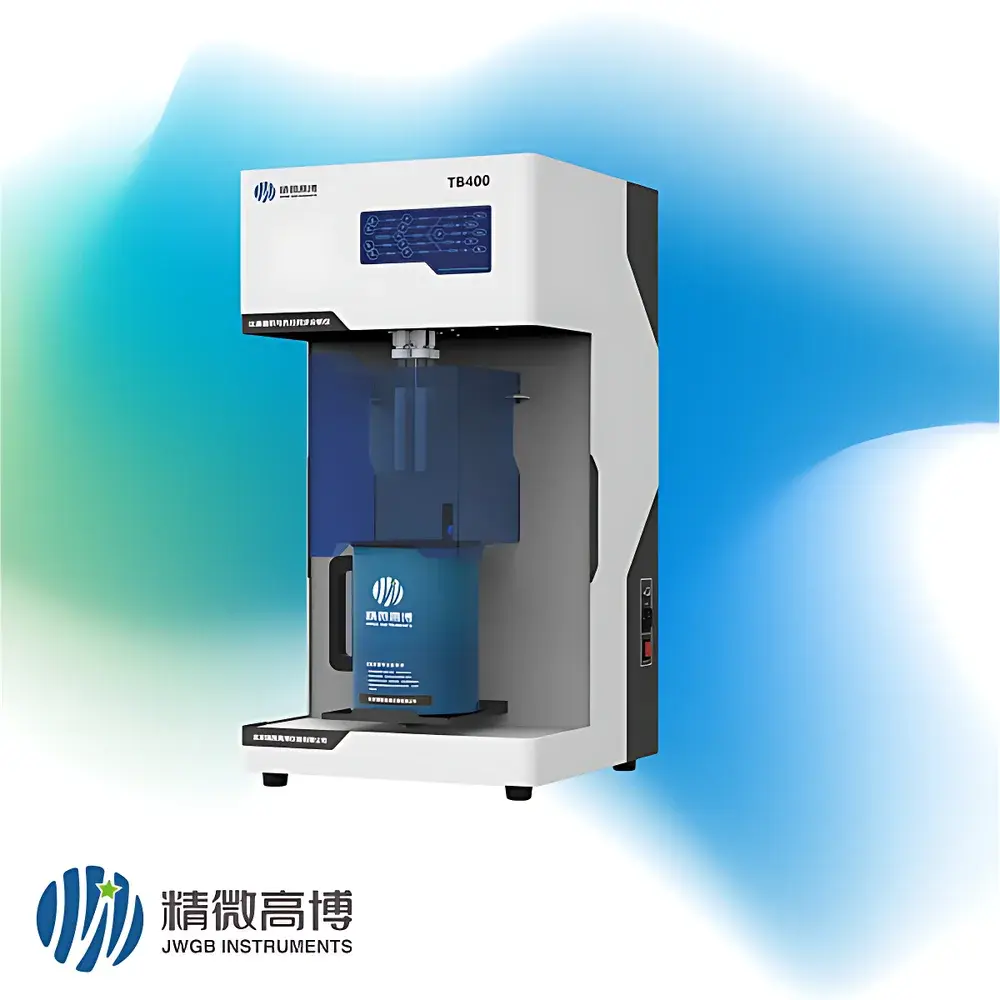
JWGB JW-TB400 Calcium Hydroxide-Specific Specific Surface Area and Pore Size Analyzer
| Brand | JWGB |
|---|---|
| Origin | Beijing, China |
| Manufacturer Type | Direct Manufacturer |
| Instrument Category | Domestic |
| Model | JW-TB400 Calcium Hydroxide-Specific Specific Surface Area and Pore Size Analyzer |
| Instrument Type | Specific Surface Area and Pore Size Analyzer |
| Principle | Static Volumetric Gas Adsorption Method |
| Number of Analysis Stations | 4 |
| Specific Surface Area Range | >0.0005 m²/g |
| Pressure Range | 10⁻⁵–0.998 atm |
| Theoretical Basis | Static Volumetric Adsorption Theory |
Overview
The JWGB JW-TB400 Calcium Hydroxide-Specific Specific Surface Area and Pore Size Analyzer is an engineered solution designed to meet the stringent surface characterization requirements of hydrated lime (Ca(OH)₂), slaked lime, and related alkaline construction materials. It operates on the well-established static volumetric gas adsorption principle—where controlled doses of high-purity nitrogen (or alternative probe gases such as krypton for ultra-low surface area samples) are introduced into a calibrated manifold system under vacuum, and equilibrium adsorption uptake is measured gravimetrically or volumetrically at discrete relative pressure points (P/P₀). This method complies with ISO 9277:2010, ASTM D3663-22, and IUPAC 2015 guidelines for physisorption-based surface area and porosity analysis. Unlike dynamic (flow) systems, the static volumetric architecture ensures thermodynamic equilibrium at each data point, minimizing kinetic artifacts and enabling high reproducibility in low-surface-area matrices typical of dense, low-porosity calcium hydroxide powders.
Key Features
- Four independent analysis stations sharing a single high-stability cryogenic Dewar and unified gas dosing manifold—eliminating inter-station calibration drift and ensuring cross-channel comparability within ±1.5% RSD for BET surface area.
- Dedicated calcium hydroxide analysis protocol pre-loaded in firmware, including optimized outgassing temperature ramps (60–120 °C under vacuum), extended equilibration times at low P/P₀ (<0.02), and automated correction for surface hydration effects during degassing.
- Ultra-high vacuum capability down to 1×10⁻⁵ Torr, maintained via dual-stage turbomolecular pumping, essential for accurate monolayer coverage assessment in low-surface-area samples.
- Full compliance with FDA 21 CFR Part 11 requirements for electronic records and signatures—audit trail logging, user access control, and immutable data archiving are embedded in the acquisition software.
- Integrated pressure transducers with NIST-traceable calibration across the full range (10⁻⁵–0.998 atm), enabling precise determination of micropore filling and capillary condensation thresholds.
Sample Compatibility & Compliance
The JW-TB400 accommodates standard 6–8 mm OD glass sample tubes with optional quartz or stainless-steel holders for aggressive alkaline environments. Its thermal management system supports controlled outgassing up to 200 °C (with optional upgrade), critical for removing chemisorbed water layers without inducing Ca(OH)₂ decomposition. All hardware and software modules conform to ISO/IEC 17025:2017 general requirements for testing laboratories and support GLP/GMP documentation workflows. Data outputs—including raw isotherms, BET plots, BJH pore distributions, and t-plot micropore volumes—are exportable in ASTM E2932-compliant CSV and PDF formats, suitable for regulatory submissions in building material certification (e.g., EN 459-1, ASTM C207).
Software & Data Management
JWGB’s proprietary JWinPro v5.2 software provides a validated, multi-user platform with role-based permissions, real-time isotherm visualization, and integrated uncertainty propagation modeling per ISO/IEC Guide 98-3 (GUM). Users select from 12 internationally recognized physical adsorption models—including BET (single/multi-point), Langmuir, STSA, BJH, t-plot, DR/DA, HK, SF, and NLDFT kernel-based pore size distribution—to generate traceable, publication-ready reports. All processing steps are logged with timestamped metadata, supporting full auditability. Raw data files are stored in HDF5 format with embedded instrument configuration parameters, ensuring long-term data integrity and reprocessing capability.
Applications
- Quality control of commercial calcium hydroxide used in flue gas desulfurization (FGD), soil stabilization, and mortar formulation.
- Correlation of specific surface area with reactivity in pozzolanic reaction kinetics studies.
- Monitoring structural changes during carbonation (Ca(OH)₂ → CaCO₃) via time-resolved pore volume loss and surface area reduction.
- Validation of nano-Ca(OH)₂ synthesis protocols where surface area directly governs dispersion stability and nucleation efficiency.
- Comparative benchmarking against reference materials certified by NIST SRM 1989 (silica gel) and NIST SRM 2973 (graphene oxide).
FAQ
Is the JW-TB400 compatible with non-calcium-hydroxide samples?
Yes—the instrument supports generic solid powder analysis; however, calcium hydroxide-specific calibration, degassing profiles, and reporting templates are pre-configured and validated.
What gases can be used besides nitrogen?
Krypton (for sub-0.1 m²/g samples), argon (for low-temperature NLDFT modeling), and carbon dioxide (for 273 K micropore analysis) are supported with appropriate sensor and cold trap configurations.
Does the system include ISO/IEC 17025 validation documentation?
A full IQ/OQ/PQ protocol package—including installation qualification checklists, operational performance tests, and precision/repeatability verification reports—is provided with each unit.
Can raw isotherm data be exported for third-party modeling?
Yes—full-resolution adsorption/desorption isotherms (P/P₀ vs. cm³/g STP) are exportable in ASCII and HDF5 formats, retaining all metadata required for external NLDFT or QSDFT analysis.
What maintenance intervals are recommended for the vacuum system?
Turbomolecular pump oil replacement every 12 months; Pirani and capacitance manometer recalibration annually; full system leak check prior to each calibration cycle or quarterly—whichever occurs first.



