
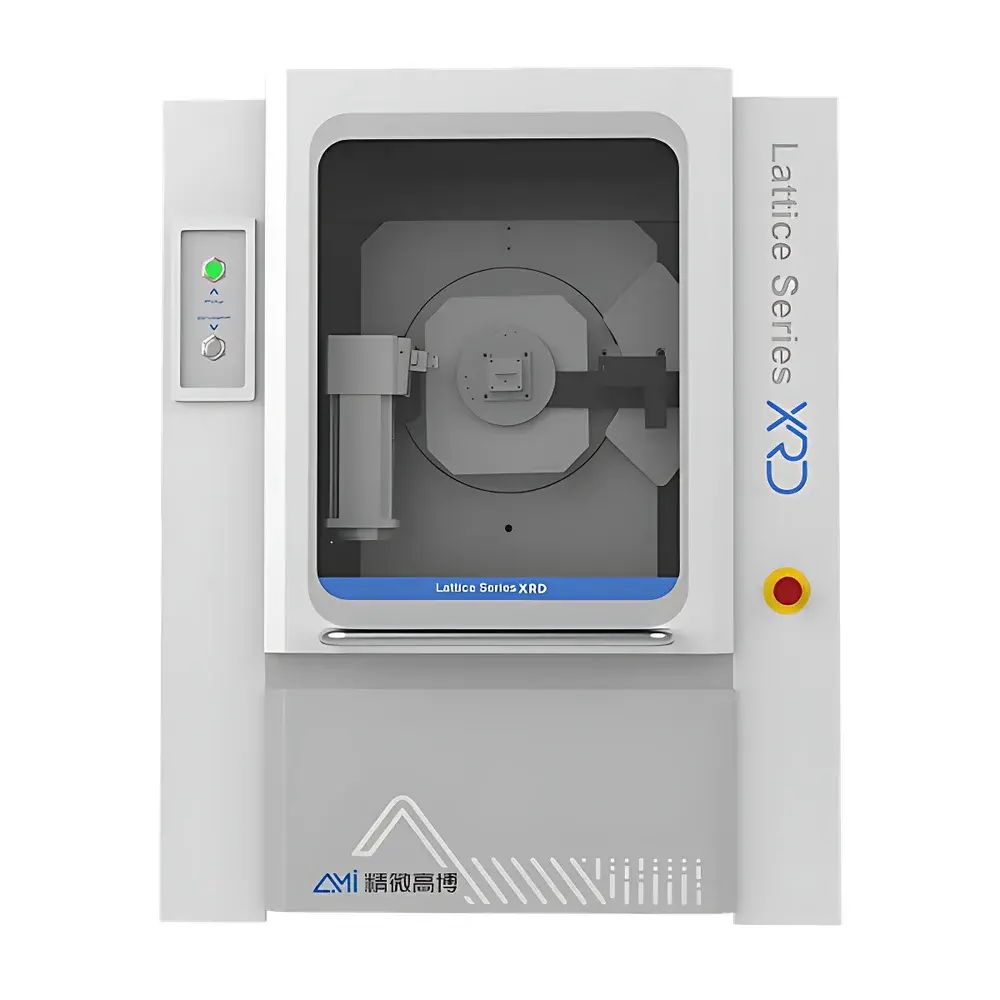
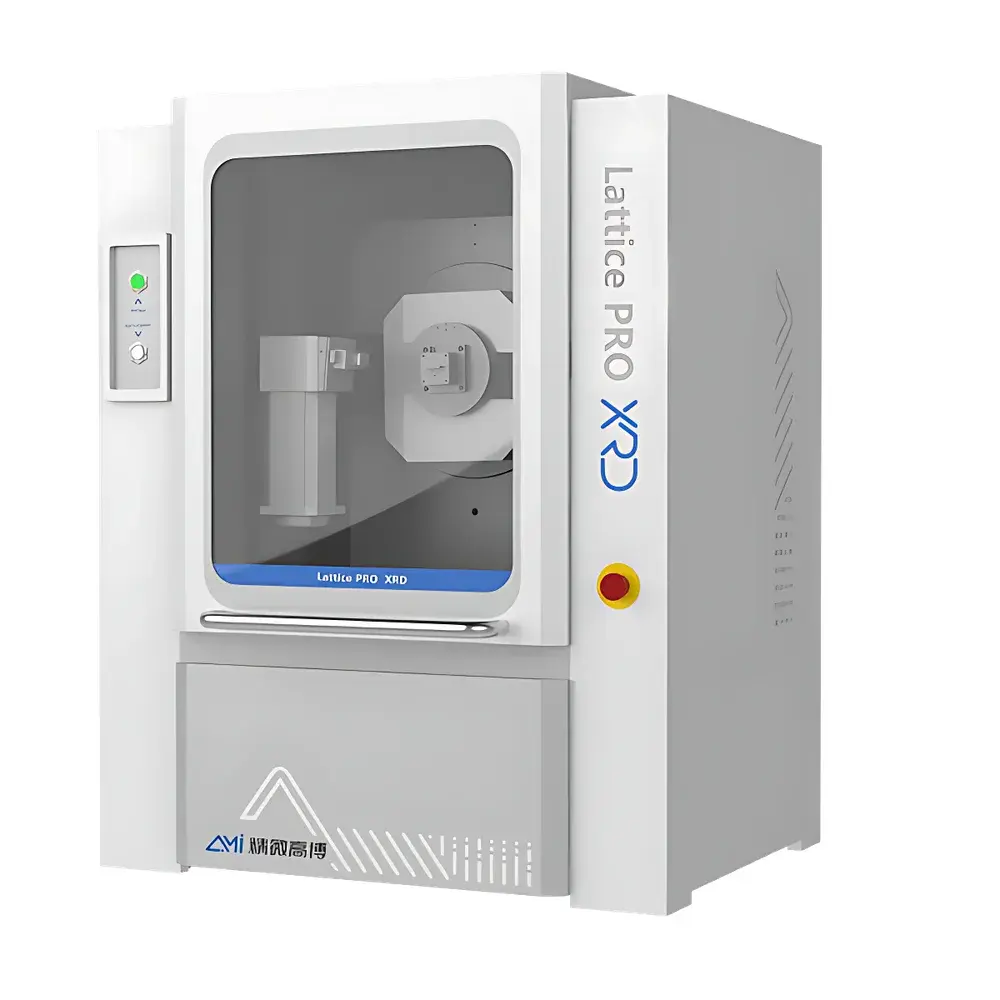
JWGB Lattice Series High-Power Benchtop X-ray Diffractometer
| Brand | JWGB |
|---|---|
| Origin | Beijing, China |
| Manufacturer Type | Manufacturer |
| Product Category | Domestic |
| Model | Lattice Series |
| Instrument Type | Powder X-ray Diffractometer |
| Instrument Configuration | Benchtop |
| X-ray Power | 1200 W |
| Angular Accuracy | ±0.01° |
| Angular Resolution | 0.1° |
| Detector | 256 × 256 Pixel Photon-Counting 2D Array Detector |
| Goniometer Geometry | θ–2θ (Lattice Basic) or θ–θ (Lattice Pro) |
| X-ray Tube Anode Material | Cu or Co (sealed tube) |
| Angular Range | –3° to 156° (Z-axis tilt ≤ –20°), 0° to 160° (Z-axis tilt > –20°) |
| Goniometer Radius | 150–228 mm (adjustable) |
| Detector Energy Resolution | 0.2 keV |
| Dimensions | 900 mm × 680 mm × 550 mm |
| Weight | 100 kg |
Overview
The JWGB Lattice Series High-Power Benchtop X-ray Diffractometer is a precision-engineered powder XRD system designed for high-intensity data acquisition in constrained laboratory spaces. It employs a high-power sealed-tube X-ray source (600/1200/1600 W at 40 kV, 40 mA) coupled with a photon-counting 2D array detector (256 × 256 pixels), enabling rapid, high-fidelity Bragg diffraction measurements via Bragg’s law (nλ = 2d sinθ). The instrument operates on either θ–2θ (Lattice Basic) or θ–θ (Lattice Pro) goniometer geometry—both configured with a minimum radius of 150 mm and continuously adjustable up to 228 mm—to optimize angular dispersion and peak separation. Its angular accuracy of ±0.01° and resolution of 0.1° support rigorous quantitative phase analysis (QPA), crystallite size determination (Scherrer method), microstrain evaluation (Williamson–Hall), and lattice parameter refinement. The system is fully compatible with standard Cu-Kα (1.5418 Å) and Co-Kα (1.7903 Å) radiation, and its modular optical path accommodates specialized configurations including grazing-incidence XRD (GIXRD), small-angle XRD (SAXRD), X-ray reflectivity (XRR), and reflection-mode in situ battery cells.
Key Features
- High-power X-ray source delivering up to 1200 W (40 kV, 40 mA) for enhanced photon flux and reduced measurement time without compromising thermal stability.
- Photon-counting 2D array detector with real-time background suppression, enabling simultaneous collection across a wide 2θ range and eliminating sequential scanning artifacts.
- Adjustable goniometer radius (150–228 mm) to balance resolution, intensity, and sample-to-detector geometry for diverse experimental configurations.
- Dual goniometer options: θ–2θ for conventional powder diffraction and θ–θ for fixed-chi or surface-sensitive modes (e.g., GIXRD, XRR).
- Integrated Z-axis tilt capability (–20° to +20°) supporting variable incidence angle experiments critical for thin-film and multilayer characterization.
- Benchtop footprint (900 × 680 × 550 mm) and robust mechanical architecture ensure stability under long-duration scans and vibration-prone environments.
Sample Compatibility & Compliance
The Lattice Series accommodates standard powder pellets, bulk solids, thin films, coatings, ceramics, battery electrodes, and mesoporous materials—including SBA-15, ITO glass, Si₃N₄, and NMC cathodes. Sample holders support ambient, heating (up to 1000°C with optional stage), and reflection-mode in situ electrochemical cells. All hardware and firmware comply with IEC 61000-6-3 (EMC emission standards) and IEC 61010-1 (safety requirements for electrical equipment). Data acquisition workflows align with ISO 17873:2021 (XRD-based phase quantification) and ASTM E975 (standard practice for indexing powder diffraction patterns). Optional audit-trail-enabled software modules support GLP/GMP environments compliant with FDA 21 CFR Part 11 requirements.
Software & Data Management
The system ships with JWGB DiffraSuite™—a modular software platform supporting automated alignment, scan parameter scripting, real-time 2D image integration, and Rietveld refinement via integrated TOPAS-Academic engine. Raw 2D frames are stored in vendor-neutral HDF5 format with embedded metadata (wavelength, voltage, current, goniometer angles, detector gain). Batch processing supports multi-sample QPA using internal standard or reference intensity ratio (RIR) methods. Export options include CIF, XYE, CSV, and PDF reports with traceable calibration logs. Remote monitoring and scheduled acquisition are supported via secure HTTPS API, facilitating unattended overnight runs and centralized lab management.
Applications
- Quantitative phase analysis of cement clinker and blended cements using external standardless methods.
- Crystallinity and graphitization degree assessment of carbonaceous materials via (002) peak deconvolution.
- In situ stress mapping in aluminum alloys using sin²ψ analysis of {200} and {220} reflections.
- Structural refinement of layered oxide cathodes (e.g., NMC811) under varying SOC conditions in reflection-mode battery cells.
- Small-angle XRD characterization of ordered mesopores in SBA-15 (p6mm symmetry) with d-spacing resolution down to ~3 nm.
- Grazing-incidence diffraction (GID) of 20 nm ITO films to resolve out-of-plane and in-plane lattice distortions.
- X-ray reflectivity modeling for density, roughness, and interfacial layer thickness in multilayer optical stacks.
FAQ
What X-ray tube anodes are available?
Cu and Co sealed-tube anodes are standard; custom Mo or Cr anodes can be ordered upon request.
Is the detector energy-resolved?
Yes—the photon-counting detector provides energy discrimination with 0.2 keV resolution, enabling fluorescence rejection and Kα₁/Kα₂ separation.
Can the system perform Rietveld refinement natively?
Yes—DiffraSuite™ includes licensed TOPAS-Academic for full-pattern fitting, microstructure modeling, and error propagation reporting.
What is the minimum detectable crystallite size?
Under optimized conditions (1200 W, 256×256 detector, 0.1° step), the system reliably resolves crystallites ≥ 3 nm using Scherrer analysis.
Does the instrument support automated sample changers?
Yes—a 16-position robotic autosampler is available as an optional upgrade with barcode sample tracking and collision avoidance logic.




