
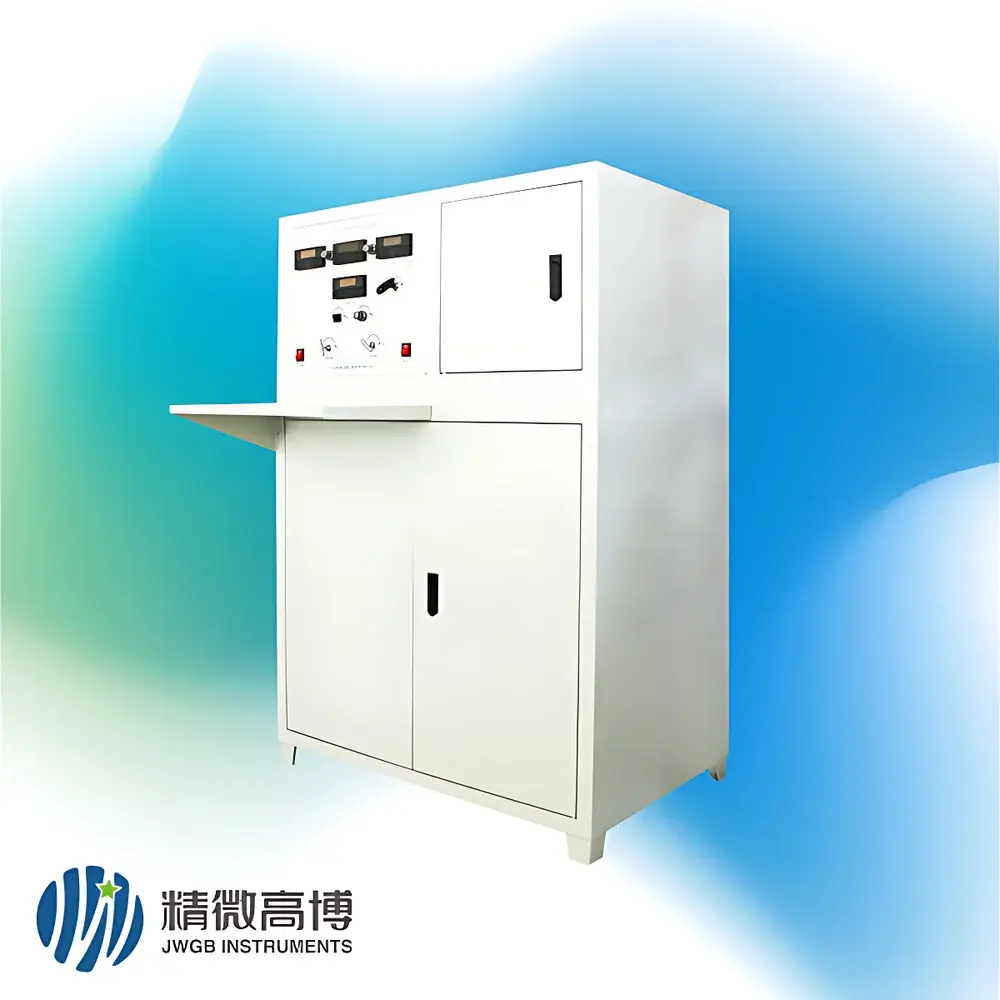
JWGB YG-97A Mercury Intrusion Porosimeter
| Brand | JWGB |
|---|---|
| Origin | Beijing, China |
| Manufacturer Type | Direct Manufacturer |
| Product Category | Domestic |
| Model | YG-97A Mercury Intrusion Porosimeter |
| Price | Upon Request |
| Pore Diameter Range | 30 nm – 600 µm |
| Pressure Range | 0.01 – 50 MPa (7250 psi) |
| Vacuum Level | ≤ 0.05 Pa |
| Sample Chamber Volume | Up to 15 cm³ |
| Measurement Accuracy | ≤ 0.5% |
| Blank Volume at 50 MPa | ~0.25 mL |
| Safety | Integrated Mercury Vapor Containment System |
| Compliance | ISO 15901-1:2005, GB/T 21650.1–2008 |
Overview
The JWGB YG-97A Mercury Intrusion Porosimeter is a high-precision, single-station instrumentation platform engineered for the quantitative characterization of pore structure in rigid, non-collapsible solid materials. It operates on the fundamental principle of mercury intrusion porosimetry (MIP), leveraging the non-wetting behavior of mercury against most solid surfaces under controlled pressure. As external pressure increases, mercury is forced into interconnected and isolated pores—starting from the largest—and the volume intruded at each pressure step is recorded. Using the Washburn equation, these volumetric data are converted into pore radius distributions, enabling calculation of total pore volume, cumulative pore volume vs. diameter, differential pore size distribution, median pore diameter, and pore throat ratio. The instrument is explicitly designed for samples with dominant pore features ≥30 nm, making it especially suitable for geological cores, ceramic preforms, catalyst supports, construction aggregates, battery electrode substrates, and pharmaceutical excipients where macroporosity and mesoporosity dominate structural functionality.
Key Features
- Single independent analysis station with a maximum sample chamber volume of 15 cm³—optimized for both powdered and monolithic specimens without fragmentation requirements.
- Dual-path pressure measurement architecture ensures traceable, high-fidelity pressure control across the full 0.01–50 MPa range (up to 7250 psi test pressure), with continuous real-time monitoring via redundant digital pressure transducers.
- High-vacuum preconditioning system comprising a dual-stage rotary vane pump achieving ≤0.05 Pa base pressure—critical for complete removal of adsorbed gases and moisture prior to intrusion.
- Capacitance-based mercury volume detection with sub-microliter resolution, integrated with temperature-compensated signal conditioning for enhanced reproducibility.
- Rigorous mercury containment design—including sealed sample handling ports, activated carbon filtration, and negative-pressure exhaust ducting—meets occupational hygiene guidelines for elemental mercury exposure (OSHA PEL: 0.1 mg/m³; ACGIH TLV: 0.025 mg/m³).
- Comprehensive analytical modeling suite supporting ASTM D4404 and ISO 15901-1 compliant outputs: cumulative pore volume, incremental pore distribution, total porosity, average pore diameter, pore throat ratio, and hysteresis analysis (intrusion/extrusion curves).
Sample Compatibility & Compliance
The YG-97A accepts both granular and bulk solid specimens—including rock cores, sintered ceramics, cementitious matrices, polymer foams, and metal-organic frameworks—provided they exhibit mechanical stability under hydrostatic compression and lack significant surface reactivity with mercury. Samples must be pre-dried and degassed under vacuum prior to analysis to prevent vapor interference and ensure thermodynamic equilibrium. The system fully complies with ISO 15901-1:2005 “Porous materials — Determination of pore size distribution and porosity by mercury porosimetry” and its Chinese national equivalent GB/T 21650.1–2008. All pressure calibration procedures follow NIST-traceable protocols, and vacuum sensor outputs are validated per ISO 27874. Data integrity meets GLP audit requirements through timestamped, user-logged operation records and immutable raw data storage.
Software & Data Management
Control and analysis are executed via JWGB’s proprietary MIPStudio™ software, a Windows-based application supporting automated method sequencing, real-time pressure/volume trending, and multi-model fitting (including cylindrical, slit, and ink-bottle pore geometry assumptions). Raw datasets are stored in HDF5 format with embedded metadata (operator ID, date/time stamp, calibration status, environmental conditions). Export options include CSV, XML, and PDF reports compliant with FDA 21 CFR Part 11 requirements—featuring electronic signatures, audit trails, and role-based access control. Batch processing allows comparative analysis across up to 32 historical runs, with overlay visualization of intrusion/extrusion hysteresis loops and statistical deviation mapping.
Applications
- Geoscience & Petroleum Engineering: Quantification of pore-throat size distribution in reservoir sandstones and shales to inform permeability prediction and capillary pressure modeling.
- Advanced Ceramics & Refractories: Assessment of green-body density, sintering optimization, and thermal shock resistance correlation with open porosity metrics.
- Heterogeneous Catalysis: Evaluation of support material accessibility, pore blocking after impregnation, and long-term deactivation mechanisms.
- Construction Materials Science: Durability assessment of concrete and mortar via critical pore diameter and interconnectivity index.
- Energy Storage: Characterization of anode/cathode scaffold architectures in Li-ion and solid-state batteries, particularly regarding ion transport bottlenecks.
- Pharmaceutical Development: Excipient porosity profiling for tablet compaction behavior and dissolution rate modeling per USP & Ph. Eur. guidelines.
FAQ
What pore size range is reliably quantified by the YG-97A?
The instrument delivers validated measurements from 30 nm to 600 µm (equivalent to 0.3–4140 psi capillary pressure), with optimal accuracy between 100 nm and 200 µm.
Can the YG-97A analyze soft or compressible materials?
No. Mercury intrusion assumes pore collapse is negligible; highly compressible or elastomeric samples (e.g., hydrogels, certain polymers) require alternative methods such as nitrogen physisorption or liquid extrusion porosimetry.
How is mercury safety ensured during routine operation?
The system incorporates a closed-loop vapor capture manifold with activated carbon adsorption, leak-tight sample transfer valves rated to 60 MPa, and continuous ambient air monitoring integration capability.
Is calibration traceable to international standards?
Yes—pressure transducers are calibrated annually against NIST-certified dead-weight testers; vacuum sensors are verified using calibrated Pirani gauges per ISO 27874 Annex B.
Does the software support IQ/OQ/PQ documentation for regulated labs?
Yes—MIPStudio™ includes built-in qualification templates aligned with ASTM E2500 and ICH Q9, with configurable checklists for installation, operational, and performance qualification protocols.



