
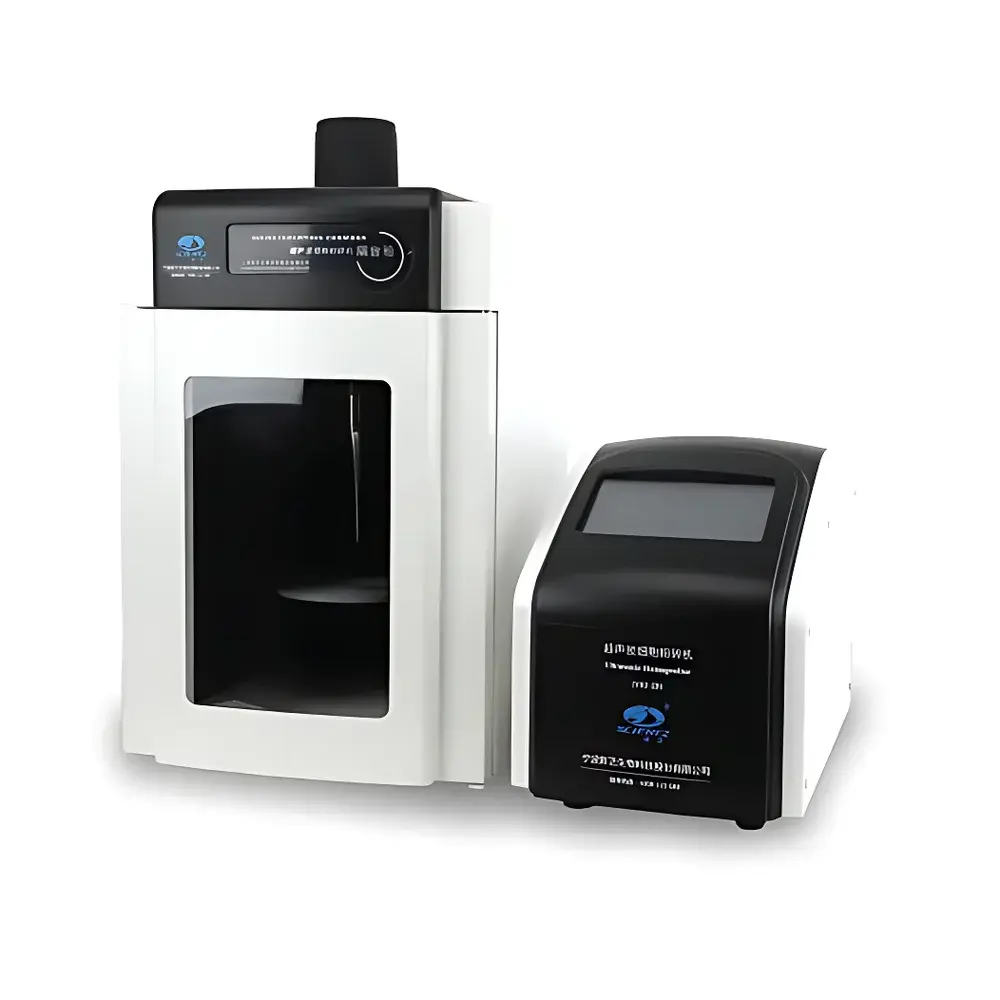
JY99-IIDN Ultrasonic Cell Disruptor
| Origin | Zhejiang, China |
|---|---|
| Manufacturer Type | Distributor |
| Origin Category | Domestic (China) |
| Model | JY99-IIDN |
| Instrument Type | Ultrasonic Homogenizer |
| Sample Suitability | Soft biological materials |
| Output Particle Size | 0.01–0.5 mm |
| Maximum Feed Particle Size | <15 mm |
| Sieve Cut-Off | 40 mesh |
| Batch Processing Volume | 50–1200 mL |
| Operating Frequency | 19.5–20.5 kHz |
| Display | Backlit LCD |
| Power Adjustment Range | 1800 W (20%–99% in 1% increments) |
| Standard Probe Diameter | 25 mm |
| Optional Probe Diameters | 20 mm, 28 mm |
| Duty Cycle | 0.1–99.9% |
| Temperature Monitoring | Yes (overheat protection with audible/visual alarm) |
| Host Dimensions (W×D×H) | 40×28×22 cm |
| Net Weight | 13 kg |
| Host + Transducer Weight | 15 kg |
| Soundproof Enclosure Dimensions (W×D×H) | 534×295×435 mm |
Overview
The JY99-IIDN Ultrasonic Cell Disruptor is an engineered ultrasonic homogenization system designed for controlled mechanical lysis of biological samples through acoustic cavitation. Operating at a stable frequency range of 19.5–20.5 kHz, the instrument generates high-intensity ultrasonic waves transmitted via titanium alloy probes into liquid suspensions, inducing transient microcavitation bubbles that collapse violently—producing localized shear forces, microstreaming, and thermal transients sufficient to disrupt cell membranes, organelles, and soft tissue matrices without significant denaturation when parameters are optimized. Unlike rotor-stator or bead-beating methods, this non-contact energy transfer enables reproducible subcellular fractionation, nucleic acid/protein release, and nanoemulsion formation while minimizing cross-contamination and metal leaching risks. It is widely deployed in academic laboratories, biopharmaceutical R&D facilities, and quality control environments where scalable, tunable, and traceable sample preparation is required prior to downstream analysis—including Western blotting, qPCR, ELISA, and nanoparticle synthesis.
Key Features
- Microprocessor-controlled operation with backlit LCD interface for real-time monitoring of power output, duty cycle, elapsed time, and temperature status
- Continuous 1% incremental power adjustment across 20–99% of full 1800 W nominal output—enabling precise energy dosing for sensitive samples such as primary neurons or exosomes
- Dual operating modes: continuous and pulsed (with independently programmable on/off intervals down to 0.1 s resolution), reducing thermal accumulation during extended processing
- Integrated temperature sensor with configurable overheat alarm threshold—automatically halts sonication if probe jacket temperature exceeds user-defined limit (typically 40–60 °C)
- Modular probe system: standard 25 mm diameter tapered titanium horn; optional 20 mm (high intensity, low volume) and 28 mm (high throughput, uniform field distribution) configurations available for application-specific optimization
- Comprehensive safety architecture including overload detection, short-circuit protection, and automatic shutdown upon abnormal impedance shift or transducer resonance drift
Sample Compatibility & Compliance
The JY99-IIDN is validated for use with soft biological matrices including cultured mammalian cells, bacterial pellets (E. coli, Bacillus spp.), yeast, plant leaf extracts, viral lysates, and soft animal tissues (e.g., liver, spleen). It is not recommended for fibrous, calcified, or highly viscous samples without pre-mechanical reduction. While the device itself does not carry CE, UL, or FDA 510(k) certification, its operational parameters align with common laboratory safety practices referenced in ISO/IEC 17025:2017 (clause 6.4.10 on equipment suitability) and support GLP-compliant workflows when integrated into documented SOPs. The soundproof enclosure (534 × 295 × 435 mm) reduces ambient noise to ≤65 dB(A) at 1 m distance, meeting OSHA 29 CFR 1910.95 hearing conservation thresholds for routine benchtop use.
Software & Data Management
The JY99-IIDN operates via embedded firmware with no external PC dependency. All critical process parameters—including total sonication time, pulse sequence profile, power setpoint, and duty cycle—are stored in non-volatile memory and displayed in real time. Though it lacks USB/Ethernet connectivity or audit-trail logging per FDA 21 CFR Part 11, users may manually record session metadata using standardized lab notebooks or LIMS-integrated templates. For regulated environments, integration with third-party environmental monitoring systems (e.g., Vaisala viewLinc or DeltaTrak) is feasible via analog voltage outputs (0–5 V) for temperature and power status signals—supporting basic traceability requirements under GMP Annex 11.
Applications
- Cell lysis and subcellular fractionation for proteomics and transcriptomics workflows
- Preparation of antigen extracts for monoclonal antibody development
- Nanoparticle dispersion and stabilization in colloidal drug delivery formulations
- Extraction of intracellular metabolites and secondary plant compounds
- Homogenization of clinical specimens (e.g., sputum, biopsy homogenates) prior to PCR-based pathogen detection
- Emulsification of oil-in-water systems for cosmetic and nutraceutical product development
- Accelerated solvent extraction (ASE) of thermolabile phytochemicals
FAQ
What is the maximum recommended processing volume for consistent cavitation efficiency?
For optimal energy transfer and uniform sample disruption, volumes between 200–800 mL are recommended when using the standard 25 mm probe. Volumes below 100 mL require reduced power and shorter pulses to avoid probe overheating and excessive foaming.
Can the JY99-IIDN be used for sterile applications?
Yes—titanium probes are autoclavable at 121 °C for 20 minutes. However, the host unit and transducer must remain outside sterilization chambers; only the detachable probe and coupling fluid (if used) undergo sterilization.
Is calibration traceable to national standards?
The instrument does not include factory calibration certificates. Users should perform periodic verification using calibrated hydrophones (e.g., NPL or NIST-traceable models) and reference standards such as polystyrene latex particle dispersion assays per ISO 20988:2007.
How often should the ultrasonic probe tip be inspected?
Visual inspection before each use is mandatory. Pitting, erosion, or diameter reduction >5% at the active tip warrants replacement to maintain acoustic coupling efficiency and prevent inconsistent lysis performance.
Does the system support remote start/stop via external trigger?
No—there is no TTL or relay input interface. All operations must be initiated and terminated manually via the front-panel controls.



