
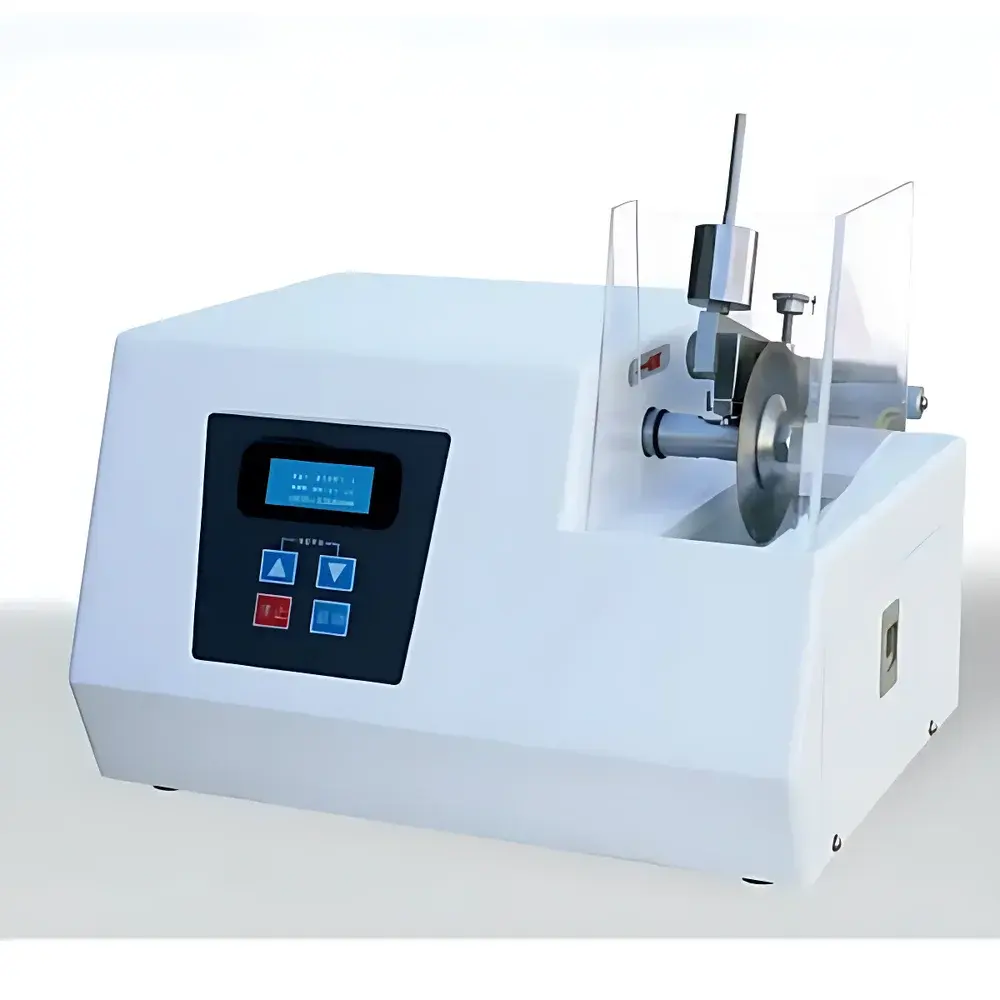
JYDTQ-5 Precision Molten-Bead Cutting Machine
| Brand | Guangzhou Jingying |
|---|---|
| Origin | Guangdong, China |
| Manufacturer Type | Direct Manufacturer |
| Product Category | Domestic |
| Model | JYDTQ-5 |
| Instrument Type | Precision Cutting Machine |
| Travel of Moving Carriage | 25 mm |
| Positioning Accuracy | 0.01 mm |
| Spindle Speed Range | 10–600 rpm |
| Blade Diameter | Φ100 × 0.5 × 20 mm |
| Power Rating | 80 W |
| Input Voltage | 220 V / 50 Hz |
| Overall Dimensions | 390 × 430 × 400 mm |
| Net Weight | 19 kg |
Overview
The JYDTQ-5 Precision Molten-Bead Cutting Machine is an engineered solution for controlled, high-fidelity sectioning of brittle, high-value crystalline materials—particularly synthetic optical crystals, laser gain media (e.g., Nd:YAG, Yb:YAG), and calibration reference standards used in X-ray fluorescence (XRF) and inductively coupled plasma (ICP) sample preparation. Unlike conventional abrasive saws, the JYDTQ-5 employs a low-speed, high-torque spindle architecture optimized for minimizing thermal stress, micro-cracking, and subsurface damage during cutting of molten-bead fused samples—commonly prepared from glassy or ceramic matrix standards. Its core design principle centers on mechanical stability, positional repeatability, and operator-independent process execution, making it suitable for laboratories adhering to ISO/IEC 17025-compliant sample preparation workflows where traceability and dimensional fidelity are critical.
Key Features
- Sub-micron positioning accuracy (±0.01 mm) enabled by precision-ground linear guides and calibrated micrometer-driven horizontal feed mechanism
- Variable-speed DC spindle (10–600 rpm) with soft-start and torque compensation, reducing blade loading and extending diamond blade service life
- Four interchangeable fixture sets—including V-groove, flat-base, angular tilt, and centering collet configurations—supporting multi-axis orientation control for off-normal cuts and crystallographic plane alignment
- Integrated end-stop limit switches with dual-channel redundancy ensure repeatable endpoint detection and automatic spindle shutdown upon completion
- Rigid cast-aluminum base frame with vibration-damping feet minimizes resonance-induced runout; total system mass (19 kg) contributes to operational stability at low rotational speeds
- Compact footprint (390 × 430 × 400 mm) enables integration into fume hoods or laminar flow cabinets for controlled-atmosphere cutting of hygroscopic or reactive beads
Sample Compatibility & Compliance
The JYDTQ-5 accommodates fused glass beads (typically 30–40 mm diameter, up to 15 mm thickness), sintered oxide pellets, and single-crystal wafers with hardness values up to Mohs 9. It is routinely deployed in certified reference material (CRM) production labs and metallurgical QA/QC facilities where ASTM E1353 (Standard Practice for Preparation of Fused Bead Specimens for XRF Analysis) and ISO 20051 (XRF—Preparation of fused discs) compliance is required. The machine’s closed-loop positioning and programmable dwell timing support GLP documentation requirements; all motion parameters are manually set and recorded per batch—not software-automated—ensuring full auditability without electronic signature dependencies.
Software & Data Management
The JYDTQ-5 operates as a fully manual, hardware-controlled instrument with no embedded firmware or digital interface. All operational parameters—including spindle speed selection, carriage travel initiation, and endpoint confirmation—are executed via tactile rotary dials and momentary push-button controls. This analog architecture eliminates cybersecurity vulnerabilities, ensures long-term calibration integrity, and complies with environments where IT infrastructure restrictions prohibit network-connected lab equipment. Process logs (date, operator ID, sample ID, spindle speed, feed position, blade type) are maintained externally in laboratory notebooks or LIMS-integrated spreadsheets per ISO/IEC 17025 Clause 7.5.2.
Applications
- Cutting fused borate or lithium tetraborate beads for homogeneity validation prior to XRF analysis
- Sectioning synthetic sapphire or yttrium aluminum garnet (YAG) substrates for lattice orientation verification via Laue diffraction
- Preparing cross-sectional slices of pressed powder pellets for SEM-EDS layer profiling
- Trimming oversized calibration standards to nominal geometry specifications defined in USP and EP 2.2.47
- Micro-sectioning brittle intermetallic compounds (e.g., Ni₃Al, TiAl) where thermal shock from high-speed cutting induces phase decomposition
FAQ
Is the JYDTQ-5 compatible with diamond-coated or resin-bonded cutting blades?
Yes—blade mounting uses standard ISO 40 arbor geometry (20 mm bore); compatibility extends to all commercially available Φ100 mm thin-section blades with 0.5 mm kerf width and maximum operating speed ≥600 rpm.
Does the machine support water cooling during operation?
No built-in coolant delivery system is provided; however, the base plate includes threaded M4 ports for optional third-party drip-feed or mist-cooling manifold integration.
Can the horizontal feed be locked at intermediate positions for partial-depth cuts?
Yes—the micrometer feed knob features a locking collar that secures carriage position with ≤0.005 mm drift over 8-hour continuous use.
What maintenance intervals are recommended for the spindle assembly?
Lubrication of the sealed ball bearing spindle is factory-performed and rated for 10,000 hours of operation under nominal load; no user-serviceable components exist within the motor housing.
Is CE or UL certification available for this model?
The JYDTQ-5 meets IEC 61000-6-2 (immunity) and IEC 61000-6-4 (emissions) standards; full CE marking requires end-user responsibility for local conformity assessment under Machinery Directive 2006/42/EC due to its non-automated control architecture.



