
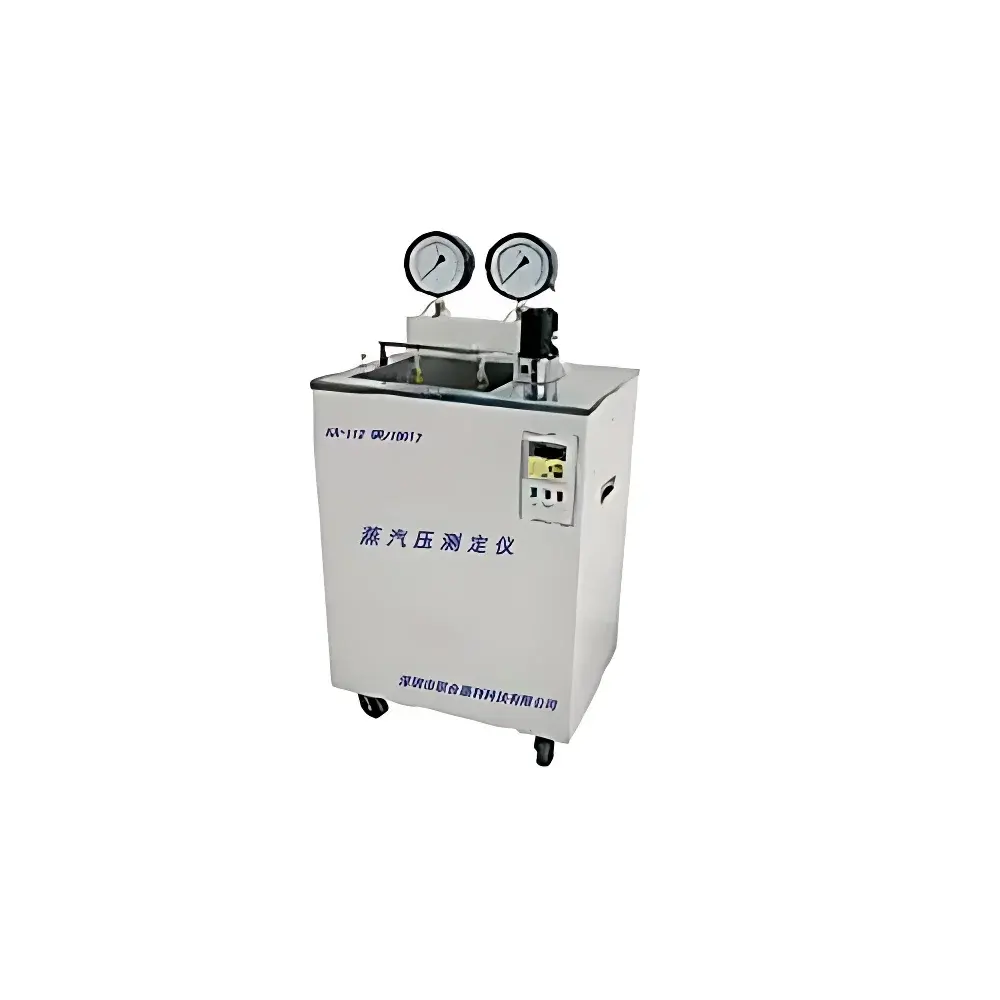
KA-112 Karrie Manual Reid Vapor Pressure (RVP) Tester for Petroleum Products
| Brand | Karrie |
|---|---|
| Model | KA-112 |
| Standard Compliance | GB/T 8017, ASTM D323 |
| Test Temperature | 37.8 °C |
| Temperature Control Accuracy | ±0.1 °C |
| Heating Power | Main Thermostatic Heater 800 W + Auxiliary Heater 1200 W |
| Stirring Motor Power | 15 W |
| Power Supply | AC 220 V ±10%, 50 Hz |
| Bath Material | Stainless Steel |
| Enclosure | Powder-Coated Steel |
| Mobility | Equipped with Four Locking Casters |
| Pressure Gauge Mounting | Remote Connection via Flexible Tubing to Preserve 0.4-Class Accuracy |
| Drain Valve | Integrated for Bath Fluid Replacement |
| Exclusion | Not suitable for Liquefied Petroleum Gas (LPG) |
Overview
The KA-112 Karrie Manual Reid Vapor Pressure (RVP) Tester is a precision-engineered laboratory instrument designed exclusively for the determination of vapor pressure in volatile petroleum products according to internationally recognized standardized test methods—specifically GB/T 8017 and ASTM D323. RVP is a critical quality control parameter used to assess the volatility, evaporative tendency, and safety handling characteristics of gasoline, light crude oils, naphthas, and other distillates with initial boiling points below 121 °C. The instrument operates on the fundamental principle of equilibrating a defined 1:4 volume ratio of sample to vapor space within a sealed, temperature-controlled test chamber (the “RVP bomb”) at a strictly maintained 37.8 °C (100 °F), followed by direct measurement of the equilibrium vapor pressure using a calibrated, high-stability analog pressure gauge. Unlike automated or digital RVP systems, the KA-112 retains manual operation integrity—ensuring full operator visibility into procedural steps such as sample introduction, agitation sequence, and pressure stabilization—thereby supporting method adherence, training fidelity, and audit-ready documentation in GLP-compliant environments.
Key Features
- Stainless steel RVP test bomb constructed to ASTM D323 dimensional and material specifications, ensuring mechanical integrity during repeated pressurization cycles and resistance to hydrocarbon-induced stress corrosion.
- Remotely mounted 0.4-class precision pressure gauge connected via flexible stainless-steel braided tubing—eliminating mechanical coupling between agitation forces and gauge sensing elements to preserve long-term metrological stability.
- Double-stage heating architecture: primary thermostatic heater (800 W) maintains precise 37.8 °C bath equilibrium, while auxiliary heater (1200 W) enables rapid thermal recovery after sample insertion or ambient fluctuations.
- Digitally controlled immersion bath with PID-based temperature regulation, achieving ±0.1 °C uniformity across the entire stainless steel bath volume (≥20 L capacity).
- Low-power (15 W), magnetically coupled stirring motor ensures homogeneous thermal distribution without introducing vibration artifacts or electrical interference.
- Integrated drain valve and level indicator facilitate efficient bath fluid replacement and maintenance; powder-coated enclosure provides corrosion resistance in laboratory environments with incidental solvent exposure.
- Four industrial-grade locking casters enable safe repositioning within QC laboratories or shared analytical spaces without requiring disassembly or recalibration.
Sample Compatibility & Compliance
The KA-112 is validated for use with gasoline blends (including ethanol-gasoline mixtures up to E15), reformulated gasoline, light naphthas, and volatile crude fractions meeting the compositional criteria outlined in GB/T 8017 and ASTM D323—including maximum initial boiling point (IBP) limits and restrictions on dissolved water content. It is explicitly excluded from application to liquefied petroleum gas (LPG), butane, propane, or any hydrocarbon mixture exhibiting vapor pressures exceeding 1550 kPa at 37.8 °C. Instrument design and operational protocols align with ISO/IEC 17025 requirements for test method validation, and routine calibration traceability is supported through NIST-traceable pressure standards and certified thermometric references. Documentation packages include factory calibration certificates, compliance verification reports, and user-executable verification checklists aligned with internal QA audits.
Software & Data Management
As a manually operated benchtop tester, the KA-112 does not incorporate embedded firmware or proprietary software. All measurements are recorded directly by the operator onto standardized test worksheets compliant with ASTM D323 Annex A1 and GB/T 8017 Section 8. However, the instrument’s modular mechanical interface supports seamless integration into LIMS environments: pressure readings can be logged via external digital pressure transducers (e.g., Druck DPI 610 series) with RS-485 or USB output, and temperature data may be captured using calibrated PT100 probes interfaced with third-party DAQ systems. Full audit trails—including operator ID, sample ID, ambient conditions, and raw pressure/temperature timestamps—are maintainable under FDA 21 CFR Part 11–compliant electronic record systems when paired with validated acquisition software.
Applications
- Quality assurance of finished gasoline at refineries and blending terminals prior to distribution.
- Batch release testing in accordance with API RP 2510 and EPA Tier 3 fuel specifications.
- Research and development of low-RVP reformulated fuels targeting reduced evaporative emissions.
- Educational laboratories conducting ASTM method training for petroleum engineering and analytical chemistry curricula.
- Third-party contract testing laboratories accredited to ISO/IEC 17025:2017 for petroleum product analysis.
- Regulatory compliance verification for national fuel standards (e.g., China GB 17930, EU EN 228, US EPA 40 CFR Part 80).
FAQ
What standards does the KA-112 comply with?
It is fully engineered and verified for conformance with GB/T 8017 and ASTM D323 for Reid Vapor Pressure determination.
Can the KA-112 be used for LPG testing?
No. LPG requires specialized high-pressure instrumentation per GB/T 6602 and ASTM D1267; refer to the Karrie KA-702 LPG Saturated Vapor Pressure Tester for that application.
Is temperature calibration traceable to national standards?
Yes—each unit ships with a factory-issued calibration certificate referencing NIST-traceable reference thermometers, and users may perform in-house verification using certified RTD probes.
How is pressure gauge accuracy preserved during agitation?
By physically isolating the 0.4-class Bourdon-tube pressure gauge from the RVP bomb via flexible tubing, mechanical shock transmission is eliminated, maintaining gauge linearity and repeatability over extended service life.
Does the instrument require annual recalibration?
Per ISO/IEC 17025 and internal QA policies, pressure gauge and temperature sensor calibration should be verified at least annually—or before each use cycle in regulated environments—using documented, traceable standards.





