
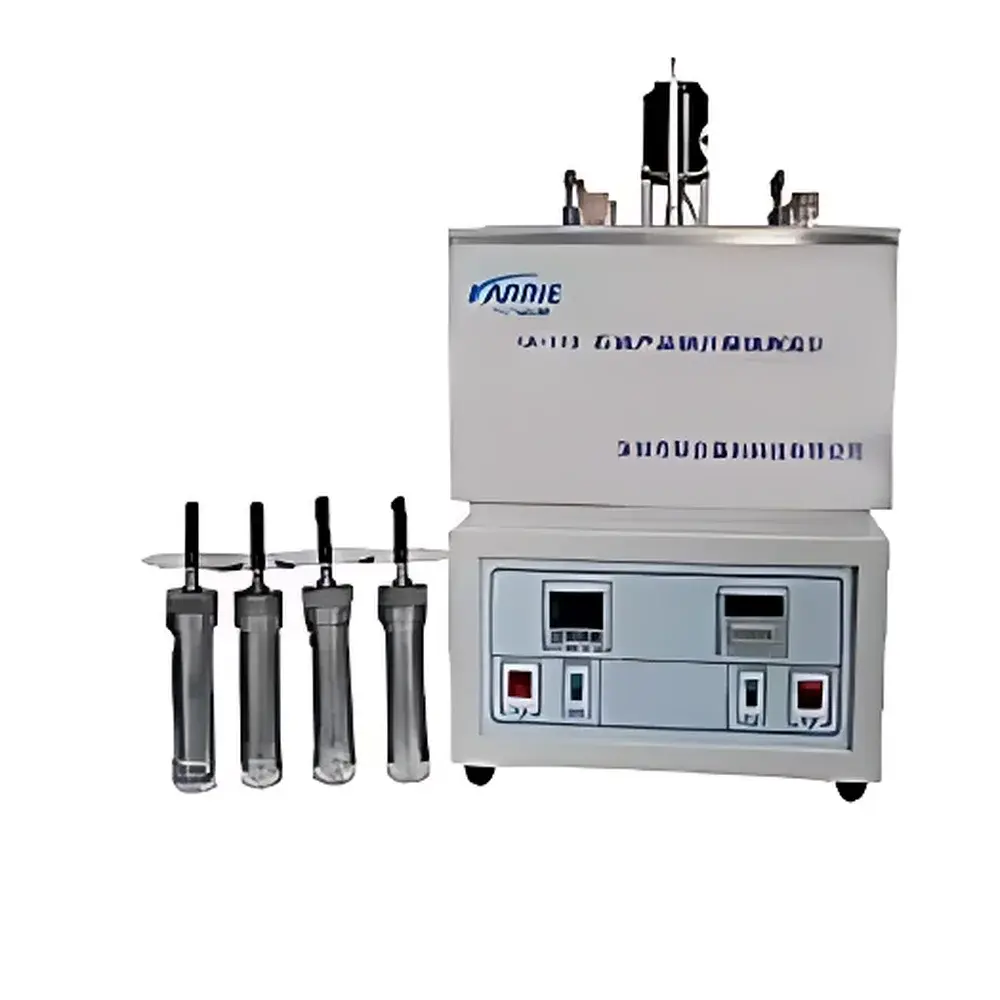
KA-113 Karrie Copper Strip Corrosion Tester for Petroleum Products
| Brand | Karrie (KARRIE) |
|---|---|
| Origin | Shenzhen, China |
| Model | KA-113 |
| Temperature Setpoints | 40 °C, 50 °C, 100 °C |
| Bath Capacity | 4 test positions |
| Temperature Stability | ±0.5 °C |
| Heating Power | 1600 W |
| Stirring Motor Power | 15 W |
| Power Supply | AC 220 V ±10%, 50 Hz |
| Construction | Powder-coated steel enclosure, stainless steel bath vessel |
Overview
The KA-113 Karrie Copper Strip Corrosion Tester is a precision laboratory instrument engineered to evaluate the corrosivity of petroleum products toward copper surfaces in strict accordance with standardized test methodologies. It operates on the fundamental principle of controlled thermal exposure: a polished copper strip is immersed in a representative sample and held at a specified temperature for a defined duration under inert or ambient atmospheric conditions. Following exposure, the strip is cleaned and visually compared against the ASTM D130 copper corrosion standard color chart to assign a corrosion rating (ranging from 1a — light orange — to 4c — jet black). This qualitative yet highly reproducible assessment provides critical insight into the presence of active sulfur compounds, mercaptans, hydrogen sulfide, or other corrosive species that may compromise fuel system integrity, storage tank compatibility, or downstream refining equipment. The tester supports routine quality control in refineries, independent testing laboratories, and regulatory compliance facilities where adherence to GB/T 5096 and ASTM D130 is mandatory.
Key Features
- Four independent test positions enable parallel evaluation of multiple samples or replicate determinations within a single run—improving throughput without compromising thermal uniformity.
- Digital PID temperature controller delivers stable thermal regulation at user-selectable setpoints (40 °C, 50 °C, and 100 °C), maintaining bath stability within ±0.5 °C across the entire working volume—a requirement for method-compliant execution per both GB/T 5096 and ASTM D130.
- Stainless steel bath vessel ensures long-term chemical resistance to hydrocarbon solvents, acids, and oxidation byproducts generated during extended thermal exposure.
- Integrated low-power stirring motor (15 W) drives a corrosion-resistant impeller to promote homogeneous heat distribution and eliminate thermal stratification—critical for consistent strip exposure conditions.
- Robust mechanical architecture includes a powder-coated steel housing, hinged safety lid with viewing window, and ergonomic test cell access—designed for daily use in industrial QC environments.
- Programmable digital timer with audible end-of-test alert allows unattended operation while ensuring precise exposure durations (e.g., 3 h at 50 °C for gasoline, 3 h at 100 °C for diesel), reducing operator dependency and human error.
Sample Compatibility & Compliance
The KA-113 is validated for use with a broad spectrum of hydrocarbon-based fluids including aviation gasoline (AVGAS), jet fuel (Jet A/A-1), automotive gasoline, natural gasoline, naphthas, kerosene, diesel fuel (EN 590, ASTM D975), distillate fuel oils, lubricating base oils, and solvent naphthas—provided their Reid Vapor Pressure does not exceed 124 kPa. Instrument operation conforms fully to the procedural requirements of GB/T 5096–2017 and ASTM D130–22. While the device itself is not certified to ISO/IEC 17025, its design enables laboratories to meet method validation criteria for repeatability (≤1 ASTM corrosion number between replicates) and intermediate precision when operated within documented SOPs aligned with GLP principles.
Software & Data Management
The KA-113 operates as a standalone benchtop instrument with no embedded software or data logging capability. All operational parameters—including setpoint temperature, exposure time, and test identification—are manually entered via front-panel controls. Temperature and timing functions are hardware-based and traceable to NIST-traceable calibration standards. For laboratories requiring electronic records, integration with external LIMS or ELN systems is achieved through manual entry of test metadata (e.g., sample ID, lot number, analyst, start/end timestamps, observed corrosion rating) following completion of each assay. The absence of network connectivity or firmware satisfies regulatory expectations for instruments used in environments subject to FDA 21 CFR Part 11 Annex 11 or EU GMP Annex 11 where audit trail simplicity and configuration control are prioritized.
Applications
- Refinery final product release testing to verify conformance with copper corrosion limits specified in ASTM D4814 (gasoline), ASTM D1655 (jet fuel), or EN 14214 (biodiesel).
- Investigation of sulfur scavenger efficacy in hydrotreated feedstocks prior to blending.
- Root-cause analysis of field-reported fuel system corrosion incidents involving injector coking or filter plugging.
- Supplier qualification testing for purchased intermediates such as hydrotreated naphtha or kerosene cuts.
- Educational demonstration of sulfur compound reactivity in petroleum chemistry curricula.
FAQ
What standards does the KA-113 comply with?
It is designed and verified for full conformance with GB/T 5096–2017 and ASTM D130–22.
Can the bath temperature be adjusted outside the factory-set points?
No—the unit is configured exclusively for 40 °C, 50 °C, and 100 °C per standard requirements; no continuous-range adjustment is provided.
Is calibration documentation included?
A factory calibration certificate for the digital temperature controller and timer is supplied; users must perform periodic verification using traceable reference thermometers and stopwatches per internal QA protocols.
What maintenance is required?
Routine cleaning of the stainless steel bath with non-chlorinated solvents, inspection of stirrer coupling integrity, and annual verification of heater element resistance and insulation resistance are recommended.
Does the instrument include copper strips or the ASTM D130 color comparator?
No—these consumables and reference materials must be sourced separately in accordance with ASTM D130 Annex A1 specifications.






