
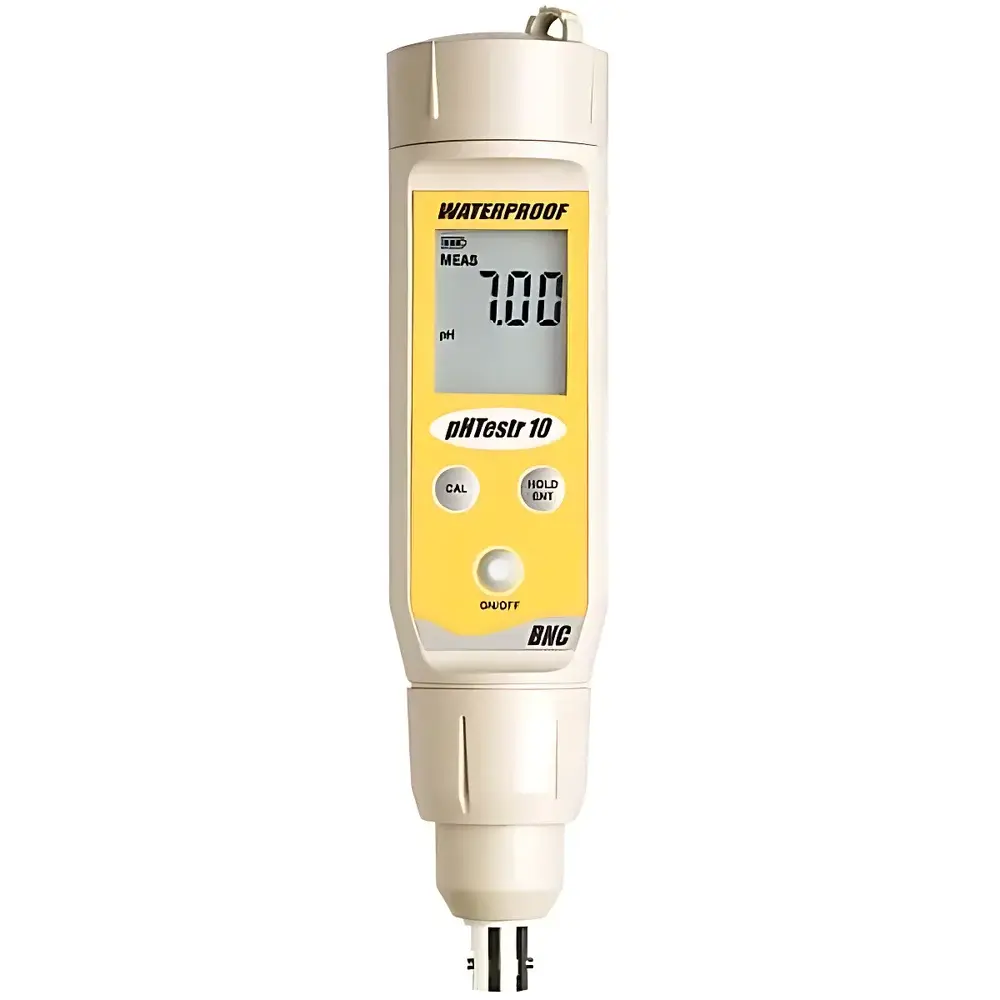
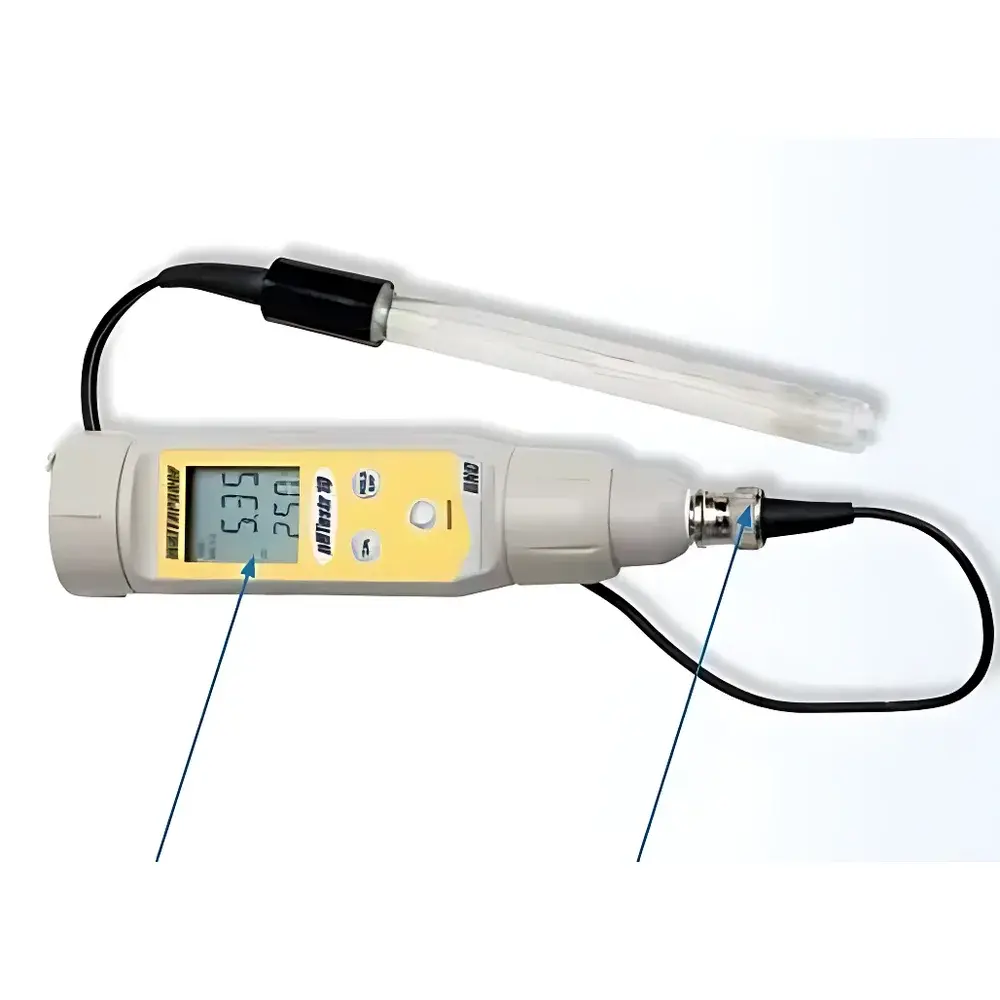
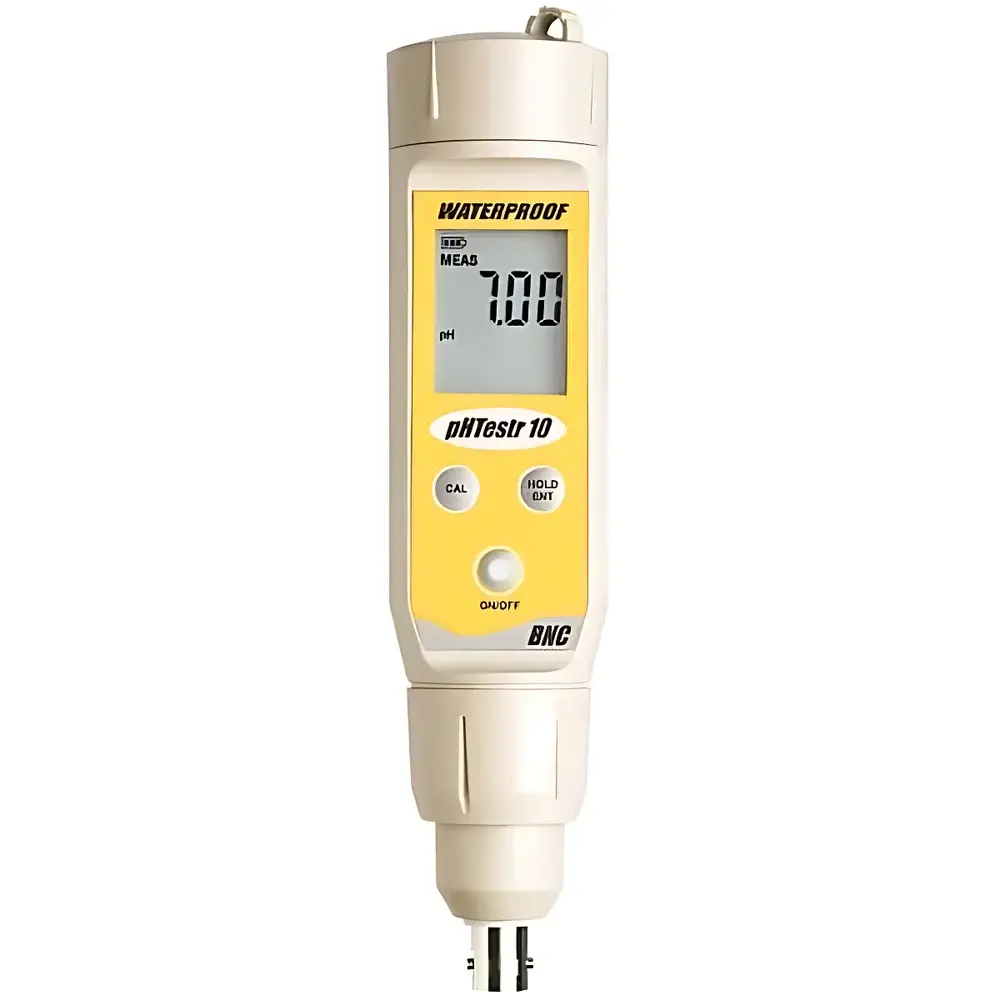
Oakton pHTestr10BNC Waterproof Pocket pH Meter
| Brand | Oakton |
|---|---|
| Origin | USA |
| Model | pHTestr10BNC |
| Instrument Type | Pen-style pH Meter |
| Parameter Type | Single-parameter (pH) |
| Measurement Range | -1 to 15 pH |
| Resolution | 0.01 pH |
| Accuracy | ±0.01 pH |
| Calibration Points | Up to 3-point |
| Buffer Recognition | Automatic NIST and USA standard buffer identification |
| Temperature Range | -5 to 50 °C (23 to 122 °F) |
| Temperature Compensation | Manual |
| IP Rating | IP67 |
| Display | LCD with backlight |
| Input | BNC pH electrode connector, 8-pin mini-DIN temperature probe port |
| Power | 4 × A76 (LR44) batteries |
| Battery Life | Extended via auto-off and low-battery indicator |
| Enclosure Material | Valox® polymer housing |
| Floatation | Buoyant design for accidental submersion recovery |
| Diagnostic Features | Self-diagnostics with error codes |
| Additional Functions | Hold function, automatic shutdown, battery status indicator |
Overview
The Oakton pHTestr10BNC is a rugged, portable, single-parameter pH meter engineered for field-deployable and routine laboratory use where reliability, environmental resilience, and electrode flexibility are critical. Unlike fixed-electrode pen-style meters, the pHTestr10BNC employs a universal BNC input interface—enabling compatibility with any industry-standard pH electrode, including specialized sensors for harsh media (e.g., high-ionic-strength brines, low-conductivity deionized water, or viscous slurries). Its measurement principle follows conventional potentiometric pH determination per ISO 3696, ASTM D1293, and USP , utilizing the Nernst equation to convert electrode potential (mV) into pH units with temperature-compensated accuracy. The device operates across an extended pH range of –1.0 to 15.0, accommodating strongly acidic and alkaline process streams commonly encountered in wastewater treatment, electroplating, semiconductor cleaning, and chemical synthesis QA/QC workflows.
Key Features
- IP67-rated Valox® polymer housing—fully dust-tight and submersible up to 1 m for 30 minutes; buoyant design ensures recovery if dropped into aqueous environments
- BNC electrode interface supports interchangeable pH sensors—including double-junction, gel-filled, refillable, and solid-state electrodes—eliminating the need to replace the entire meter for application-specific adaptations
- High-resolution LCD display with backlight and intuitive touch-key calibration interface for rapid setup under variable lighting conditions
- Automatic recognition of both NIST-traceable and USA-standard calibration buffers (pH 4.01, 7.00, 10.01), reducing operator error during multi-point calibration
- 0.01 pH resolution and ±0.01 pH accuracy at 25 °C, validated per manufacturer’s calibration protocol using certified reference solutions
- Integrated self-diagnostic system delivers real-time error codes (e.g., “ERR 1” for open circuit, “ERR 2” for shorted electrode), supporting GLP-compliant troubleshooting and maintenance logging
- Programmable auto-off (after 8 minutes of inactivity) and battery-status indicator extend operational life of four A76 (LR44) cells to approximately 2,000 hours of intermittent use
Sample Compatibility & Compliance
The pHTestr10BNC is compatible with aqueous and semi-aqueous samples across diverse industrial and regulatory contexts. Its wide measurement range (–1 to 15 pH) and manual temperature compensation support applications involving aggressive electrolytes (e.g., concentrated HCl or NaOH), buffered biological media, and low-conductivity ultrapure water—provided appropriate electrode selection and proper rinsing protocols are followed. The instrument complies with IEC 60529 (IP67), RoHS Directive 2011/65/EU, and FCC Part 15 Class B emissions standards. While not inherently 21 CFR Part 11 compliant, its audit-ready calibration logs (when used with traceable buffers and documented procedures) support GMP/GLP environments when integrated into site-specific SOPs.
Software & Data Management
The pHTestr10BNC operates as a standalone, non-data-logging instrument. All calibration and measurement data must be recorded manually or transcribed into LIMS or ELN systems. However, its consistent output stability, repeatable calibration response, and built-in hold function facilitate accurate manual transcription. For laboratories requiring electronic recordkeeping, Oakton recommends pairing the meter with a validated external data logger or Bluetooth-enabled adapter (sold separately) that interfaces via analog voltage output—subject to site-specific validation per FDA guidance on legacy instrument connectivity.
Applications
- Field monitoring of effluent pH in municipal and industrial wastewater discharge points
- In-process pH verification during chemical dosing in cooling towers and boiler feedwater systems
- Quality control of cleaning agents, etchants, and passivation baths in electronics manufacturing
- Educational labs requiring durable, student-safe instrumentation with standardized electrode interchangeability
- Environmental sampling in rivers, lakes, and groundwater wells where portability and water resistance are essential
- Pharmaceutical excipient and buffer solution verification during formulation development
FAQ
Does the pHTestr10BNC include a pH electrode?
No—the meter is sold without an electrode. Users must select and purchase a compatible BNC pH electrode based on their sample matrix and required durability.
Can it perform automatic temperature compensation (ATC)?
No—it requires manual temperature entry via keypad. An optional 8-pin mini-DIN temperature probe may be connected for reference, but compensation remains user-initiated.
Is calibration traceable to NIST?
Yes—automatic recognition of NIST-certified buffer solutions (pH 4.01, 7.00, 10.01) enables traceable calibration when used with certified standards and documented procedures.
What is the operating temperature range for reliable measurement?
The unit functions between –5 °C and 50 °C; however, optimal accuracy is maintained within 15–30 °C per ISO 7027 guidelines for pH metrology.
How is the instrument powered, and what is typical battery life?
It uses four A76 (LR44) alkaline button cells. With auto-off enabled, battery life exceeds 2,000 hours of cumulative active use under typical field conditions.





