
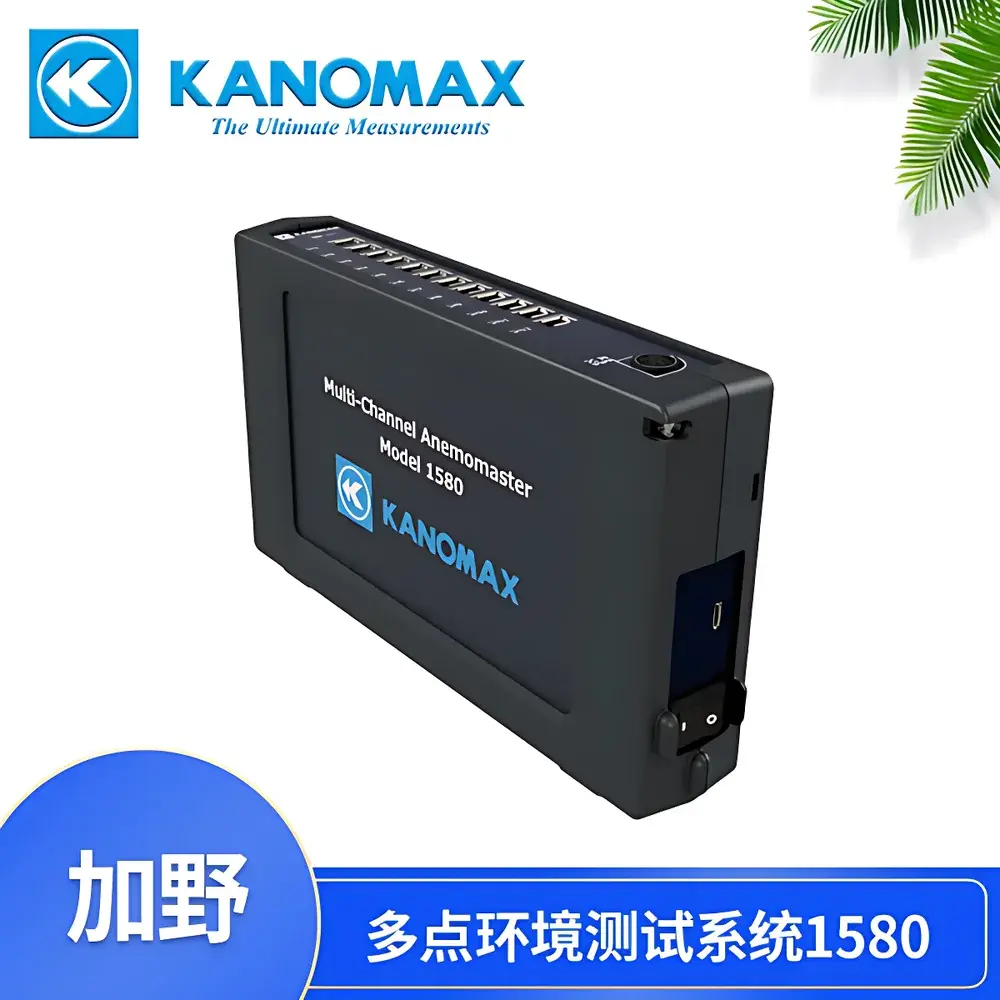
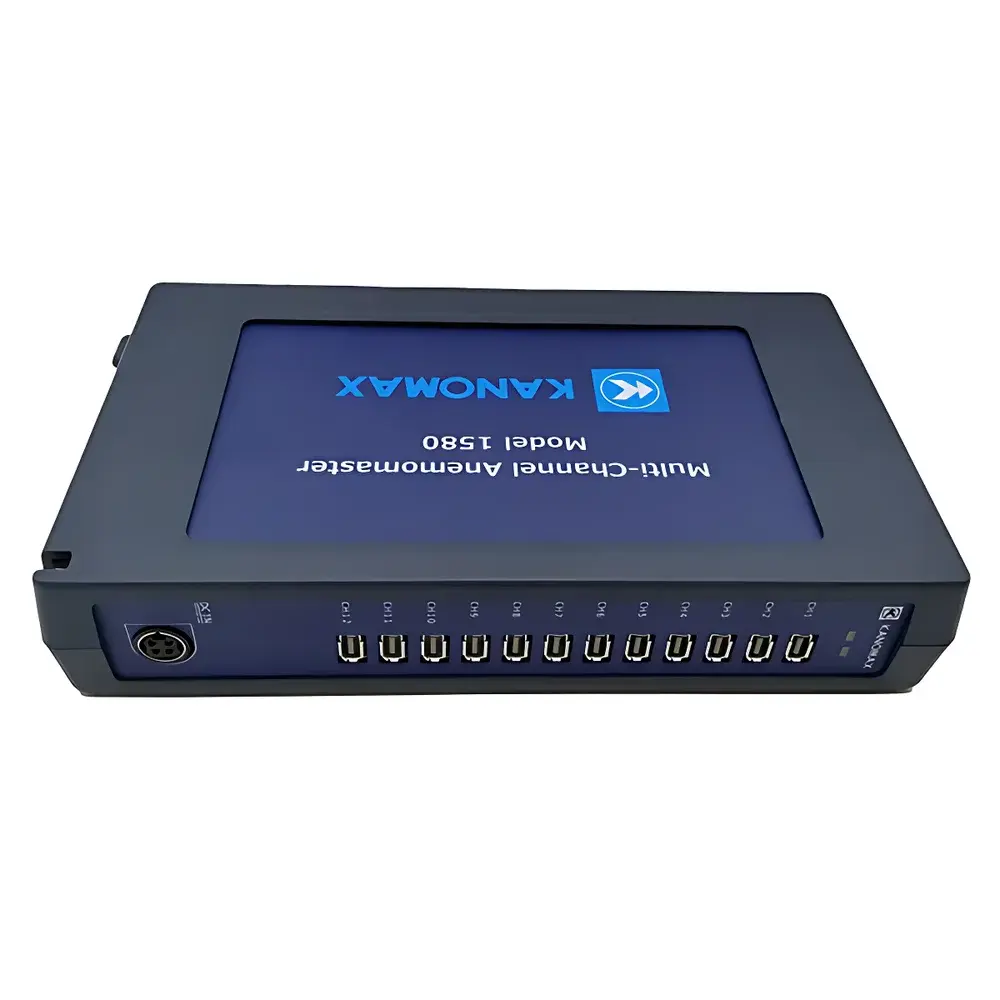
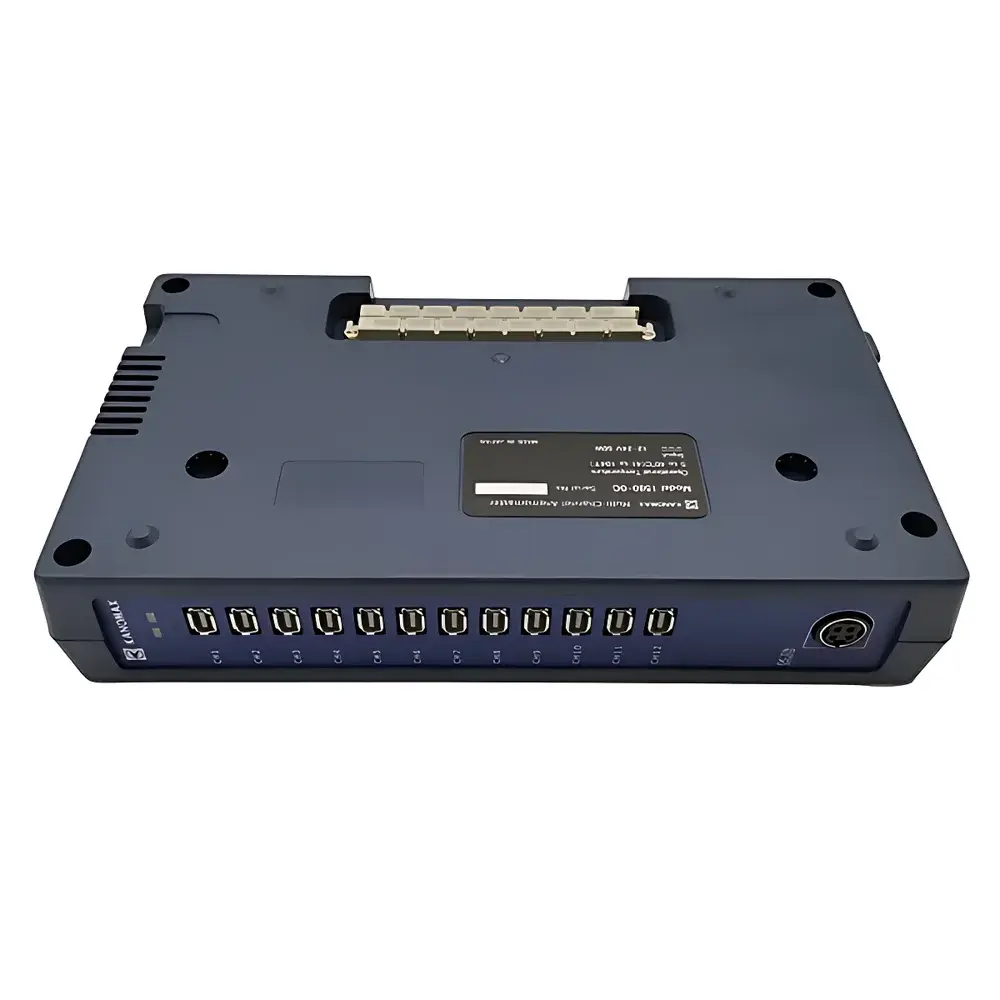
Kanomax 1580-0C Multi-Channel Thermal Anemometry System
| Brand | Kanomax |
|---|---|
| Origin | Japan |
| Instrument Type | Thermal Anemometer |
| Resolution | 0.01 m/s |
| Measurement Range | 0.01–50.0 m/s |
| Accuracy | ±2% of reading or ±0.02 m/s (whichever is greater) |
| Operating Temperature | 5–40 °C |
| Operating Humidity | 0–85% RH (non-condensing) |
| Channel Capacity | 12 simultaneous analog input channels |
| Probe Compatibility | 15 interchangeable probe models |
| Power Supply | AC 100–240 V or DC 12–24 V |
| Unit Dimensions | 220 × 130 × 40 mm |
| Unit Weight | 0.6 kg |
| Communication | USB Micro-B, RS-485 serial (via standardized cable), LAN (optional via software interface) |
Overview
The Kanomax 1580-0C Multi-Channel Thermal Anemometry System is a modular, high-resolution environmental monitoring platform engineered for simultaneous, synchronized measurement of air velocity, temperature, and relative humidity across up to 12 spatially distributed points. Based on constant-temperature anemometry (CTA) principles, the system employs thermally sensitive platinum resistance elements housed in micro-scale probes to detect convective heat loss proportional to local airflow—enabling stable, low-range detection down to 0.01 m/s with sub-second thermal response times. Designed for laboratory-grade reproducibility and field-deployable robustness, the 1580-0C serves as a central acquisition unit compatible with Kanomax’s full family of 15 standardized probes—including directional and omnidirectional variants, high-temperature (up to 120 °C), ultra-compact (<3 mm diameter), and combined thermo-hygrometric sensors. Its compact footprint (220 × 130 × 40 mm), dual power flexibility (AC/DC), and integrated mounting interfaces support permanent installation in HVAC ducts, cleanroom validation arrays, wind tunnel test sections, and mobile applications such as vehicle cabin airflow mapping.
Key Features
- 12-channel synchronized data acquisition with independent configuration per channel—supporting mixed sensor types (velocity-only, velocity + temperature, or velocity + temperature + RH) within a single system.
- Thermal anemometer architecture optimized for low-flow precision: 0.01 m/s minimum detectable velocity with ±2% reading (±0.02 m/s) accuracy across full 0.01–50.0 m/s range.
- Modular probe ecosystem: 15 certified probe models—interchangeable without recalibration—featuring built-in temperature compensation, rapid thermal response (≤1 s for 90% step response at 1 m/s), and mechanical compatibility with standard mounting fixtures.
- Ultra-compact probe options (e.g., Model 0976-03) enable measurements in confined geometries including microchannels, electronic enclosures, and laminar flow hoods.
- Dual power architecture: Accepts AC 100–240 V or DC 12–24 V inputs; supports battery-powered mobile operation when paired with external DC sources.
- Integrated communication stack: Native USB Micro-B interface for direct PC connection; optional RS-485 serial bus (with daisy-chain capability) for distributed sensor networks; LAN connectivity enabled via Windows-based software suite.
Sample Compatibility & Compliance
The 1580-0C system accommodates heterogeneous sampling environments through its probe-flexible design. Directional probes (e.g., Models 0972, 0973) maintain angular sensitivity for vector-aligned airflow assessment in ductwork or ventilation grilles, while omnidirectional variants (e.g., Models 0975-00, 0975-21) provide isotropic response suitable for turbulent or unstructured flows. High-temperature probes (Models 0976-07, 0976-17) operate continuously at 120 °C, enabling thermal process validation in ovens, dryers, and semiconductor fabrication tools. All probes comply with IEC 60751 (Pt100 RTD tolerances) and meet ISO 14644-3 Annex B requirements for cleanroom airflow uniformity testing. The system itself conforms to EN 61326-1 (EMC for laboratory equipment) and UL 61010-1 (safety). Data integrity protocols align with GLP/GMP documentation expectations, supporting audit-ready timestamped records and user-accessible calibration history logs.
Software & Data Management
The included Windows 10-compatible software (v3.2+) provides real-time visualization, configuration, and export functionality. It supports multilingual UI switching (English, Japanese, Chinese) and enables concurrent monitoring of up to 144 channels when cascading multiple 1580-0C units with MODEL 1592-0C analog output modules. Each channel permits individual scaling, offset adjustment, and unit conversion (m/s, ft/min, °C, °F, %RH). Real-time plots include time-series graphs, statistical overlays (min/mean/max), and derivative functions (e.g., turbulence intensity calculation). Data logging supports CSV and native .kdx formats; Excel export preserves metadata including probe ID, calibration date, and environmental conditions. Software implements role-based access control and full audit trail per FDA 21 CFR Part 11 guidelines—recording operator ID, parameter changes, and data export events with immutable timestamps.
Applications
- HVAC system commissioning and balancing—multi-point velocity profiling across diffusers, duct branches, and mixing zones.
- Cleanroom classification per ISO 14644-1: uniformity mapping of unidirectional airflow in Class 3–8 environments.
- Pharmaceutical facility environmental monitoring—continuous validation of air change rates in isolators and RABS.
- Automotive cabin climate control R&D—spatial airflow characterization using vehicle-mounted 1580-0C systems with GPS-synchronized logging.
- Electronics thermal management—cooling airflow verification inside server racks, battery enclosures, and power converters.
- Academic aerodynamics labs—low-speed wind tunnel boundary layer studies with synchronized multi-probe arrays.
FAQ
What is the maximum number of probes supported by a single 1580-0C unit?
A single MODEL 1580-0C supports up to 12 probes simultaneously—each configurable independently for velocity, temperature, or humidity sensing.
Can the system operate in high-humidity environments without condensation risk?
Yes—the operating specification explicitly defines 0–85% RH non-condensing; internal circuitry includes conformal coating and moisture-resistant connectors.
Is probe calibration traceable to national standards?
All factory-calibrated probes include NIST-traceable certificates; users may perform field verification using Kanomax’s portable reference calibrator (Model 1550-00).
Does the software support automated report generation for regulatory submissions?
Yes—customizable templates allow PDF/Excel report generation with embedded metadata, statistical summaries, and pass/fail flags against user-defined acceptance criteria.
How is synchronization achieved across multiple 1580-0C units in a large-scale deployment?
Units are synchronized via hardware trigger signals over RS-485 or software-controlled time-stamping using network time protocol (NTP) when connected via LAN.
Related Products







