
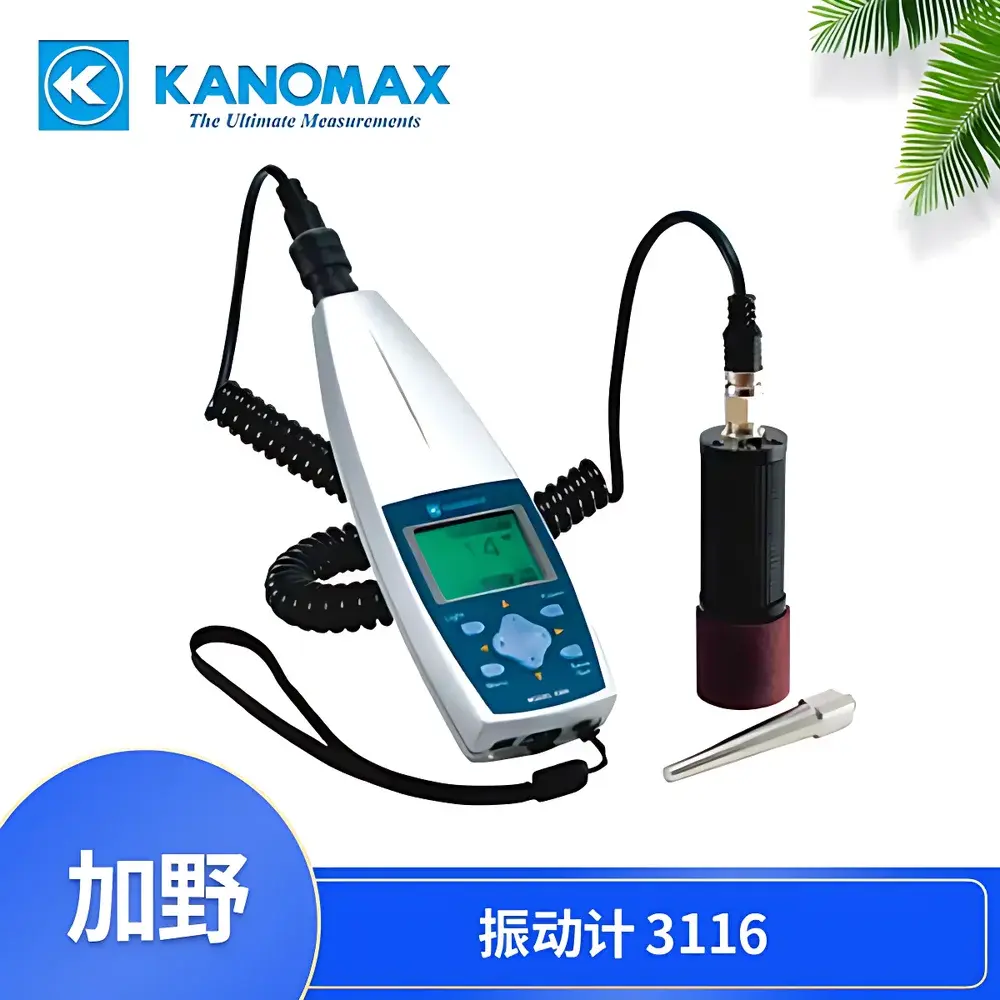
KANOMAX 3116 Portable Vibration Meter
| Brand | KANOMAX |
|---|---|
| Origin | Japan |
| Model | 3116+ |
| Acceleration Range | 0.02–200 m/s² RMS |
| Velocity Range | 0.02–200 mm/s RMS |
| Displacement Range | 2–2000 µm EQp-p |
| Accuracy | ±5% |
| Frequency Range (Acceleration) | 3 Hz–10 kHz |
| Frequency Range (Velocity) | 10 Hz–1 kHz (compliant with JIS B 0907:1989) |
| Frequency Weighting | 10–400 Hz bandpass for vibration evaluation |
| AC Output | 1 Vrms (full scale) |
| Headphone Output | Yes, with volume control |
| Communication Interface | RS-232C |
| Power Supply | Two AAA batteries or optional AC adapter |
| Dimensions | 145 mm (H) × 48 mm (W) × 23 mm (D) |
| Weight | Approx. 130 g |
Overview
The KANOMAX 3116 Portable Vibration Meter is a handheld, battery-operated instrument engineered for field-based assessment of mechanical vibration in industrial, maintenance, and environmental monitoring applications. It operates on the principle of piezoelectric acceleration sensing, converting mechanical vibration into proportional electrical signals for real-time analysis of acceleration, velocity, and displacement parameters. Designed in strict accordance with JIS B 0907:1989 for vibration evaluation in rotating machinery and structural components, the device delivers traceable, repeatable measurements across three fundamental vibration metrics—acceleration (RMS), velocity (RMS), and displacement (EQp-p)—within defined frequency bands optimized for diagnostic relevance. Its compact form factor (145 × 48 × 23 mm), lightweight construction (~130 g), and integrated magnetic sensor mount enable rapid deployment on metallic surfaces without external fixtures, supporting ISO 20816-1-compliant spot checks during predictive maintenance routines.
Key Features
- Triple-parameter measurement: Simultaneous acquisition and display of acceleration (0.02–200 m/s² RMS), velocity (0.02–200 mm/s RMS), and displacement (2–2000 µm EQp-p) in real time.
- Frequency-selective analysis: Dedicated 10–400 Hz bandpass filter aligned with ISO 5347 and JIS B 0907 standards for evaluating machine health per common severity charts.
- Integrated magnetic base and probe holder: Ensures stable transducer coupling to ferromagnetic surfaces, minimizing signal attenuation and improving measurement reproducibility.
- Dual output capability: Analog AC output (1 Vrms full-scale) for connection to oscilloscopes or data loggers, plus stereo headphone output with adjustable volume for audible vibration diagnostics.
- RS-232C serial interface: Enables bidirectional communication with Windows-based PC software for data export, report generation, and long-term trend analysis.
- Low-power architecture: Operates continuously for up to 20 hours on two standard AAA alkaline cells; AC adapter option supports extended benchtop use.
Sample Compatibility & Compliance
The KANOMAX 3116 is compatible with rigid metallic surfaces (e.g., motor housings, gearboxes, pump casings, HVAC ductwork, and structural steel members) where magnetic mounting is feasible. Non-magnetic surfaces require optional adhesive or stud-mounted accelerometers (not included). The instrument conforms to JIS B 0907:1989 for general-purpose vibration measurement and supports alignment with ISO 10816-1 (evaluation of machine vibration by measurements on non-rotating parts) and ISO 20816-1 (machinery vibration — measurement and evaluation) when used within its specified frequency and amplitude ranges. Its ±5% basic accuracy meets Class 2 requirements per ISO 2954 for vibration meter performance verification.
Software & Data Management
Data acquired via the RS-232C port can be imported into KANOMAX’s proprietary PC application (compatible with Windows 10/11), which supports time-stamped logging, statistical summary (min/max/avg/peak), FFT spectrum preview (limited resolution), and customizable report templates compliant with internal QA documentation protocols. Export formats include CSV and PDF. While the device itself does not embed audit trails or electronic signatures, its data output structure supports integration into validated laboratory information management systems (LIMS) under GLP or GMP frameworks when paired with appropriate procedural controls and calibration records.
Applications
- Predictive maintenance screening of rotating equipment (motors, fans, compressors, pumps) in manufacturing plants and utility infrastructure.
- Vibration baseline establishment during commissioning and periodic revalidation of critical assets.
- Field verification of vibration isolation effectiveness in HVAC and building mechanical systems.
- Supporting root cause analysis in failure investigations involving bearing wear, imbalance, misalignment, or resonance conditions.
- Compliance checks against facility-specific vibration thresholds for occupational health and safety (e.g., ISO 5349 hand-arm vibration exposure limits).
FAQ
Does the KANOMAX 3116 support real-time spectral analysis?
No—it provides time-domain RMS and peak-equivalent values only. For frequency-domain analysis (e.g., FFT), external data acquisition hardware or post-processing software is required.
Is calibration certification included with purchase?
A factory calibration certificate traceable to JCSS (Japan Calibration Service System) is provided; annual recalibration is recommended per ISO/IEC 17025 guidelines.
Can the device measure hand-arm vibration (HAV)?
It is not configured for ISO 5349-1 HAV assessment, which requires specialized weighting filters (Wh), triaxial sensors, and exposure time integration—not supported by this single-axis, broadband instrument.
What is the maximum sampling duration per measurement session?
The unit stores no internal memory; measurements are displayed and output in real time. Continuous logging depends on connected PC software and host system capacity.
Is the RS-232C interface optically isolated?
No—users should ensure proper grounding and avoid connecting to electrically noisy industrial PCs without transient suppression.
Related Products







