
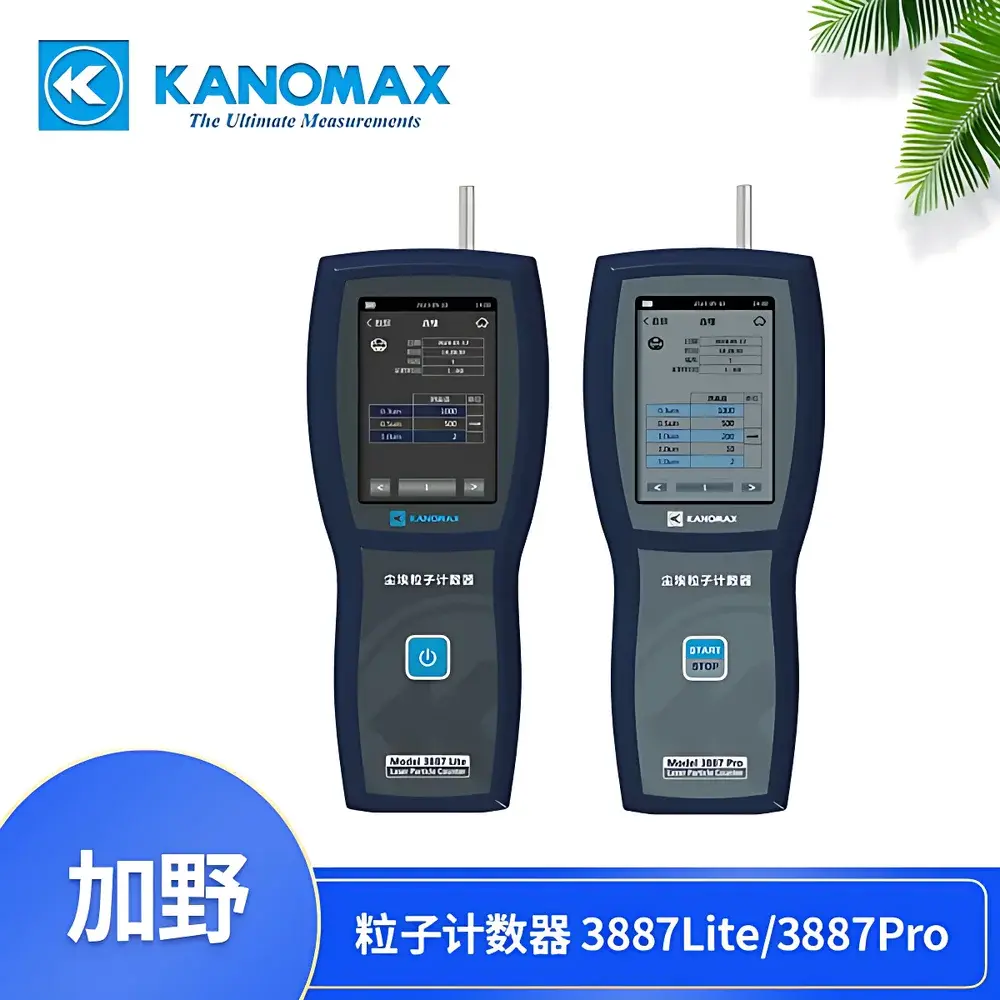
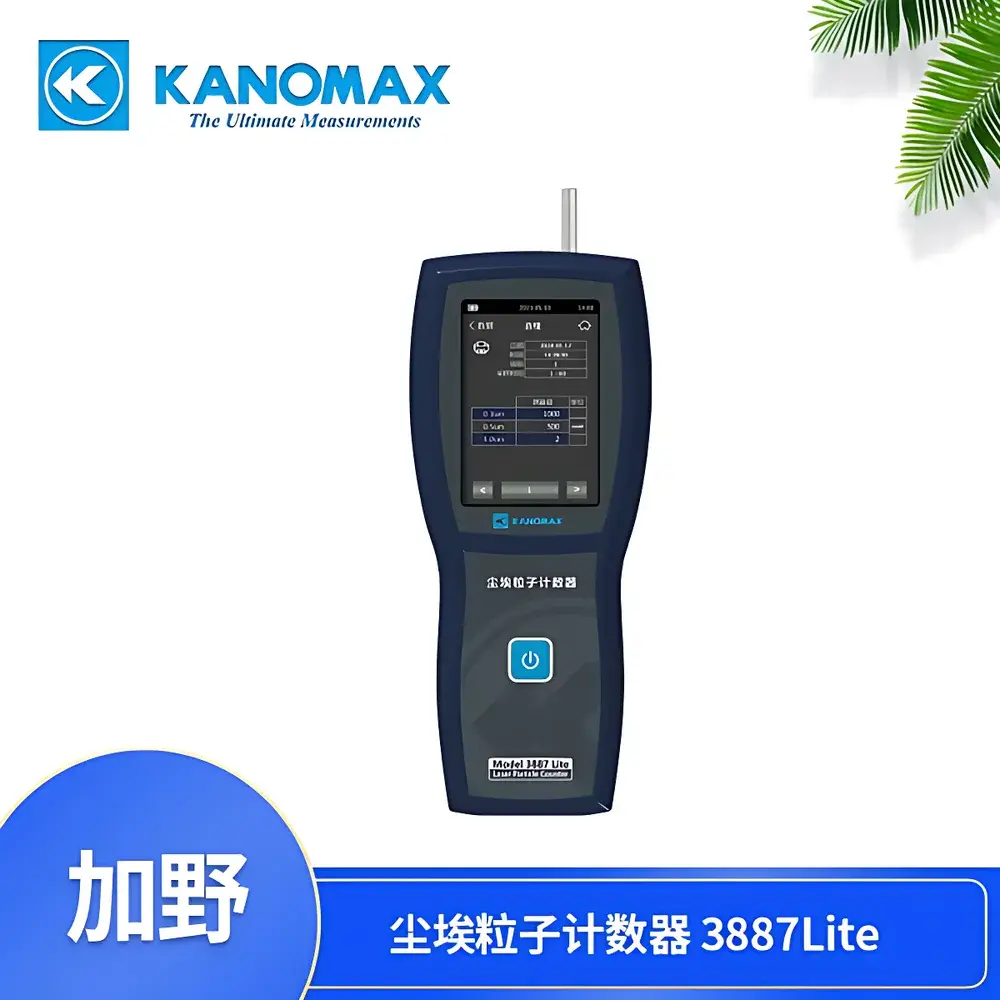
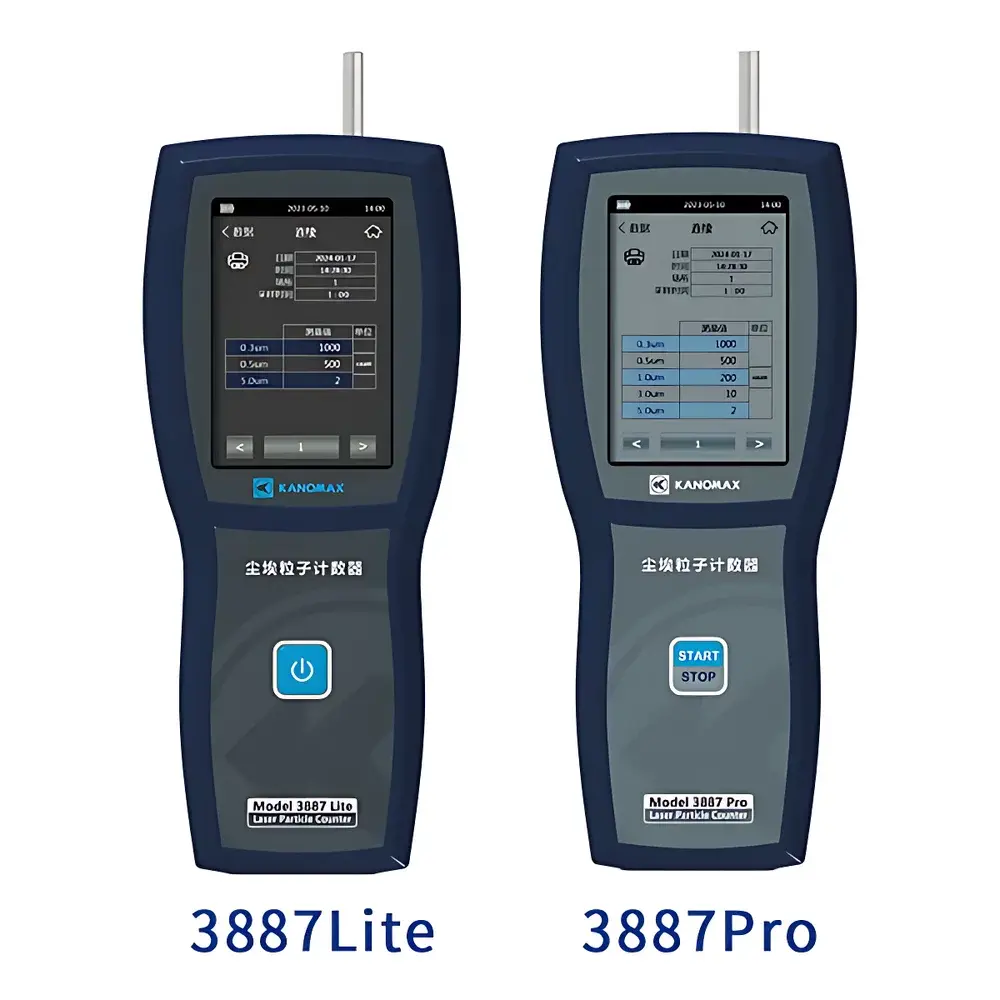
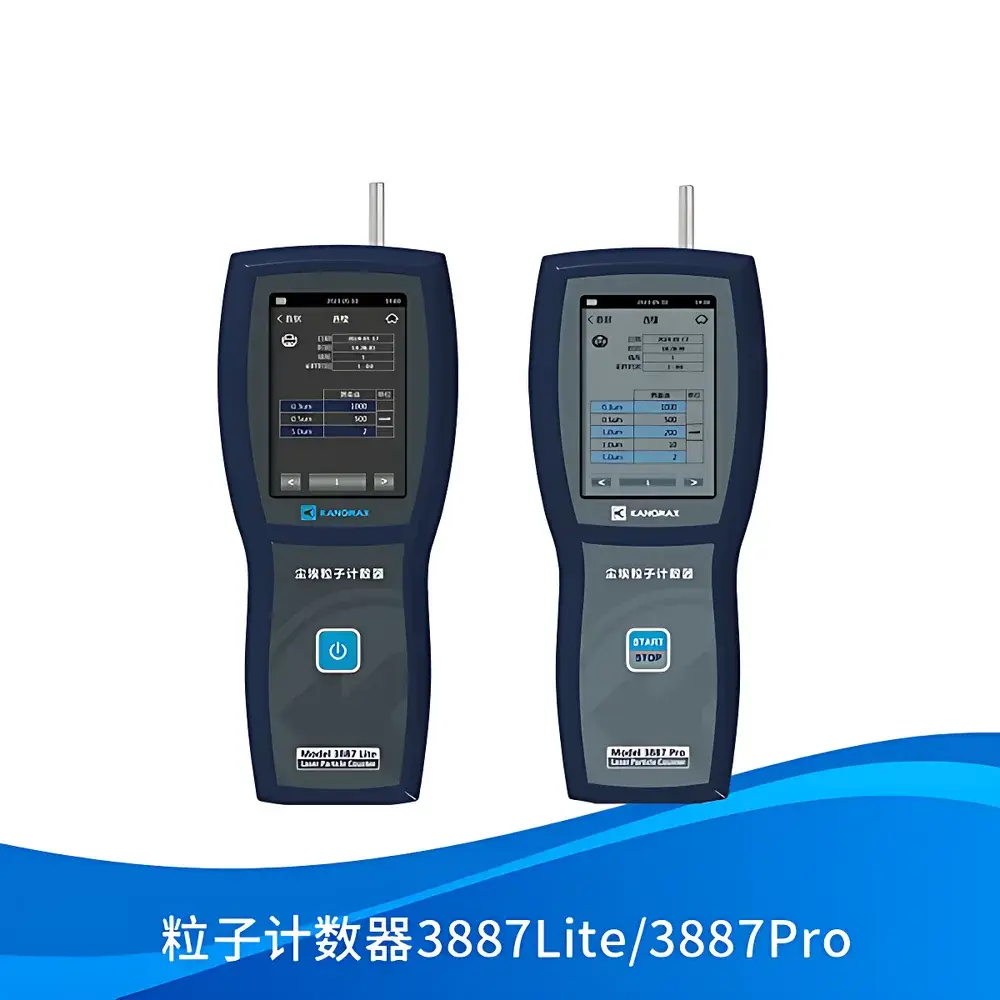
Kanomax 3887Lite / 3887Pro Handheld Laser Particle Counter for Pharmaceutical Cleanroom Monitoring
| Brand | Kanomax |
|---|---|
| Origin | Japan |
| Model | 3887Lite / 3887Pro |
| Instrument Type | Handheld Particle Counter |
| Flow Rate | 2.83 L/min ±5% |
| Detectable Particle Sizes | 0.3, 0.5, 1.0, 3.0, 5.0 µm (3887Pro) |
| Display | 3.5-inch resistive touchscreen |
| Light Source | Laser diode |
| Counting Efficiency Compliance | ISO 21501-4 & JIS B9921 |
| Maximum Detectable Concentration | 2,000,000 particles/ft³ |
| Coincidence Loss | <5% at 2,000,000 particles/ft³ |
| Count Range | 1–70,000,000 |
| Sampling Modes | Single, Repeat, Continuous, Calculate, Remote, GB/T 16292, ISO 14644-1 |
| Sampling Time | 6 sec – 99 min 59 sec |
| Interval Time | 6 sec – 99 min 59 sec |
| Sample Count | 1–999 or continuous |
| Data Storage Capacity | 7,000 records |
| Power Supply | Rechargeable Li-ion battery (≈5 h operation) + USB-C AC adapter |
| Dimensions | 87 × 200 × 55 mm |
| Weight | ≈600 g |
| Operating Environment | 10–40 °C, 0–85% RH (non-condensing) |
| Communication Interfaces | USB & RS-485 |
| Standard Accessories | Zero-count filter, sampling port cap, user manual, AC adapter with cable, calibration report, RS-485 terminal block, protective carrying case |
Overview
The Kanomax 3887Lite and 3887Pro are compact, handheld laser particle counters engineered for routine and audit-ready environmental monitoring in regulated pharmaceutical cleanrooms (ISO Class 5–8, EU GMP Grade A–D). Based on light scattering principles compliant with ISO 21501-4 and JIS B9921, these instruments utilize a stable 650 nm laser diode to detect airborne particulates across discrete size channels. With a calibrated volumetric flow rate of 2.83 L/min (0.1 ft³/min), they meet the fundamental sampling requirement for ISO 14644-1 and GB/T 16292-2010 compliance testing. The dual-model architecture supports both cost-optimized verification (3887Lite: 0.3/0.5/5.0 µm) and full-spectrum classification (3887Pro: 0.3/0.5/1.0/3.0/5.0 µm), enabling seamless alignment with USP , EU Annex 1, and FDA guidance on viable and non-viable particle control in aseptic processing environments.
Key Features
- High-fidelity 3.5-inch resistive touchscreen interface with intuitive icon-driven navigation—designed for gloved operation in cleanroom suits.
- Real-time coincidence loss correction algorithm ensures counting accuracy up to 2,000,000 particles/ft³, validated per ISO 21501-4 threshold criteria.
- Seven standardized test modes—including GB/T 16292, ISO 14644-1, continuous logging, and remote-triggered sampling—support both routine QC checks and formal qualification protocols.
- Configurable sampling parameters: user-defined duration (6 sec–99:59 min), interval timing, and cycle count (1–999), facilitating multi-point mapping per ISO 14644-2 Annex B.
- On-device data management: stores up to 7,000 complete sample records with timestamp, location tag, operator ID, and statistical outputs (min/max/mean).
- Intelligent resume functionality preserves session state during unexpected power interruption—critical for uninterrupted ISO-compliant monitoring campaigns.
- Dual communication architecture (USB 2.0 + isolated RS-485) enables direct PC connection, integration into SCADA/BMS systems, or optional thermal printer output.
Sample Compatibility & Compliance
The 3887 series is validated for use with standard 0.3–5.0 µm isokinetic sampling probes and compatible with stainless-steel or conductive polymer tubing (e.g., 1 m length option). All factory calibrations are traceable to NIST-traceable PSL standards, and each unit ships with a certified calibration report meeting ISO/IEC 17025 requirements. The instrument’s counting efficiency curve satisfies ISO 21501-4 Class 1 performance thresholds across its specified size range. For pharmaceutical applications, it supports full adherence to EU GMP Annex 1 (2022), FDA Aseptic Processing Guidance (2004), and Chinese GMP 2010 requirements for non-viable particle monitoring. Optional audit trails (via PC software) support 21 CFR Part 11 compliance when paired with Kanomax’s validated desktop application.
Software & Data Management
Kanomax’s proprietary PC software (Windows 10/11 compatible) provides secure, structured access to stored datasets. Functions include dynamic trend visualization, pass/fail overlay against ISO class limits, automated report generation (PDF/CSV), and export to LIMS via ODBC. Audit log features record all user actions—including parameter changes, data exports, and calibration events—with time-stamped, non-erasable entries. When deployed in GxP environments, the software can be configured to enforce electronic signatures and role-based access control, aligning with ALCOA+ data integrity principles. Raw data files are stored in encrypted binary format with checksum validation to prevent tampering.
Applications
- Pharmaceutical aseptic filling line environmental qualification (Grade A hood monitoring, background room surveillance)
- HEPA filter integrity verification and leak detection in clean air devices
- Biotechnology cleanroom commissioning and periodic requalification per ISO 14644-2
- Medical device manufacturing ISO Class 7–8 facility monitoring
- Electronics cleanrooms (semiconductor wafer fab, LCD panel assembly) for process contamination control
- Research laboratories requiring portable, GLP-compliant particulate baseline assessment
- HVAC system performance validation and troubleshooting
FAQ
Does the 3887Pro support real-time data streaming to a central monitoring system?
Yes—via RS-485 Modbus RTU protocol, the instrument transmits live particle counts, flow status, battery level, and error flags at user-defined intervals.
Is the internal battery certified for air transport under IATA regulations?
The integrated lithium-ion battery complies with UN 38.3 and carries a ≤100 Wh rating, permitting safe shipment by air without special declaration.
Can the device be used in controlled humidity environments above 85% RH?
Operation is limited to 0–85% RH non-condensing; extended exposure above this threshold may affect optical path stability and sensor longevity.
How often does the instrument require recalibration?
Annual recalibration is recommended per ISO 17025 guidelines; however, daily zero-checks using the included HEPA-filtered zero-count air source are mandatory before critical measurements.
Are firmware updates available, and how are they applied?
Firmware revisions are distributed via Kanomax’s secure customer portal and installed through USB-connected PC software—no field service required.
Related Products







