
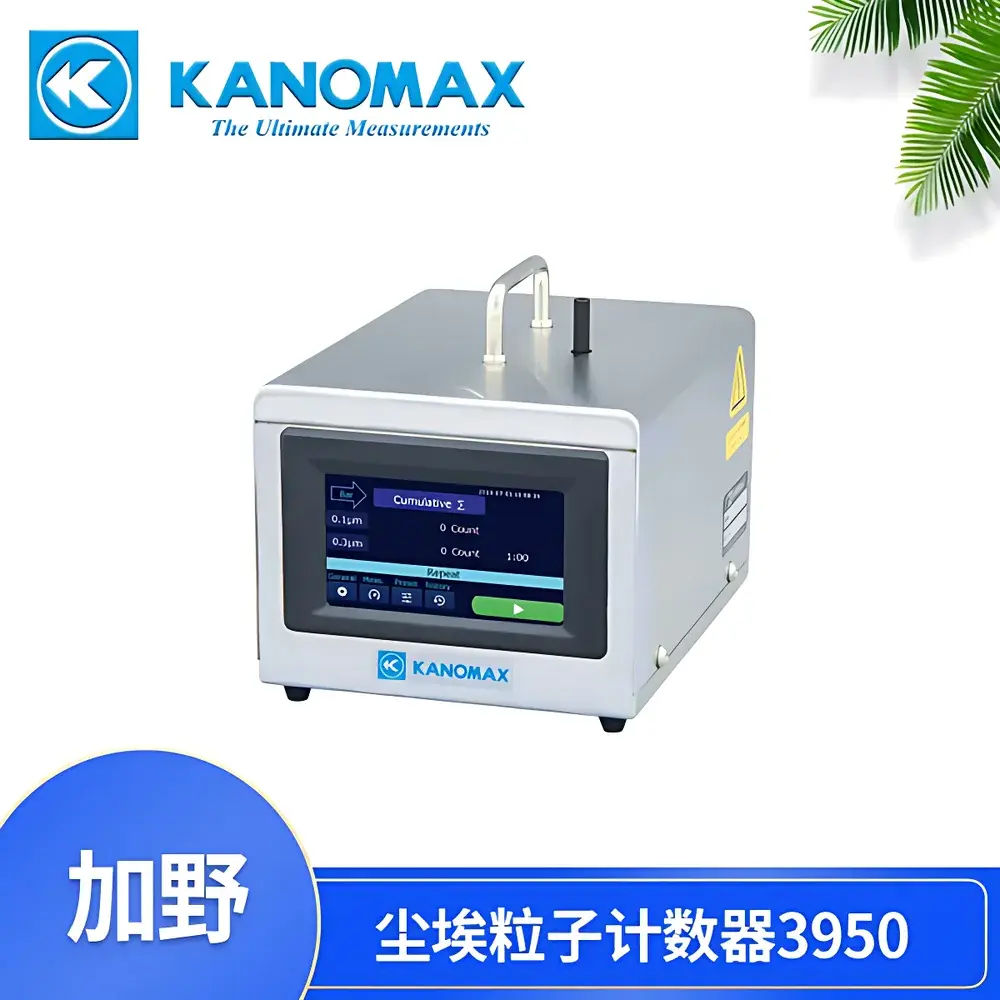
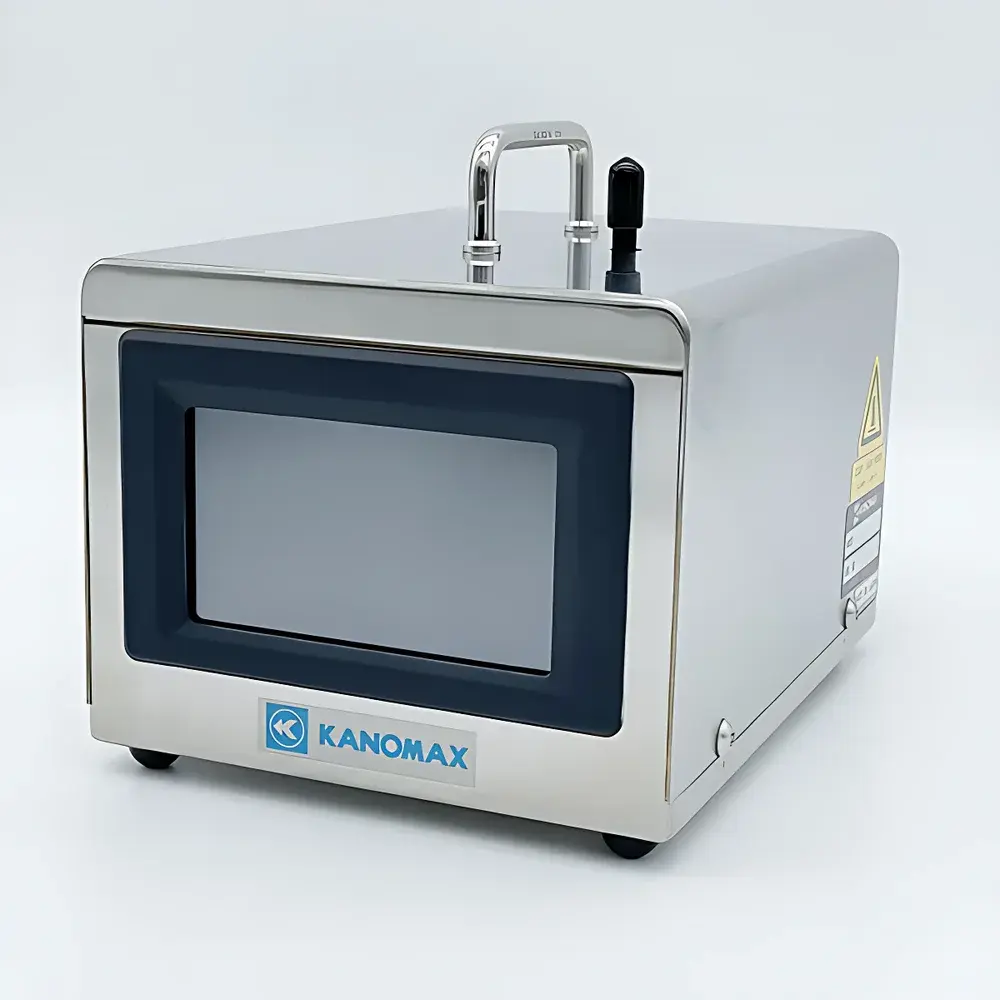
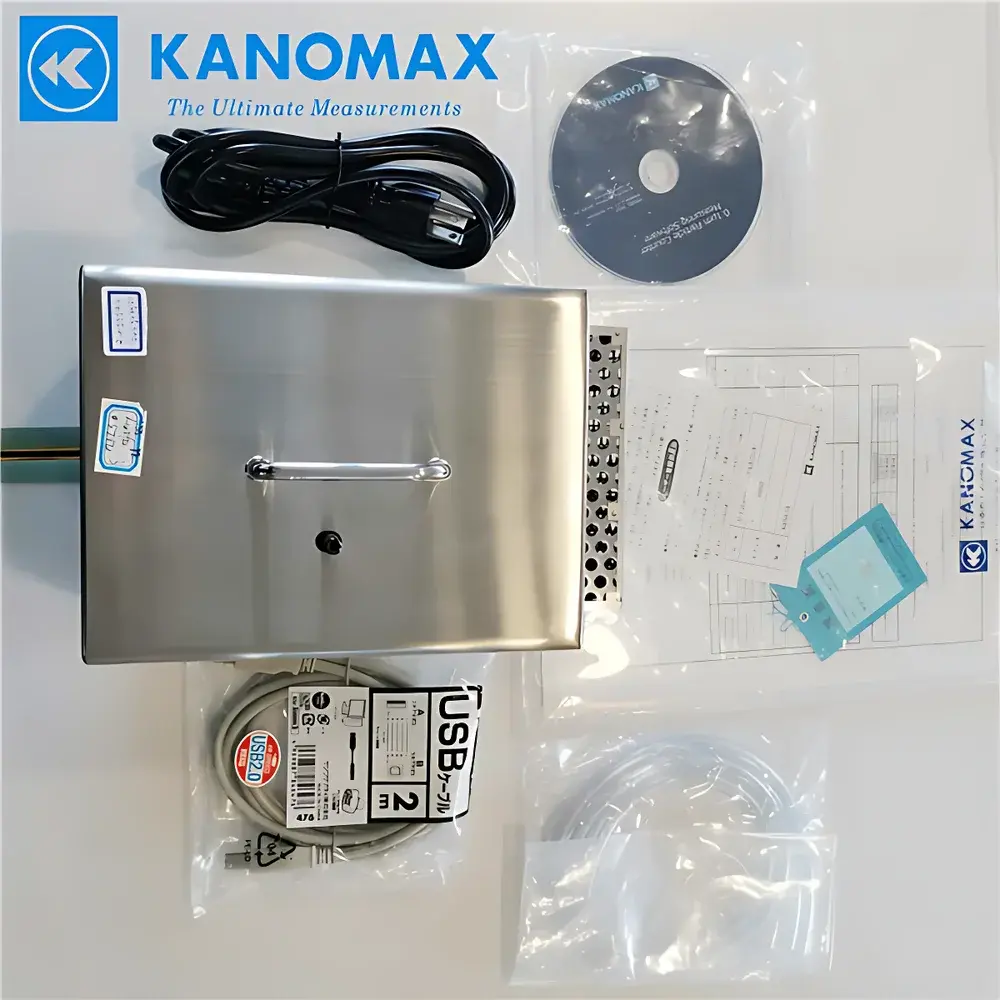
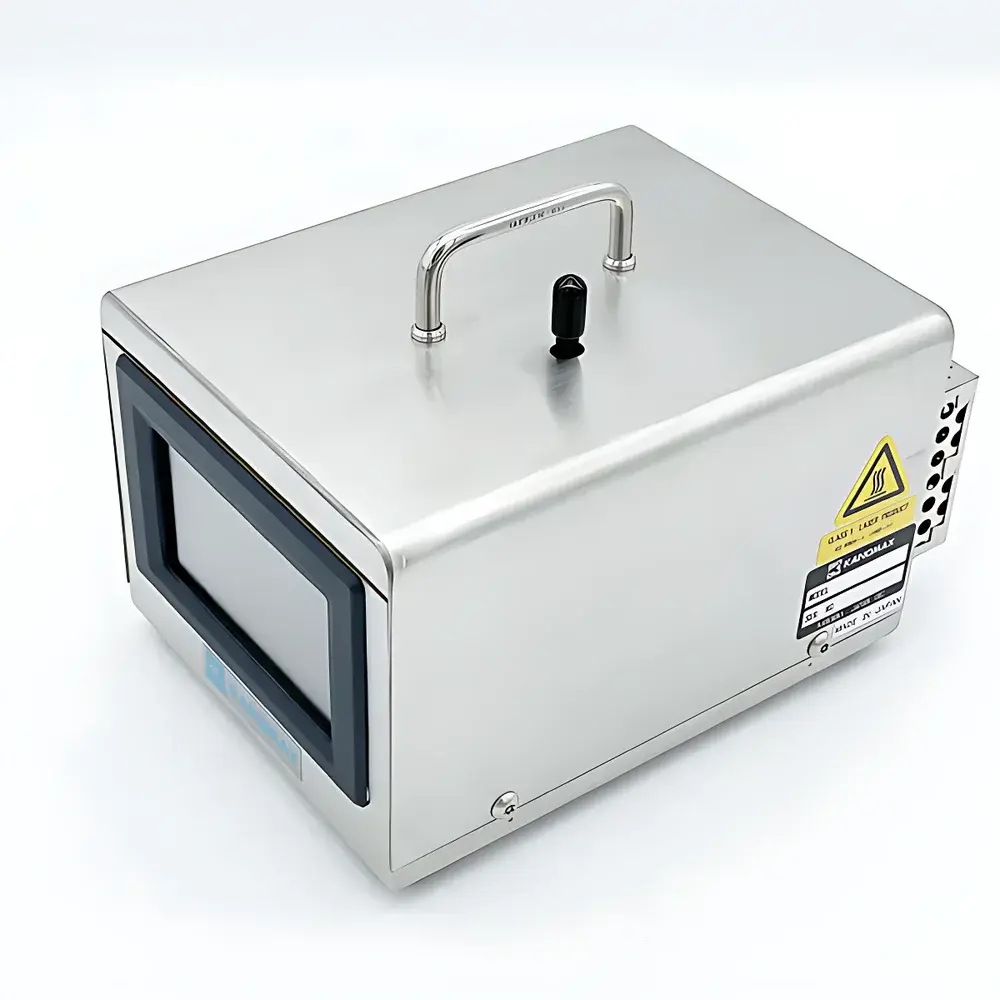
KANOMAX 3950-00 Ultra-Low-Threshold Particle Counter for ISO Class 3–5 Cleanroom Monitoring
| Brand | KANOMAX |
|---|---|
| Origin | Japan |
| Model | 3950-00 |
| Flow Rate | 2.83 L/min (0.1 CFM) |
| Flow Accuracy | ±5% |
| Timing Accuracy | ±1 s per 6 min |
| Repeatability | ±5% |
| Size Distribution Error | ±15% |
| Indication Error | ±30% |
| Particle Detection Threshold | 0.1 µm and 0.3 µm |
| Compliance | JIS B9921 & ISO 21501-4 |
| Display | 4.3" color TFT touchscreen |
| Communication | RS-485, Ethernet, USB Host/Device |
| Data Storage | Up to 10,000 records (CSV) |
| Operating Environment | 15–35 °C, 0–85% RH (non-condensing) |
| Dimensions | 150 × 163 × 228 mm |
| Weight | 3.4 kg |
Overview
The KANOMAX 3950-00 is a compact, high-sensitivity optical particle counter engineered for continuous, real-time monitoring of ultra-clean environments—specifically ISO Class 3 to Class 5 cleanrooms used in pharmaceutical aseptic processing, microelectronics fabrication, and medical device manufacturing. It employs single-particle light scattering (SPLS) detection with a 650 nm laser source and optimized optical geometry to resolve particles as small as 0.1 µm with validated counting efficiency per ISO 21501-4 and JIS B9921. Unlike conventional benchtop counters, the 3950-00 is designed for embedded integration: its 3.4 kg mass, sub-230 mm depth, and standardized communication interfaces enable direct OEM installation into laminar flow hoods, isolators, environmental monitoring systems (EMS), and automated wafer handling platforms. The instrument operates at a nominal volumetric flow rate of 2.83 L/min (0.1 CFM), calibrated traceably to NIST-traceable PSL standards, and delivers stable performance across temperature and humidity gradients typical of controlled manufacturing spaces.
Key Features
- Two-channel simultaneous detection at 0.1 µm and 0.3 µm—enabling early detection of sub-0.2 µm nucleation events critical in sterile fill-finish and photolithography processes
- 4.3-inch full-color capacitive touchscreen interface with intuitive icon-based navigation, supporting English and Japanese language modes without firmware modification
- Embedded dual-mode sampling control: programmable measurement intervals (6 s–99:59 min) and configurable sampling sequences (1–999 cycles or continuous mode)
- Comprehensive on-device data handling—including cumulative (∑), differential (Δ), and histogram visualization—with no external software dependency for basic operation
- Triple-interface connectivity: isolated RS-485 (Modbus RTU support), 10/100 Mbps Ethernet (TCP/IP stack with DHCP/Static IP), and dual-role USB (Host for thermal printers/USB flash drives; Device for PC configuration via KANOMAX DataView software)
- Robust mechanical architecture: aluminum-magnesium alloy housing rated IP20, conformal-coated PCBs, and internal diaphragm pump with integrated flow sensor and pressure compensation
Sample Compatibility & Compliance
The 3950-00 is validated for use with ambient air, nitrogen-purged enclosures, and compressed dry air (CDA) lines meeting ISO 8573-1 Class 2:2:2 specifications. Its optical chamber design minimizes particle bounce and re-entrainment, ensuring representative sampling in low-velocity laminar flows (<0.45 m/s). Calibration verification follows ISO 21501-4 Annex C procedures using monodisperse PSL spheres (NIST SRM 1963 and 1964). The instrument meets JIS B9921 Class 1 requirements for cleanroom instrumentation and supports compliance with FDA 21 CFR Part 11 when deployed with audit-trail-enabled EMS software (e.g., Vaisala viewLinc, Siemens Desigo CC). All firmware revisions undergo GLP-aligned change control documentation, and factory calibration certificates include uncertainty budgets per ISO/IEC 17025.
Software & Data Management
KANOMAX DataView v4.x (Windows 10/11 compatible) provides full configuration, remote monitoring, and report generation—including ISO 14644-1 conformity assessments, trend analysis with statistical process control (SPC) overlays, and CSV export compliant with LIMS ingestion protocols. Raw data files retain embedded timestamps, location IDs (up to 99 predefined zones), and instrument serial metadata. When connected via Ethernet, the unit supports SNMPv3 polling and MQTT publishing (JSON payload) for integration into Industry 4.0 SCADA architectures. Internal memory stores up to 10,000 measurement records with automatic overwrite protection and time-stamped event logging (power-on, calibration, error flags). Data integrity is enforced via CRC-32 checksums and write-locked file attributes during USB transfer.
Applications
- Aseptic processing line environmental monitoring (Grade A/B zones per EU GMP Annex 1)
- Photomask and reticle storage cabinet qualification in semiconductor fabs
- Real-time feedback control for HEPA filter integrity testing via upstream/downstream differential counting
- Validation of glovebox inert-atmosphere purity in battery electrode R&D labs
- OEM integration into portable cleanroom mapping carts and robotic environmental survey platforms
- ISO 14644-1 classification audits requiring 0.1 µm resolution for Class 3 (≤1,000 particles/m³) and Class 4 (≤10,000 particles/m³) certification
FAQ
Does the 3950-00 comply with FDA 21 CFR Part 11 for electronic records?
Yes—when operated with KANOMAX DataView configured for audit trail logging, user authentication, and electronic signature enforcement, it satisfies Part 11 requirements for closed-system validation.
Can the unit be used in nitrogen-purged gloveboxes?
Yes—its optical system and pump are compatible with inert gases; however, refractive index differences require optional gas-specific calibration coefficients (available upon request).
What is the maximum allowable particulate concentration for accurate counting?
The upper limit is 107 particles/m³ at 0.1 µm, beyond which coincidence loss correction algorithms activate per ISO 21501-4 Clause 6.4.
Is external power conditioning required for stable operation?
No—the internal AC/DC converter accepts 100–240 VAC, 50/60 Hz with built-in surge suppression and brownout tolerance down to 85 VAC for 200 ms.
How often does the instrument require recalibration?
Annual calibration is recommended under routine use; however, users must perform daily zero-count verification and weekly flow verification using the included orifice plate and certified flow meter.
Related Products







