
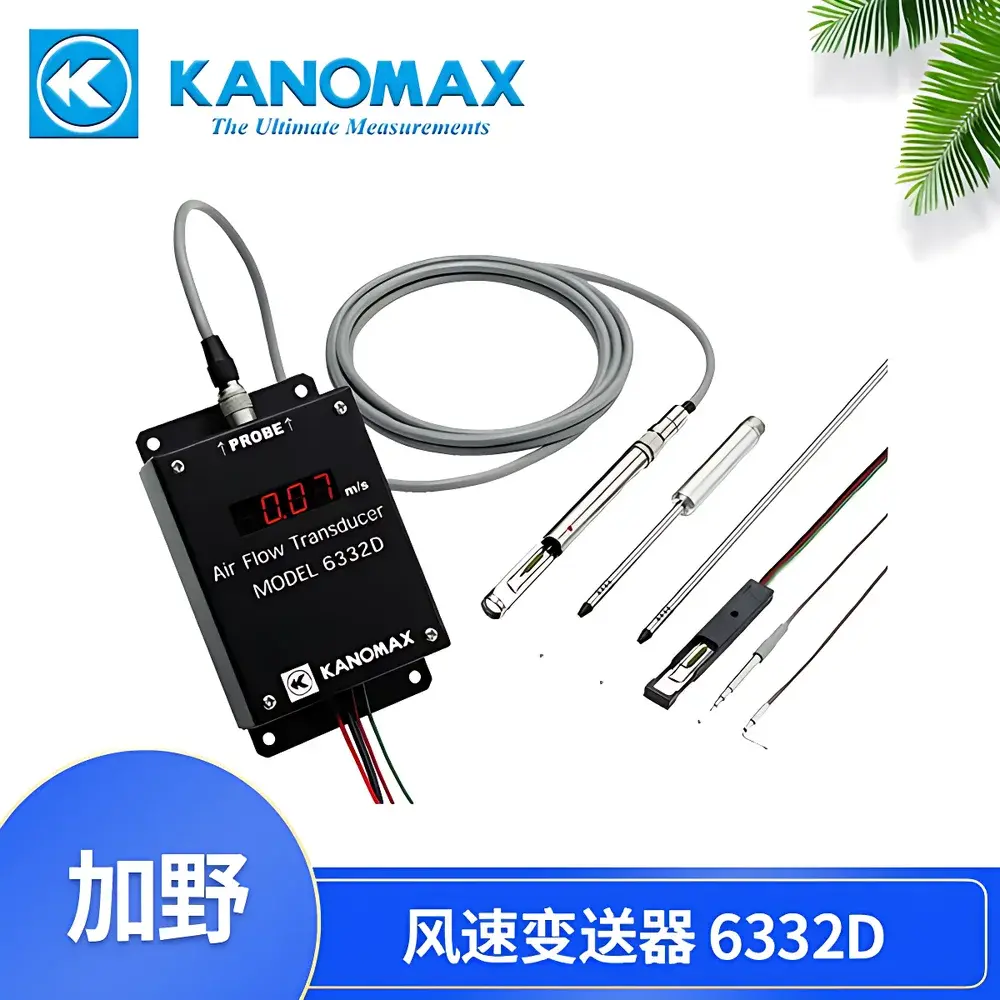
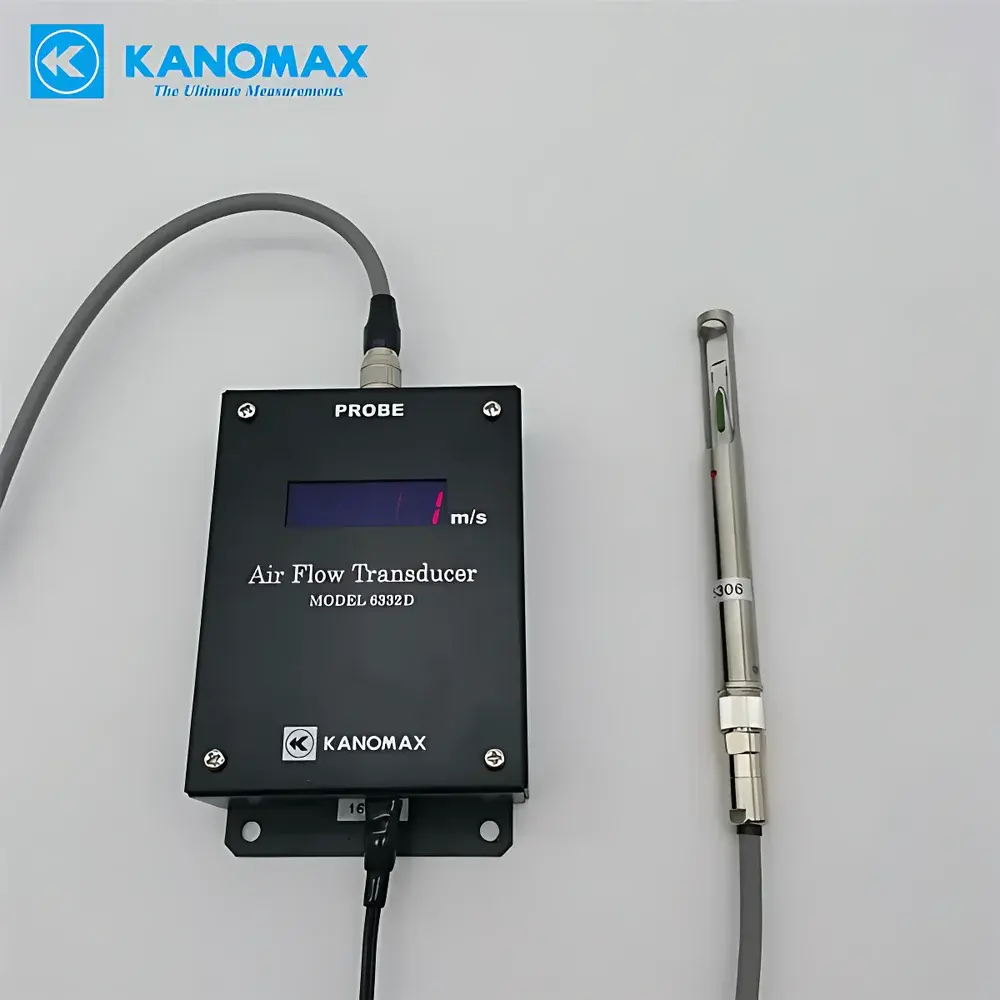
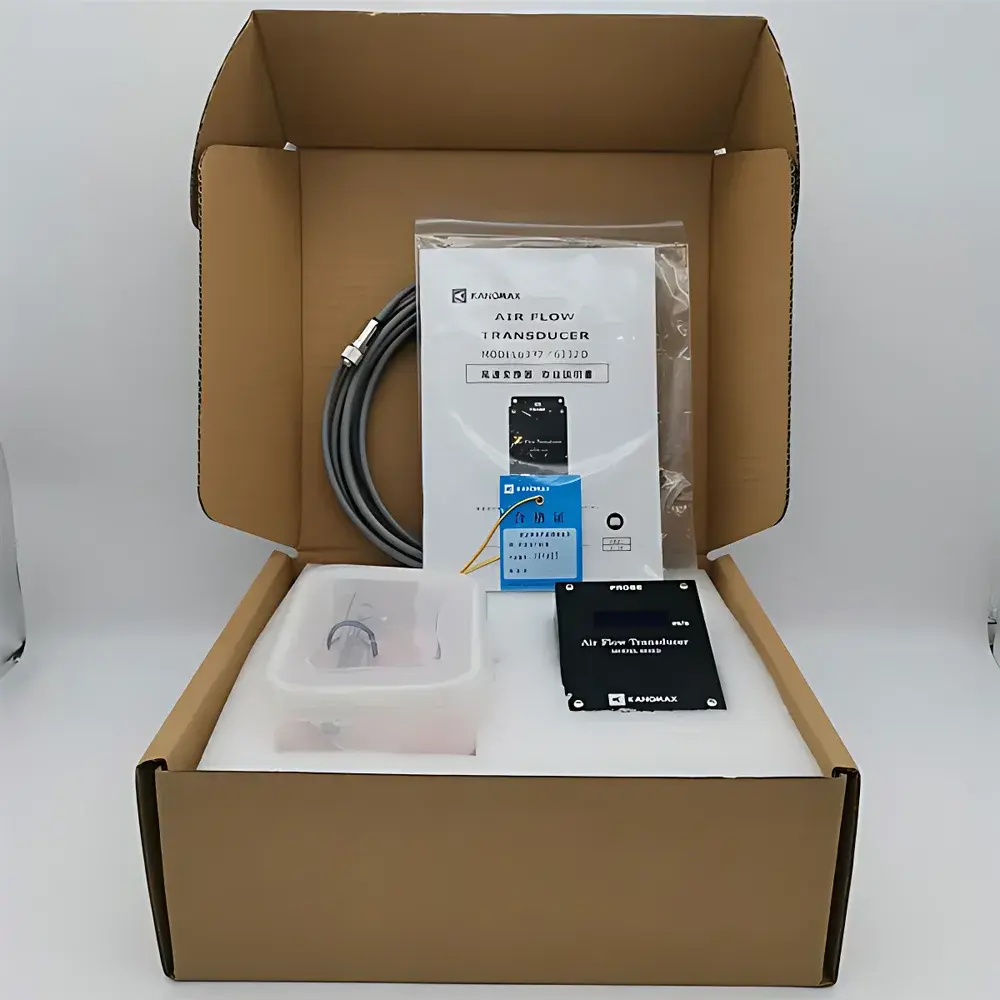
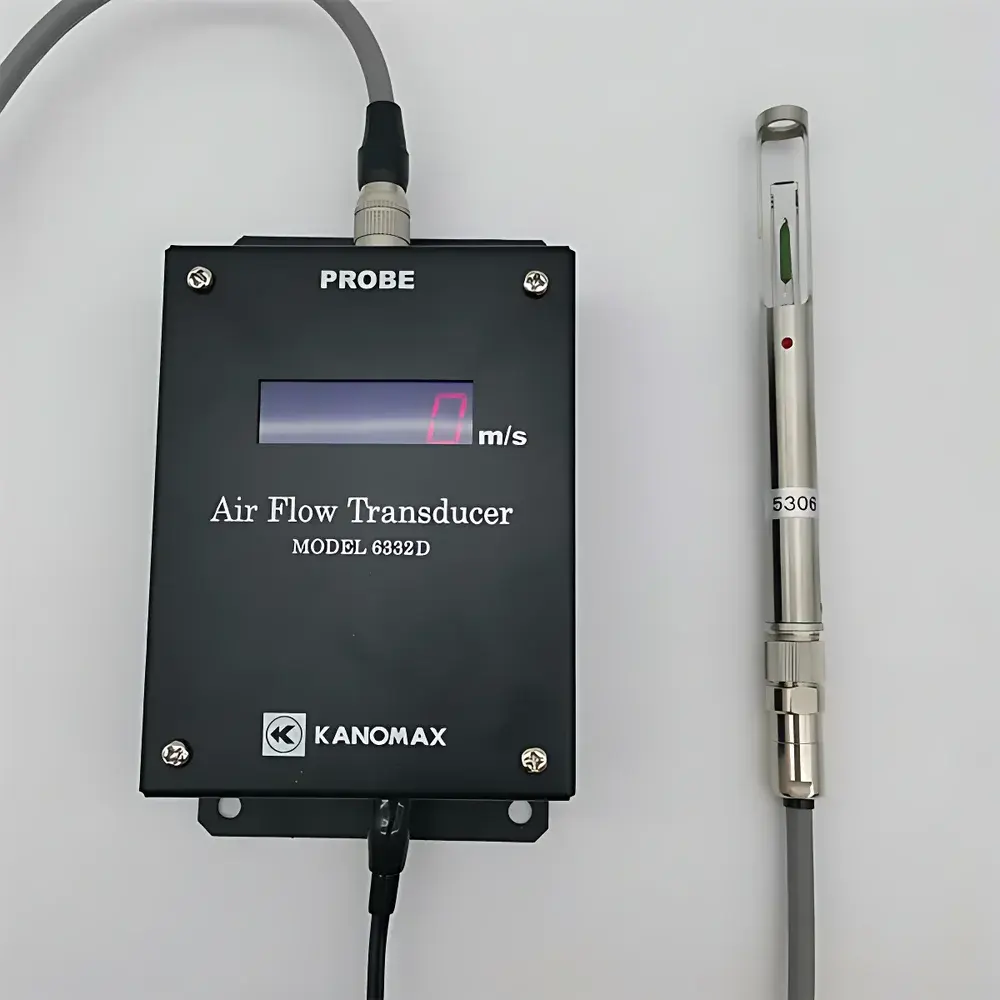
Kanomax 6332D Hot-Wire Anemometer Transmitter
| Brand | Kanomax |
|---|---|
| Origin | Liaoning, China (Manufactured under Kanomax Japan technical specification) |
| Model | 6332D+ |
| Instrument Type | Hot-Wire Anemometer |
| Resolution | 0.01 m/s |
| Measurement Range | Probe-Dependent (e.g., 0.05–30 m/s with standard 6332-01 probe) |
| Display | Integrated LCD (real-time wind speed, unit, status) |
| Analog Output | 0–5 V DC or 4–20 mA (configurable) |
| Power Supply | DC 12 V ±2 V |
| Dimensions | 128 × 78 × 30 mm |
| Weight | 320 g |
| Probe Compatibility | 10 interchangeable hot-wire and thermal anemometry probes (e.g., 6332-01 to 6332-10) |
| Multi-Unit Cascading | Yes (RS-485 Modbus RTU interface for synchronized multi-channel deployment) |
Overview
The Kanomax 6332D Hot-Wire Anemometer Transmitter is a precision-engineered environmental monitoring instrument designed for continuous, real-time measurement of air velocity in HVAC commissioning, cleanroom qualification, laboratory ventilation validation, and industrial airflow verification. Based on constant-temperature anemometry (CTA) principles, the system maintains a heated sensing element at a stable temperature differential relative to ambient air; convective cooling by airflow modulates the required heating current, which is linearly converted into calibrated wind speed output. Unlike cup or vane anemometers, the 6332D achieves high-frequency response (<10 ms rise time), low-flow sensitivity (down to 0.05 m/s), and minimal flow disturbance—making it suitable for laminar flow profiling, duct traverse mapping, and low-velocity applications such as ISO Class 5–8 cleanroom monitoring per ISO 14644-3 and EU GMP Annex 1 requirements.
Key Features
- Modular probe architecture supporting 10 interchangeable hot-wire and thermal anemometer probes—including straight, bent, retractable, and multi-point variants—enabling adaptation to ducts, fume hoods, biological safety cabinets, and confined spaces.
- Integrated backlit LCD display providing real-time wind speed (m/s, ft/min, knots), unit selection, probe ID recognition, and status indicators (e.g., sensor fault, low battery, communication error).
- Dual analog output configuration: factory-configurable 0–5 V DC or 4–20 mA current loop output, compliant with industrial SCADA and DCS integration standards (IEC 61000-6-2/6-4 EMI immunity).
- RS-485 serial interface with Modbus RTU protocol enabling daisy-chain connection of up to 32 units on a single bus—ideal for multi-point air velocity surveillance in large-scale facilities without requiring individual signal conditioning.
- Rugged aluminum alloy housing (IP54-rated enclosure) with compact footprint (128 × 78 × 30 mm) and lightweight design (320 g) for panel mounting, wall installation, or portable rack integration.
- Stable DC 12 V ±2 V power input with reverse-polarity protection and wide operating temperature range (0–50 °C) and humidity tolerance (up to 90 % RH non-condensing).
Sample Compatibility & Compliance
The 6332D transmitter is compatible with Kanomax’s full suite of NIST-traceable hot-wire probes, each individually calibrated and supplied with certificate of calibration (ISO/IEC 17025-accredited). Probe selection determines measurable range and application suitability—for example, the 6332-01 straight probe supports 0.05–30 m/s with ±(3 % of reading + 0.03 m/s) accuracy, while the 6332-05 bent probe enables access to tight duct corners. The system meets electromagnetic compatibility requirements per EN 61326-1:2013 and conforms to general safety standards IEC 61010-1:2010. While not intrinsically safe, it is rated for use in non-hazardous environments per ATEX Category 3G (Zone 2) when installed per manufacturer guidelines. Data integrity aligns with ALCOA+ principles for regulated environments; optional firmware logging supports basic audit trail functionality for GLP-compliant workflows.
Software & Data Management
The 6332D operates autonomously without proprietary software but integrates seamlessly with third-party data acquisition platforms via its analog outputs and Modbus RTU interface. When deployed in multi-unit configurations, users may employ standard Modbus master tools (e.g., Modbus Poll, Ignition SCADA, LabVIEW Modbus libraries) to collect timestamped wind speed values, configure alarm thresholds (high/low limits), and trigger relay outputs. Optional Kanomax PC utility (Windows-based, provided separately) enables probe parameter upload, zero calibration verification, and firmware update—though no cloud connectivity or remote OTA capability is included. All analog outputs are linear and span-calibrated at factory; users may perform field zeroing using the front-panel menu to compensate for thermal drift during extended operation.
Applications
- HVAC system balancing and TAB (Testing, Adjusting, Balancing) per ASHRAE Guideline 12–2020 and SMACNA HVAC Systems Duct Design Handbook.
- Cleanroom airflow uniformity testing and ISO 14644-3 classification surveys, including unidirectional airflow visualization and velocity profile mapping across filter banks.
- Pharmaceutical facility environmental monitoring—ventilation validation of isolators, RABS, and powder handling rooms under FDA 21 CFR Part 211 and EU GMP Annex 1.
- Industrial process control—drying tunnel airflow verification, oven exhaust monitoring, and combustion air intake regulation.
- Academic and research laboratories conducting boundary layer studies, wind tunnel calibration, and indoor air quality (IAQ) investigations per ISO 16814 and ANSI/ASHRAE Standard 62.1.
FAQ
What probe types are supported by the 6332D transmitter?
The 6332D accepts all 10 Kanomax hot-wire probes designated for the 6332 series (e.g., 6332-01 through 6332-10), including straight, 90° bent, telescopic, and multi-sensor variants. Each probe carries its own calibration coefficient stored in internal memory.
Can the 6332D be used in explosive atmospheres?
No—the 6332D is not certified for hazardous locations. It is rated for general-purpose industrial use in non-classified areas only. For Zone 1/2 applications, consult Kanomax’s intrinsically safe alternatives or external barrier solutions.
Is the analog output isolated from the power supply?
Yes—both 0–5 V and 4–20 mA outputs feature galvanic isolation (1500 V AC test voltage) to prevent ground loops and ensure signal integrity in electrically noisy environments.
Does the device support data logging internally?
No—the 6332D has no built-in memory or SD card slot. Continuous logging requires external DAQ hardware or PLC integration via RS-485 or analog channels.
How often should calibration be performed?
Kanomax recommends annual calibration against a NIST-traceable reference anemometer. Field zeroing may be performed daily or before critical measurements to correct for ambient thermal drift.







