
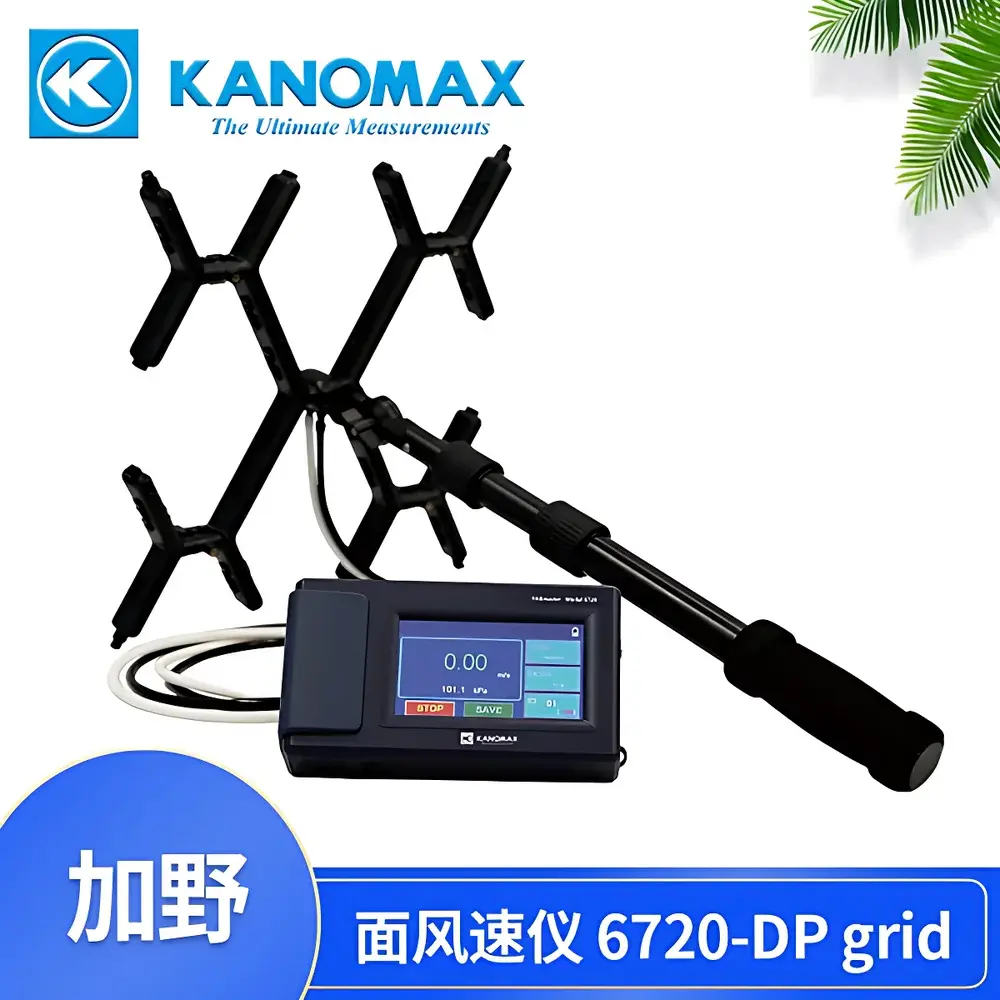
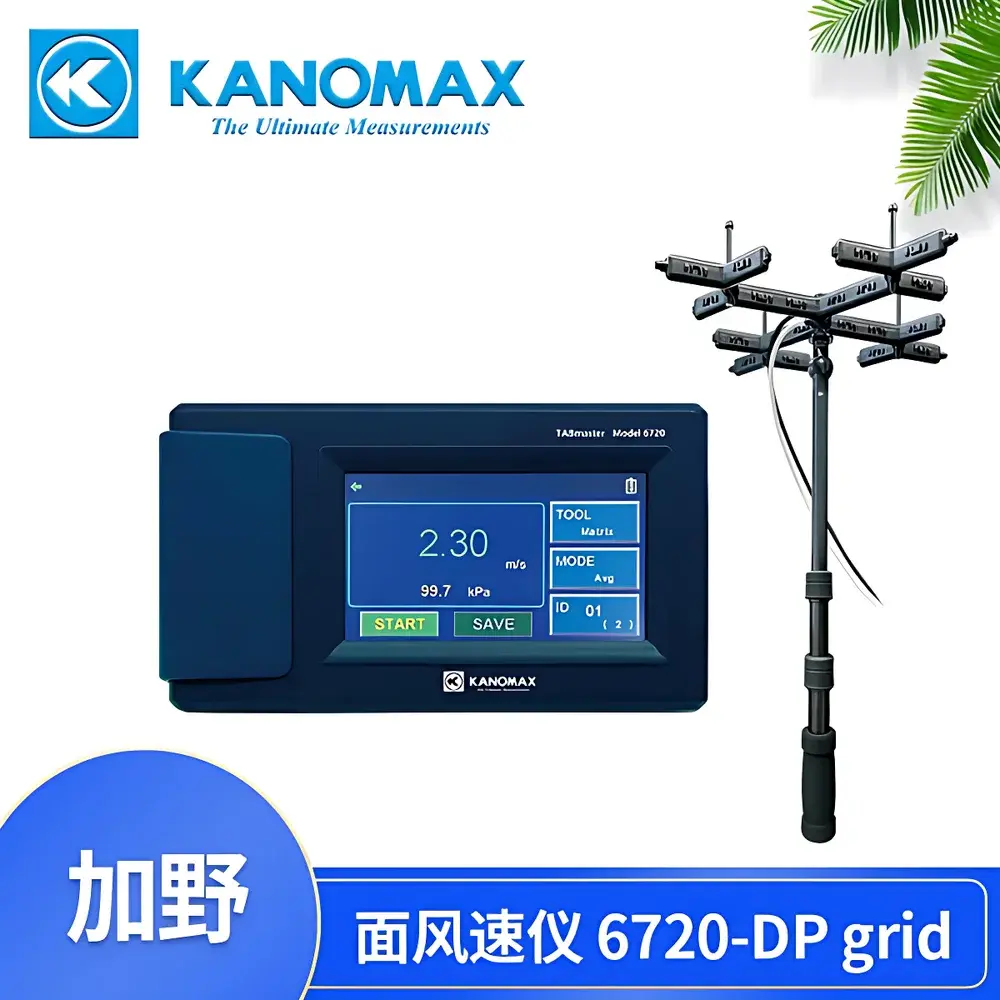
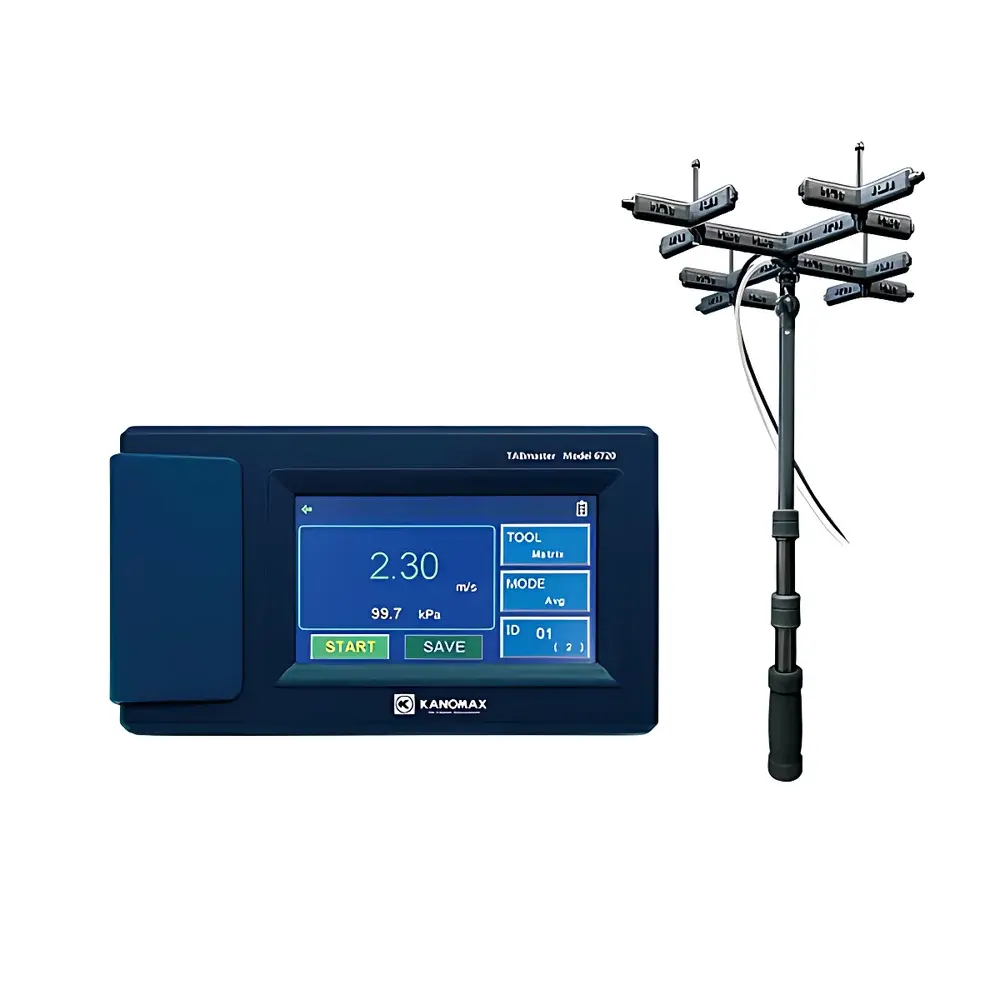
KANOMAX 6720-DP Grid Multi-Parameter Air Velocity & Differential Pressure Analyzer for Biosafety Cabinet Certification
| Brand | KANOMAX |
|---|---|
| Origin | Japan |
| Model | 6720-DP Grid |
| Instrument Type | Pitot Tube-Based Anemometer with Grid Probe Array |
| Resolution | 0.01 m/s (velocity), 0.001 Pa (differential pressure), 1 m³/h (airflow) |
| Measurement Range | 0.15–40 m/s (pitot tube), 0.15–15 m/s (grid probe), −2500 to +2500 Pa (ΔP), 40–4300 m³/h (airflow) |
| Accuracy | ±3% ±0.05 m/s (velocity >0.25 m/s), ±3% ±8 m³/h (airflow >85 m³/h), ±1.5% ±0.25 Pa (ΔP) |
| Operating Temperature | 0–60 °C (non-condensing) |
| Operating Humidity | 0–100 %RH |
| Battery Life | ~14 h (4 × AA alkaline) |
| Display | 4.3-inch full-color capacitive touchscreen |
| Data Storage | 8,000 records (device), 10,000 records (mobile app) |
| Connectivity | Bluetooth 5.0, USB-C, optional thermal printer support |
Overview
The KANOMAX 6720-DP Grid is a purpose-engineered, multi-parameter environmental verification instrument designed specifically for compliance-driven airflow validation in biosafety cabinets (BSCs), laminar flow hoods, and other critical containment enclosures. It operates on dual-sensor principles: pitot tube-based total pressure differential measurement for high-velocity point sampling (up to 40 m/s), and a 3×3 or 5×5 grid probe array for spatially resolved face velocity mapping—enabling simultaneous capture of mean face velocity, uniformity index, and inflow/exhaust velocity profiles per NSF/ANSI 49 and EN 12469 requirements. The integrated differential pressure sensor (±2500 Pa range) supports real-time monitoring of cabinet static pressure differentials—essential for verifying inward airflow integrity and filter loading status. Its architecture complies with ISO/IEC 17025 traceability frameworks when used with NIST-traceable calibration certificates, and supports audit-ready documentation workflows required under GLP, GMP, and CLIA-regulated laboratory environments.
Key Features
- Simultaneous triple-parameter acquisition: air velocity (pitot + grid), volumetric airflow (calculated from grid velocity and effective area), and differential pressure—all synchronized and timestamped.
- 4.3-inch high-resolution capacitive touchscreen with intuitive icon-driven UI optimized for glove-compatible operation in PPE-restricted lab settings.
- On-device K-factor adjustment for pitot tube calibration correction across varying duct geometries and fluid densities—critical for accurate velocity-to-flow conversion in non-standard BSC exhaust configurations.
- Auto-ranging differential pressure sensor with 0.001 Pa resolution enables detection of subtle pressure drifts indicative of HEPA filter degradation or sash position instability.
- Bluetooth 5.0 connectivity with native iOS/Android companion application supporting remote configuration, live data streaming, and offline firmware updates without physical cable dependency.
- Dual-layer data retention: 8,000 local records (including metadata: date/time, operator ID, location tag, sash height, ambient T/RH) and 10,000 cloud-synced entries via encrypted mobile app export.
- Low-power architecture with intelligent sleep mode activation after 90 seconds of inactivity—extending battery life to ≥14 hours on standard AA alkaline cells.
Sample Compatibility & Compliance
The 6720-DP Grid is validated for use with Class I, II (A2, B2), and III biosafety cabinets per NSF/ANSI 49-2022 Section 6.3 (Face Velocity Testing) and Annex D (Inflow Velocity Mapping). Its grid probe conforms to the 100 mm² minimum sampling area requirement for uniformity assessment, while the pitot tube meets ISO 10780:2022 dimensional tolerances for stagnation pressure sensing. All measurement uncertainties are quantified per ISO/IEC 17025:2017 Clause 7.6.3 and documented in KANOMAX’s accredited calibration certificate (JCSS-certified, traceable to NMIJ/AIST). The device supports configurable pass/fail thresholds aligned with EU GMP Annex 1 (2022) airflow uniformity limits (±20% of mean) and USP environmental monitoring criteria.
Software & Data Management
The bundled KANOMAX AirFlow Manager software (Windows/macOS) and mobile application provide FDA 21 CFR Part 11-compliant audit trails—including electronic signatures, user access levels (admin/operator/viewer), and immutable record locking. Raw data exports are generated in CSV and PDF formats with embedded metadata (GPS coordinates optional via mobile app), supporting integration into LIMS platforms via RESTful API. All stored records include ISO 8601 timestamps, battery voltage logs, and sensor health flags—enabling root-cause analysis during regulatory inspections. Calibration history, probe serial numbers, and environmental condition logs are automatically appended to each test report.
Applications
- Annual certification and routine performance verification of biosafety cabinets according to NSF/ANSI 49, EN 12469, and ISO 14644-3.
- Validation of fume hood face velocity and bypass airflow in chemical laboratories (per ANSI/AIHA Z9.5).
- Commissioning and recommissioning of cleanroom supply/exhaust systems requiring multi-point velocity profiling.
- Troubleshooting airflow turbulence, recirculation zones, or sash-induced velocity distortion in containment devices.
- Supporting ISO 13485 quality system documentation for medical device manufacturing facilities.
- Academic and clinical research labs requiring reproducible, auditable airflow datasets for method validation studies.
FAQ
Does the 6720-DP Grid meet NSF/ANSI 49 requirements for BSC face velocity testing?
Yes—it supports both single-point (pitot) and multi-point (grid) measurement modes with resolution and accuracy exceeding the standard’s ±0.02 m/s reporting requirement.
Can the grid probe be calibrated independently from the pitot tube?
Yes; each probe type has separate calibration coefficients stored in non-volatile memory, allowing independent traceable recalibration without affecting the other sensor channel.
Is Bluetooth printing supported with third-party thermal printers?
Only KANOMAX-certified Bluetooth printers (e.g., KP-200 series) are fully compatible due to proprietary command protocol handling for real-time print formatting and unit labeling.
What is the maximum allowable ambient humidity for differential pressure measurement?
Operation is rated up to 100 %RH at temperatures ≤40 °C; above 40 °C, condensation risk requires active dehumidification or enclosure-level climate control.
How is measurement uncertainty reported in exported data files?
Each record includes expanded uncertainty (k=2) calculated per GUM (JCGM 100:2008) using combined Type A (repeatability) and Type B (calibration, resolution, environmental) components.
Related Products







