
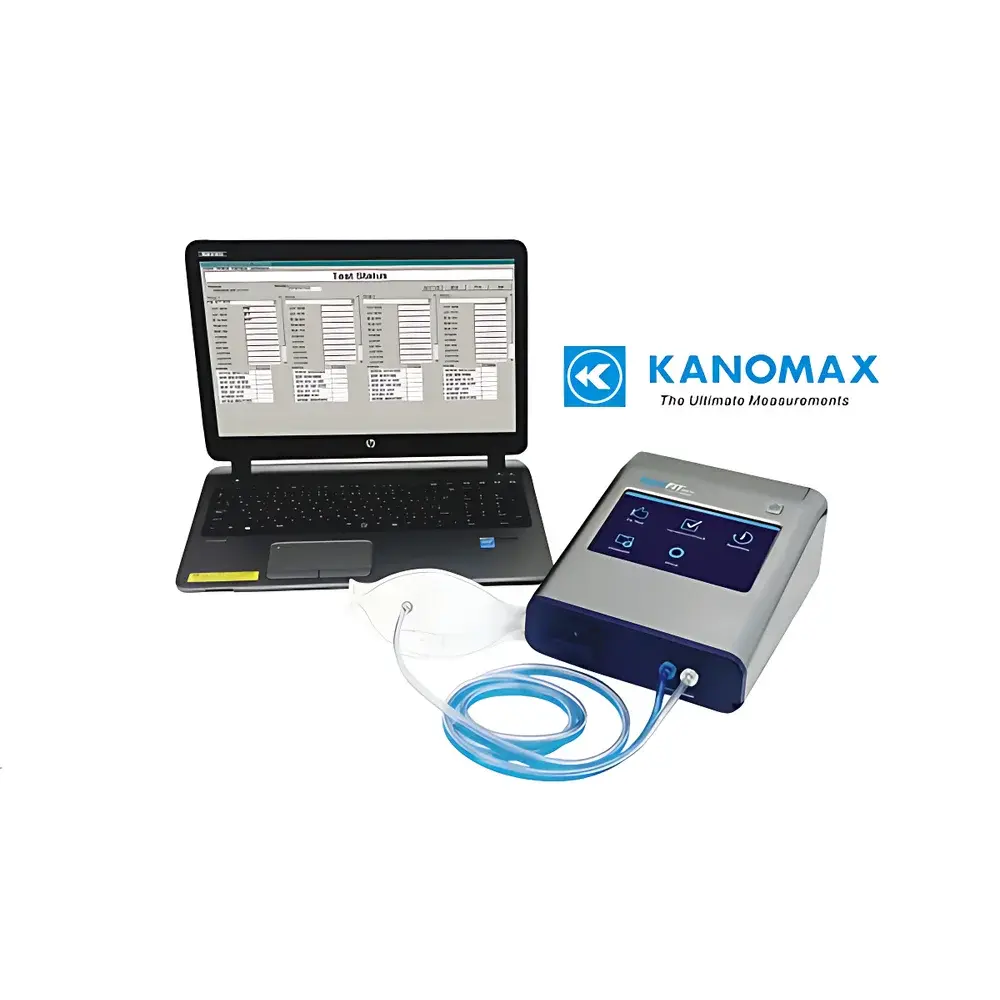
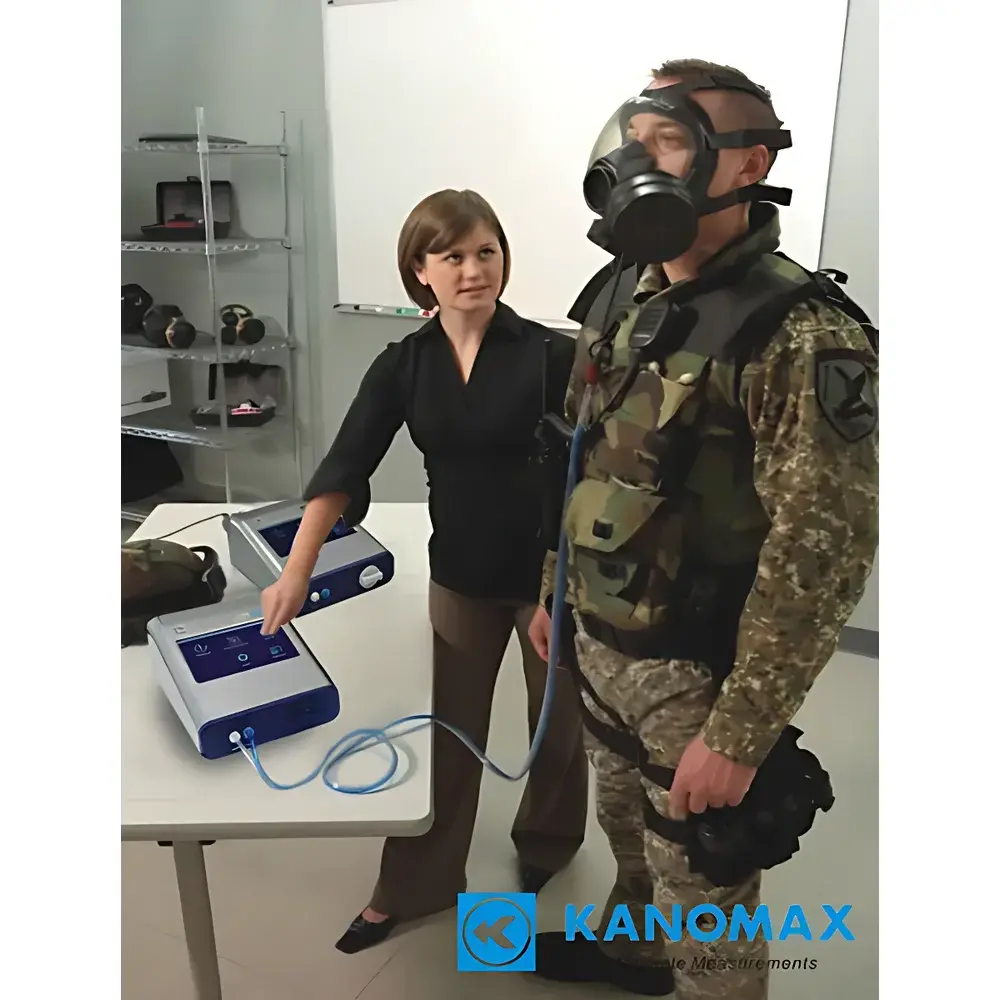
Kanomax AccuFIT 9000 Quantitative Respirator Fit Tester
| Brand | Kanomax |
|---|---|
| Origin | Japan |
| Model | Kanomax 3000-0C |
| Concentration Range | 0–100,000 particles/cm³ |
| Particle Size Range | 0.02–1.0 µm |
| Sampling Flow Rate | 100 cm³/min |
| Total Flow Rate | 700 cm³/min |
| Fit Factor Calculation Method | Direct (Cout/Cin) |
| Test Aerosol | 99.5% ethanol + analytical-grade isopropanol |
| Display | 7-inch true-color touchscreen |
| Communication Interfaces | USB (Host ×2, Device ×1), Ethernet ×1, Wi-Fi enabled |
| Language Options | English, French, Spanish, Portuguese, Chinese |
| Operating Temperature | 15–35 °C |
| Power Supply | AC 110–240 V, 50/60 Hz |
| Dimensions | 208 × 117 × 262 mm |
| Weight | 2.1 kg |
Overview
The Kanomax AccuFIT 9000 is a quantitative respirator fit tester engineered for precision, repeatability, and regulatory compliance in occupational health and clinical safety programs. It employs the ambient aerosol condensation nuclei counter (CNC) method—recognized by OSHA, CSA, and ISO 16900-1—to measure real-time particle concentration both outside (Cout) and inside (Cin) a respirator during wearer movement. The resulting fit factor (FF = Cout/Cin) provides an objective, numerical assessment of facepiece seal integrity across dynamic tasks including head tilting, talking, bending, and deep breathing. Unlike qualitative methods (e.g., saccharin or irritant smoke tests), the AccuFIT 9000 delivers traceable, auditable, and statistically robust data required under GLP-aligned workflows and regulatory enforcement frameworks—including U.S. OSHA 1910.134, Canadian CSA Z94.4, and China’s GB 2626–2019 and GB 19083–2010 standards.
Key Features
- Real-time CNC-based particle counting with dual-channel optical detection (0.02–1.0 µm), eliminating reliance on external challenge aerosols or generated smoke
- Integrated ethanol/isopropanol aerosol generation system with precise vapor-phase control—no compressed air or external nebulizers required
- Automated fit factor calculation per OSHA protocol: eight standardized exercises performed over two test cycles, each yielding individual and overall TIL (Total Inward Leakage) values
- 7-inch high-resolution capacitive touchscreen with intuitive icon-driven UI; supports five languages (English, French, Spanish, Portuguese, Chinese) without firmware reload
- Multi-unit network operation: one Windows PC can simultaneously manage up to four AccuFIT 9000 units via Ethernet or Wi-Fi, enabling high-throughput testing in industrial hygiene labs or hospital PPE validation centers
- Comprehensive I/O architecture: three USB ports (two host, one device), Gigabit Ethernet, dedicated environmental and sampling ports, and embedded Wi-Fi module compliant with IEEE 802.11 b/g/n
- On-device data storage plus direct export to Microsoft Excel (.xlsx) format—no proprietary software installation required for basic reporting
Sample Compatibility & Compliance
The AccuFIT 9000 validates fit performance across all classes of negative-pressure particulate respirators, including disposable filtering facepieces (N95, N99, N100, KN90, KN95, KP100), reusable half-mask and full-face elastomeric respirators, and surgical N95-equivalent medical masks per GB 19083–2010. Its measurement methodology satisfies the quantitative fit test requirements of ISO 16900-1:2016 (Respiratory protective devices — Methods of testing fit — Part 1: Determination of fit factor), ASTM F1885–22 (Standard Practice for Respirator Fit Testing Using Ambient Aerosol), and EN 13272:2021 (Respiratory protective devices — Fit testing — Qualitative and quantitative methods). For regulatory alignment, the instrument supports audit-ready recordkeeping with timestamped test logs, operator ID entry, and configurable pass/fail thresholds per standard-specific TIL limits (e.g., FF ≥ 100 for N95, FF ≥ 500 for PAPRs).
Software & Data Management
Data acquisition and reporting operate natively within the instrument’s embedded Linux OS—no third-party drivers or runtime dependencies. All test sequences are stored locally with metadata including date/time, operator ID, subject ID, respirator model, exercise sequence, raw Cout/Cin time-series, calculated FF per exercise, and composite overall fit factor. Export options include USB flash drive transfer and network-based push to shared folders or LIMS endpoints. While standalone operation is fully functional, optional PC-based Kanomax FitManager™ software (sold separately) adds advanced capabilities: multi-user role-based access control, electronic signature support compliant with FDA 21 CFR Part 11, automated PDF report generation with digital watermarking, and integration with enterprise HRIS or EHS platforms via RESTful API.
Applications
- Occupational health departments conducting mandatory annual respirator fit testing per OSHA 1910.134 and MSHA regulations
- Hospital infection control units validating surgical N95 and powered air-purifying respirators (PAPRs) against GB 19083–2010 and ISO 13485 QMS requirements
- Industrial hygiene laboratories performing comparative fit assessments across respirator models, sizes, and facial anthropometries
- Regulatory inspection agencies executing third-party conformity verification for domestic and imported PPE certification (e.g., CNCA, NIOSH, Health Canada)
- Academic research in aerosol science, ergonomics, and respiratory protection efficacy—supporting peer-reviewed publication with traceable metrology
FAQ
What aerosol does the AccuFIT 9000 use for testing?
It generates a stable, submicron ethanol/isopropanol condensation nuclei aerosol in situ—no external aerosol generators, compressed air sources, or hazardous challenge agents required.
Does it meet Chinese national standards for medical mask fit testing?
Yes—it complies with GB 19083–2010 (Medical Protective Masks) and GB 2626–2019 (Self-Contained Filtering Particulate Respirators), including the ≥100 total fit factor requirement for KN95/N95 equivalents.
Can test data be integrated into a laboratory information management system (LIMS)?
Yes—via Ethernet or USB, raw CSV/Excel files are exported with full metadata; optional FitManager™ software provides HL7/FHIR-compatible API integration.
Is calibration traceable to national standards?
Instrument calibration is performed using NIST-traceable reference aerosols and flow meters; certificate of conformance includes uncertainty budgets per ISO/IEC 17025 guidelines.
What maintenance is required between tests?
Routine cleaning of the sampling probe and alcohol reservoir; zero-count verification using included HEPA filter; no consumables beyond analytical-grade ethanol and isopropanol.
Related Products







