
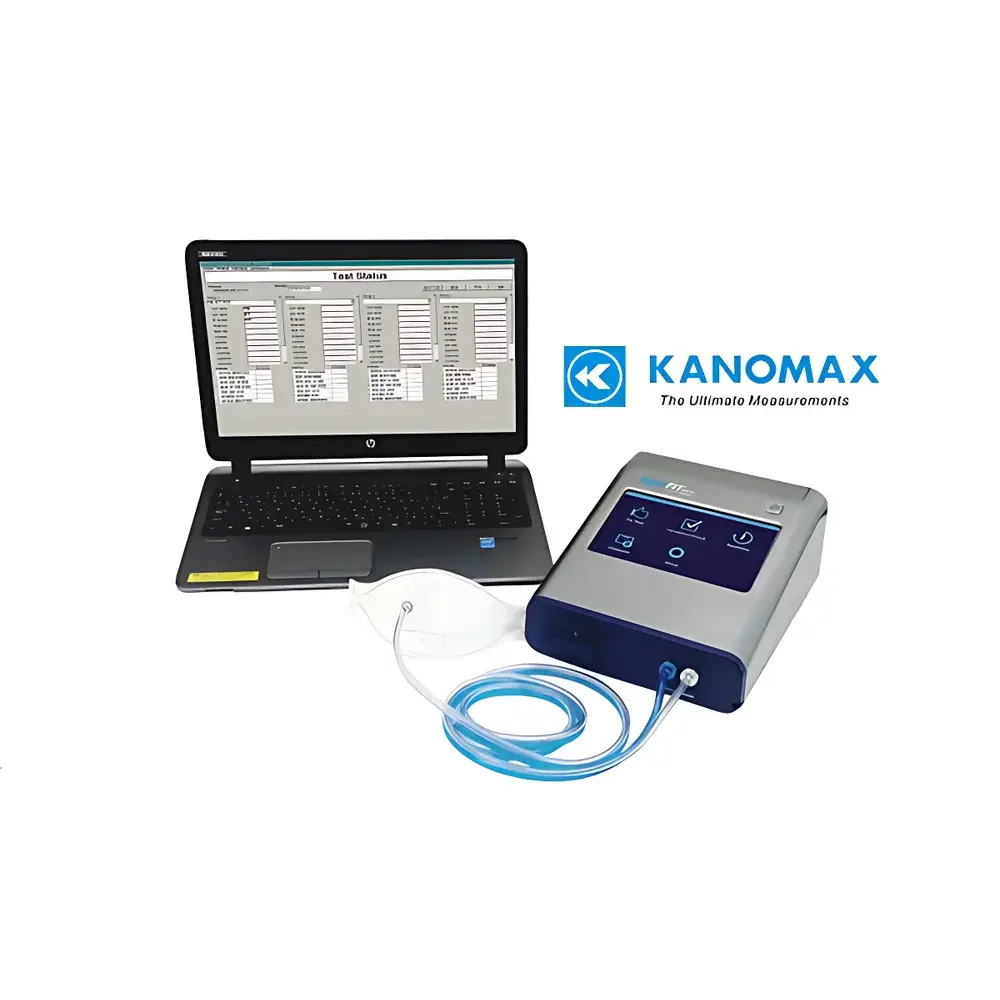
Kanomax AccuFIT 9000 Respirator Fit Testing System
| Brand | Kanomax |
|---|---|
| Origin | Japan |
| Model | AccuFIT 9000 |
| Compliance | GB 2626–2019, GB 19083–2010, OSHA 1910.134, CSA Z94.4, ISO 16900-1/3 |
Overview
The Kanomax AccuFIT 9000 is a quantitative respirator fit testing system engineered for precision, repeatability, and regulatory compliance in occupational health and clinical safety programs. It employs Controlled Negative Pressure (CNP) technology — a method standardized under ISO 16900-1 and widely accepted by OSHA and CSA — to measure the total inward leakage (TIL) of airborne particulates during real-time wearer movement protocols. Unlike qualitative methods relying on subjective sensory response, the AccuFIT 9000 delivers objective, numerical fit factors (FF) by dynamically comparing ambient aerosol concentration with intramask concentration across eight standardized test exercises (e.g., normal breathing, deep breathing, head side-to-side, head up-and-down, talking, grimacing, bending over, and normal breathing again). This enables traceable, auditable verification that respirators—including N95, KN95, FFP2, P3, and elastomeric half/full-facepiece respirators—achieve minimum required fit factors (e.g., FF ≥ 100 for N95/KN95 per GB 2626–2019 and OSHA 1910.134).
Key Features
- Quantitative CNP-based methodology compliant with ISO 16900-1, ISO 16900-3, and ASTM F3085-15
- Real-time TIL calculation and fit factor reporting with ≤ ±5% measurement uncertainty (per manufacturer validation data)
- Support for all major respirator types: disposable filtering facepieces (N95, KN90/95/100, FFP1/2/3), reusable elastomeric half-masks, full-face respirators, and powered air-purifying respirators (PAPRs)
- Integrated dual-sensor architecture: calibrated photometer for ambient particle monitoring and high-stability pressure transducer for mask chamber differential pressure control
- Multi-language interface (English, Japanese, Chinese, French, German) with intuitive touchscreen navigation
- Flexible deployment: standalone operation or networked control via USB 2.0, Ethernet (TCP/IP), or optional Wi-Fi module
- Simultaneous multi-unit management: one host PC can coordinate up to four AccuFIT 9000 units for high-throughput facility-wide testing
- Onboard data logging with timestamped test records, operator ID, respirator model, subject ID, and pass/fail status
Sample Compatibility & Compliance
The AccuFIT 9000 is validated for use with respirators certified to international performance standards including NIOSH 42 CFR Part 84 (N/R/P series), GB 2626–2019 (KN/KP series), EN 149:2001+A1:2009 (FFP classes), and AS/NZS 1716:2012. It meets the technical requirements for quantitative fit testing specified in OSHA 1910.134 Appendix A, CSA Z94.4–22 Clause 6.4.2, and China’s GB 19083–2010 Annex B. The system supports both pass/fail assessment per regulatory thresholds (e.g., FF ≥ 100 for KN95/N95; FF ≥ 500 for P3/FFP3) and granular TIL reporting for internal quality assurance and GLP-aligned documentation. All firmware and calibration routines are designed to support audit readiness under FDA 21 CFR Part 11 (when used with validated software configurations) and ISO/IEC 17025-accredited laboratory environments.
Software & Data Management
Kanomax FitManager™ software (v3.2+) provides secure, role-based test administration, automated report generation (PDF/CSV), and long-term database archiving. Each test record includes digital signatures, electronic audit trails, and configurable retention policies aligned with occupational health recordkeeping mandates (e.g., OSHA 1910.134(f)(3), GBZ/T 229.2–2010). Data export supports integration with enterprise HRIS, EHS platforms, and LIMS systems via HL7 or RESTful API extensions. Software updates maintain alignment with evolving standards — including recent revisions to ISO 16900-1:2023 and CSA Z94.4–22 — and include built-in calibration verification logs traceable to NIST-traceable reference instruments.
Applications
- Hospital infection control programs validating surgical N95 and medical-grade KN95 respirators for healthcare workers
- Manufacturing and construction sites conducting annual or task-specific respirator fit certification per OSHA and local labor safety regulations
- Fire departments and emergency response teams verifying SCBA facepiece seal integrity prior to hazardous materials operations
- Pharmaceutical and biotech cleanroom facilities ensuring personnel compliance with ISO 14644-1 Class 5–8 gowning protocols
- Government and third-party testing laboratories performing accredited respirator certification and conformity assessment
- Academic research on facial anthropometry, respirator design optimization, and inhalation toxicology exposure modeling
FAQ
What respirator standards does the AccuFIT 9000 support for quantitative fit testing?
The system is validated for NIOSH-certified N/R/P-series respirators, GB 2626–2019 KN/KP-class masks, EN 149 FFP1/2/3, and AS/NZS 1716 P1/P2/P3. Fit factor thresholds align with each standard’s regulatory requirements.
Is the AccuFIT 9000 compliant with FDA 21 CFR Part 11 for electronic records?
When deployed with Kanomax FitManager™ v3.2+ under configured audit trail, electronic signature, and access control settings, the system supports Part 11 compliance for regulated GxP environments.
Can the instrument be used for both initial fit testing and periodic retesting?
Yes — the protocol library includes OSHA-mandated initial fit test sequences as well as abbreviated retest modes for post-fitting verification following facial changes, weight fluctuation, or respirator model updates.
Does the system require external aerosol generation?
No — unlike ambient aerosol (AA) or generated aerosol (GA) methods, the CNP principle eliminates dependency on challenge aerosols, reducing consumables, cross-contamination risk, and environmental variability.
How is calibration maintained and verified?
The unit performs automatic self-diagnostics at startup. Annual calibration is recommended using Kanomax-certified service kits traceable to national metrology institutes; calibration certificates include uncertainty budgets per ISO/IEC 17025 requirements.
Related Products







