
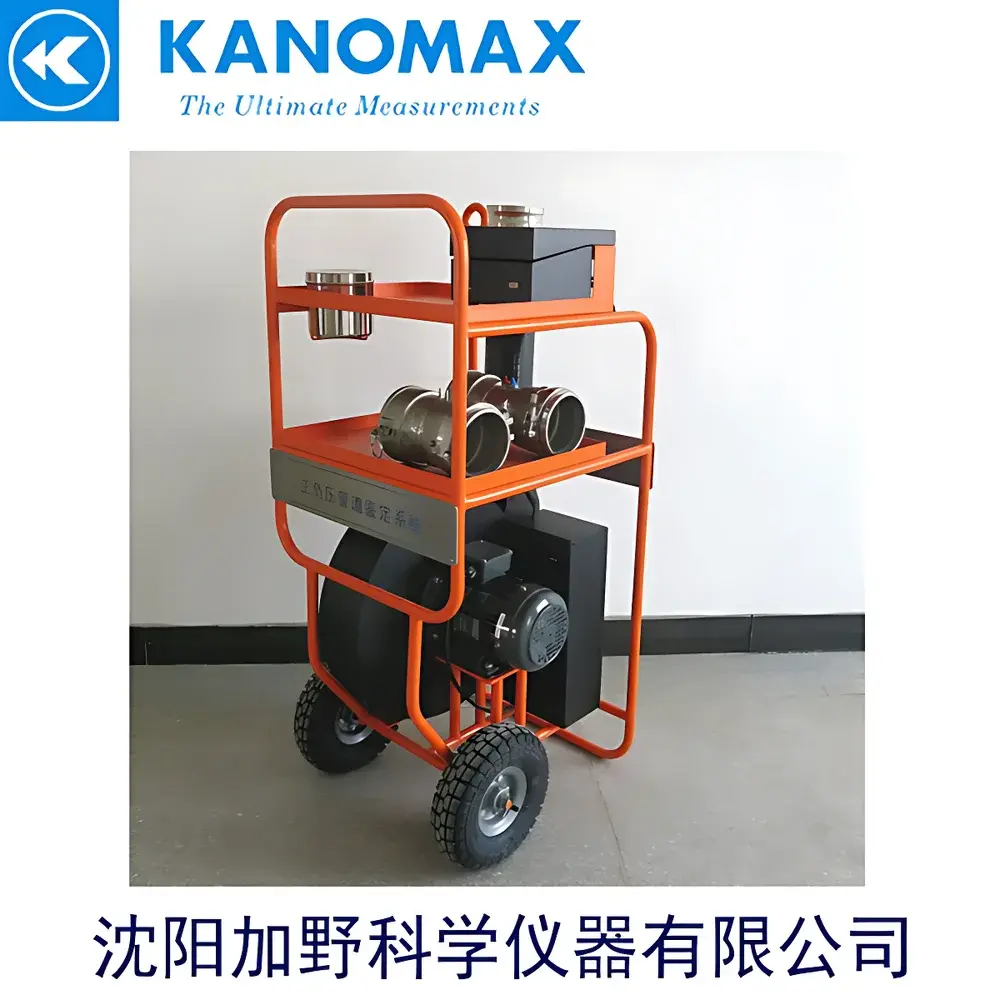
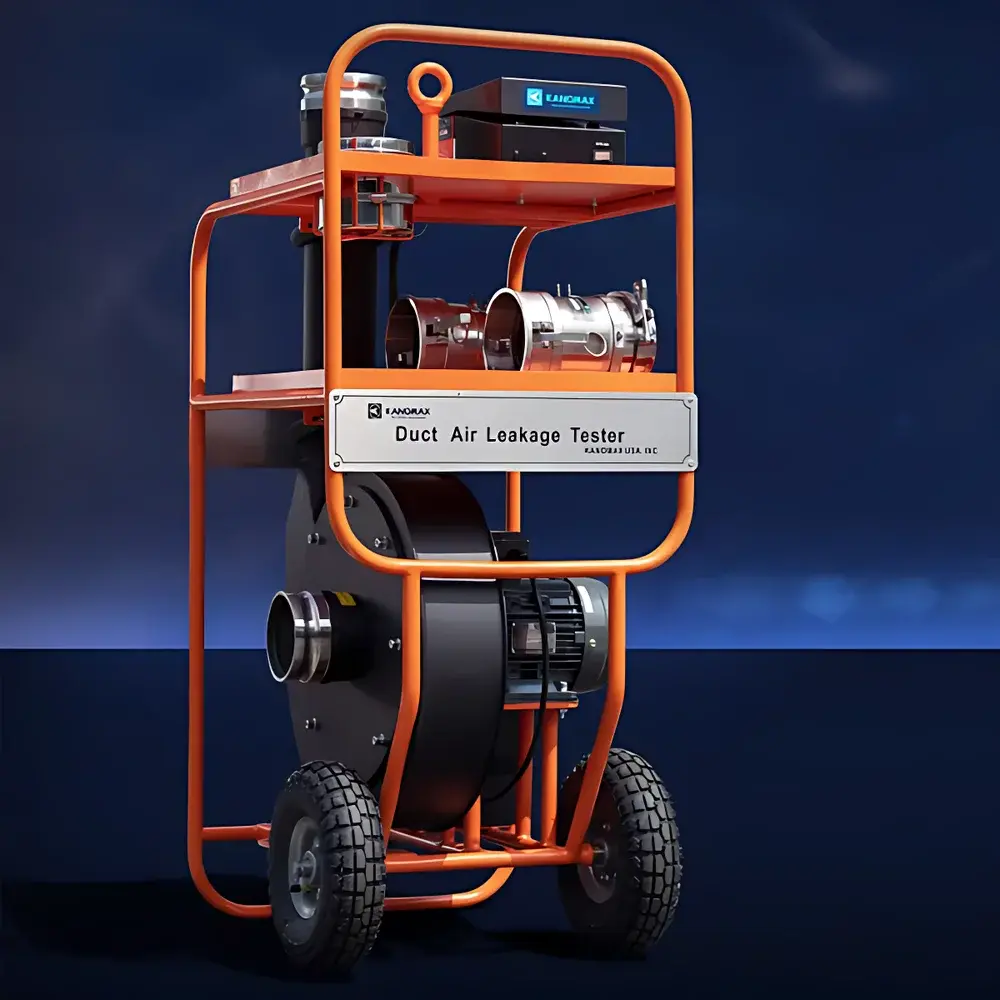
KANOMAX DALT6900 Duct Air Leakage Tester
| Brand | KANOMAX |
|---|---|
| Origin | Liaoning, China |
| Manufacturer Type | Authorized Distributor |
| Country of Origin | China |
| Model | DALT6900 |
| Pricing | Upon Request |
| Flow Range | 36–640 m³/h (main channel), 4–36 m³/h (nozzle bank) |
| Flow Accuracy | ±2.5% of reading ±0.1 m³/h |
| Flow Resolution | 0.01 m³/h |
| Static Pressure Range | ±2500 Pa |
| Pressure Accuracy | ±1% of reading ±1 Pa |
| Pressure Resolution | 0.1 Pa |
| Temperature Range | 0–60 °C |
| Temp Accuracy | ±0.5 °C |
| Temp Resolution | 0.1 °C |
| Barometric Pressure Range | 70–130 kPa |
| Baro Accuracy | ±2% of reading |
| Baro Resolution | 0.1 kPa |
| Power Supply | DALT6900-0E: 110–120 V, 1-phase, 50/60 Hz, 16 A |
| DALT6900-1E | 220–240 V, 1-phase, 50/60 Hz, 10 A |
| Net Weight | ~72 kg |
| Dimensions (W×D×H) | 540 × 500 × 1200 mm |
| Data Storage | 1000 test records |
Overview
The KANOMAX DALT6900 Duct Air Leakage Tester is a precision-engineered instrument designed for quantitative assessment of air leakage in HVAC duct systems under controlled positive and negative static pressure conditions. It operates on the principle of calibrated orifice flow measurement—utilizing dual-path airflow quantification (main channel + multi-nozzle bank) to achieve high reproducibility across a broad dynamic range (36–640 m³/h). The system complies with internationally recognized duct leakage testing protocols, including ASTM E1554, ISO 16813, and EN 12599, enabling verifiable compliance with building energy codes (e.g., ASHRAE 90.1, IECC) and commissioning standards (e.g., BCxA Guideline, NEBB Procedural Standards). Its integrated pressure regulation, real-time environmental compensation (temperature, barometric pressure), and traceable flow calibration ensure measurement integrity throughout the full operational envelope—from low-flow nozzle-based verification to high-capacity system-level validation.
Key Features
- Dual-range airflow measurement architecture: main channel (36–640 m³/h) and precision nozzle bank (4–36 m³/h), optimized for both coarse system-level and fine segment-level leakage detection
- Simultaneous real-time monitoring of leakage volume, static pressure (±2500 Pa), ambient temperature (0–60 °C), and barometric pressure (70–130 kPa)
- High-resolution digital display: 4.7-inch color LCD touchscreen with intuitive icon-driven interface, supporting multilingual UI configuration
- Onboard data management: 1000-test storage capacity with timestamped records; export via USB to CSV-compatible formats for audit-ready reporting
- Robust mechanical design: modular aluminum chassis, vibration-damped base, and field-serviceable flow elements compliant with ISO/IEC 17025 maintenance intervals
- Pressure stability control: closed-loop feedback regulation maintains setpoint deviation ≤ ±1.5% during extended dwell tests per SMACNA leakage classification requirements
Sample Compatibility & Compliance
The DALT6900 accommodates rigid and flexible duct constructions—including galvanized steel, aluminum, fiberglass-reinforced polymer (FRP), and insulated flexible ducts—across rectangular, round, and oval cross-sections up to 2.5 m in equivalent diameter. It supports both pressurization and depressurization modes per SMACNA HVAC Air Duct Leakage Test Manual (3rd ed.) and ASHRAE Guideline 1–2022. All measurement algorithms incorporate automatic environmental compensation per ISO 5167-2:2003 (orifice discharge coefficient correction) and NIST-traceable reference standards. Device firmware and calibration certificates align with GLP documentation requirements and support FDA 21 CFR Part 11-compliant electronic record workflows when integrated with validated third-party laboratory information management systems (LIMS).
Software & Data Management
The embedded firmware enables standalone operation without external PCs. Test parameters—including test duration, pressure ramp rate, dwell time, pass/fail thresholds (per Class A/B/C duct sealing criteria), and operator ID—are programmable via touchscreen. Each stored record includes raw sensor outputs (flow, ΔP, T, Patm), calculated leakage rate (m³/h @ 250 Pa), and pass/fail status per selected standard. USB mass-storage mode allows direct transfer of .csv files containing all metadata and time-series snapshots at 1-Hz resolution. Optional KANOMAX DuctTest Suite (v3.x) provides advanced analytics: trend analysis across multiple duct sections, comparative leakage density mapping (L/s/m²), and automated report generation compliant with LEED EQc1 and BREEAM Hea04 submission templates.
Applications
- Pre-commissioning verification of ductwork integrity prior to thermal insulation and ceiling closure
- Post-installation QA/QC audits for mechanical contractors working under design-build or performance-based contracts
- Periodic maintenance testing of aging HVAC infrastructure in hospitals, laboratories, and cleanrooms where air containment is critical
- Energy retrofit assessments quantifying potential fan energy savings from leakage mitigation
- Third-party commissioning agent validation for ASHRAE Standard 202–2022 and ISO 16813–2019 conformance
- Academic and vocational training in HVAC system diagnostics and building science curricula
FAQ
What duct leakage classes does the DALT6900 support?
It validates compliance with SMACNA Class A (tightest), B (moderate), and C (standard) leakage limits, with configurable pass/fail thresholds for both supply and return duct systems.
Is calibration traceable to national standards?
Yes—factory calibration is performed against NIST-traceable primary standards; certificate includes uncertainty budgets per ISO/IEC 17025 Annex A.3.
Can the device operate unattended during long-duration tests?
Yes—built-in battery-backed real-time clock and non-volatile memory retain settings and data during power interruption; auto-resume functionality restores pre-interruption test state.
Does it meet requirements for LEED or BREEAM certification submissions?
All generated reports include mandatory metadata (tester ID, location, date/time, environmental conditions, standard referenced) required by LEED v4.1 BD+C EQ Prerequisite 1 and BREEAM Hea04.
How often is recalibration recommended?
Annual recalibration is advised per ISO/IEC 17025 and manufacturer guidelines; interval may be extended to 18 months with documented interim verification using certified check standards.
Related Products







