
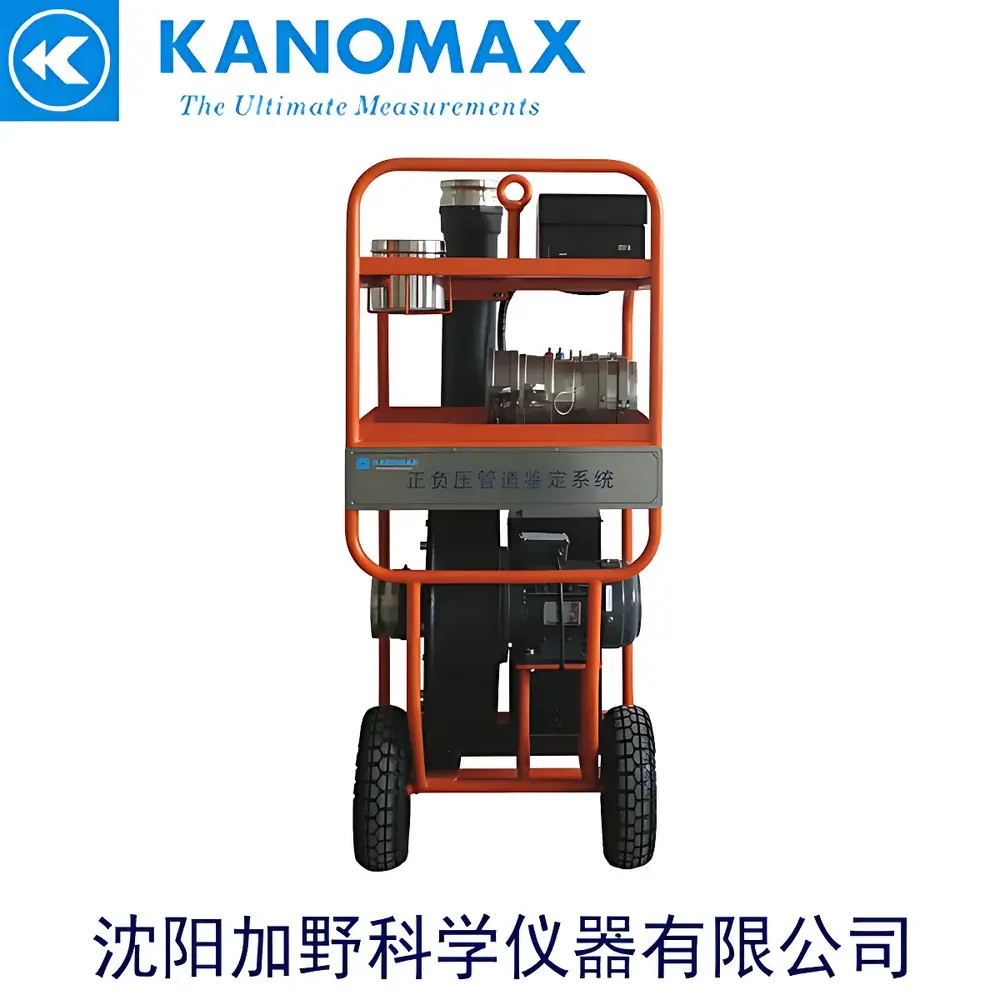
Kanomax DALT6900 Duct Air Leakage Tester
| Brand | Kanomax |
|---|---|
| Model | DALT6900 |
| Origin | China (Liaoning) |
| Power Supply | DALT6900-0E: 110–120 V, 1Φ, 50/60 Hz, 16 A |
| DALT6900-1E | 220–240 V, 1Φ, 50/60 Hz, 10 A |
| Airflow Range | 36–640 m³/h (main channel), 4–36 m³/h (nozzle bank) |
| Accuracy | ±2.5% of reading ±0.1 m³/h (airflow) |
| Resolution | 0.01 m³/h (airflow), 0.1 Pa (pressure), 0.1 °C (temperature), 0.1 kPa (atmospheric pressure) |
| Static Pressure Range | ±2500 Pa |
| Temperature Range | 0–60 °C |
| Atmospheric Pressure Range | 70–130 kPa |
| Data Storage | 1000 test records |
| Display | 4.7-inch color LCD touchscreen |
| Dimensions | 540 × 500 × 1200 mm |
| Net Weight | ~72 kg |
| Compliance Standards | EN 1507:2006, EN 12237:2002, Eurovent 2/2, DW/143, SMACNA HVAC Air Duct Construction Standards, GB 50243–2002 |
Overview
The Kanomax DALT6900 Duct Air Leakage Tester is a precision-engineered instrument designed for quantitative assessment of air leakage in HVAC duct systems under controlled positive and negative static pressure conditions. It operates on the principle of calibrated orifice flow measurement—using a dual-range airflow system comprising a primary blower channel (36–640 m³/h) and a high-sensitivity nozzle bank (4–36 m³/h)—to deliver traceable, repeatable volumetric leakage quantification across wide pressure differentials (±2500 Pa). The device integrates real-time environmental compensation (temperature, atmospheric pressure, and static pressure) to ensure measurement integrity per international duct airtightness protocols. Its architecture adheres to the physical requirements of pressurization testing as defined in EN 1507 and EN 12237, making it suitable for commissioning verification, post-installation QA/QC, and regulatory compliance audits in commercial, institutional, and industrial HVAC infrastructure.
Key Features
- Dual-range airflow measurement system with automatic range switching for optimal resolution across low- and high-leakage scenarios
- Integrated environmental sensors: high-stability temperature sensor (±0.5 °C), absolute pressure transducer (70–130 kPa, ±2%), and differential static pressure module (±2500 Pa, ±1% ±1 Pa)
- 4.7-inch full-color resistive touchscreen interface with intuitive menu navigation, real-time graphical display of leakage rate vs. pressure curve, and on-screen pass/fail evaluation per selected standard
- Onboard data logging capacity for up to 1000 complete test records—including date/time stamp, pressure setpoint, measured leakage volume, ambient conditions, and user-defined project ID
- Rugged field-deployable chassis (72 kg net weight, 540 × 500 × 1200 mm footprint) with integrated caster base and modular blower assembly for rapid setup on-site
- Compliance-ready reporting: all measurements traceable to SI units; calibration certificates available per ISO/IEC 17025-accredited procedures
Sample Compatibility & Compliance
The DALT6900 is validated for use on rigid and semi-rigid ductwork assemblies—including galvanized steel, aluminum, fiberglass-reinforced plastic (FRP), and flexible insulated ducts—across rectangular, round, and oval cross-sections. It supports both sectional testing (e.g., individual duct runs or plenums) and whole-system pressurization (e.g., AHU-to-terminal network). Its test methodology satisfies mandatory airtightness verification requirements under EN 1507 (flexible ducts), EN 12237 (rigid ducts), Eurovent 2/2 (European certification framework), DW/143 (UK ductwork specification), SMACNA HVAC Air Duct Construction Standards (US commercial practice), and GB 50243–2002 (Chinese national code for ventilation and air conditioning engineering). While not inherently FDA- or GLP-regulated, its data integrity features—including timestamped audit trails and non-editable stored records—support alignment with ISO 9001 quality management system documentation requirements.
Software & Data Management
All test data are stored internally in non-volatile memory with immutable timestamps and parameter metadata. Users may browse, export (via USB 2.0 port), or delete individual records directly from the touchscreen interface. Exported files conform to CSV format for seamless import into Excel, MATLAB, or enterprise CMMS platforms. No proprietary software installation is required for basic operation; optional PC-based configuration utility (available upon request) enables advanced report templating, batch export, and firmware updates. The system maintains full traceability: each record includes operator ID (manually entered), test location tag, duct classification (A/B/C per EN 1507), pressure hold duration, and final pass/fail status derived from real-time comparison against the applicable leakage class limit.
Applications
- Pre-commissioning verification of ductwork airtightness prior to mechanical completion sign-off
- Post-installation QA/QC for HVAC contractors and third-party commissioning agents
- Periodic maintenance audits to quantify degradation in duct integrity over time
- Energy performance diagnostics—identifying excessive leakage contributing to fan energy waste and thermal load imbalance
- Regulatory submissions to building control authorities, green building certification bodies (e.g., LEED EA Prerequisite 1), and municipal inspection agencies
- Training and demonstration in HVAC technical education programs requiring hands-on leakage quantification methodology
FAQ
What standards does the DALT6900 support out-of-the-box?
The instrument’s firmware embeds calculation logic for EN 1507:2006, EN 12237:2002, Eurovent 2/2, DW/143, SMACNA, and GB 50243–2002—including automatic application of area-based leakage limits and pressure-dependent pass thresholds.
Can the DALT6900 test both supply and exhaust duct systems?
Yes—it performs bidirectional pressurization (positive and negative static pressure) without hardware reconfiguration, enabling leakage assessment of supply, return, exhaust, and relief duct networks.
Is external calibration required before first use?
The unit ships with factory calibration valid for 12 months; however, users must perform a zero-pressure and ambient temperature verification check using the built-in self-test routine prior to each test session.
How is measurement uncertainty managed during field use?
Uncertainty contributions from airflow, pressure, temperature, and atmospheric sensors are combined per GUM (Guide to the Expression of Uncertainty in Measurement) principles; total expanded uncertainty (k=2) is documented in the calibration certificate and remains within ±3.5% for typical duct leakage ranges.
Does the DALT6900 meet ISO/IEC 17025 traceability requirements?
When used with an accredited calibration certificate (available separately), the DALT6900 satisfies metrological traceability to national standards (e.g., NIST, PTB, or CNAS-designated labs) for ISO/IEC 17025-compliant laboratories conducting duct airtightness testing.







