
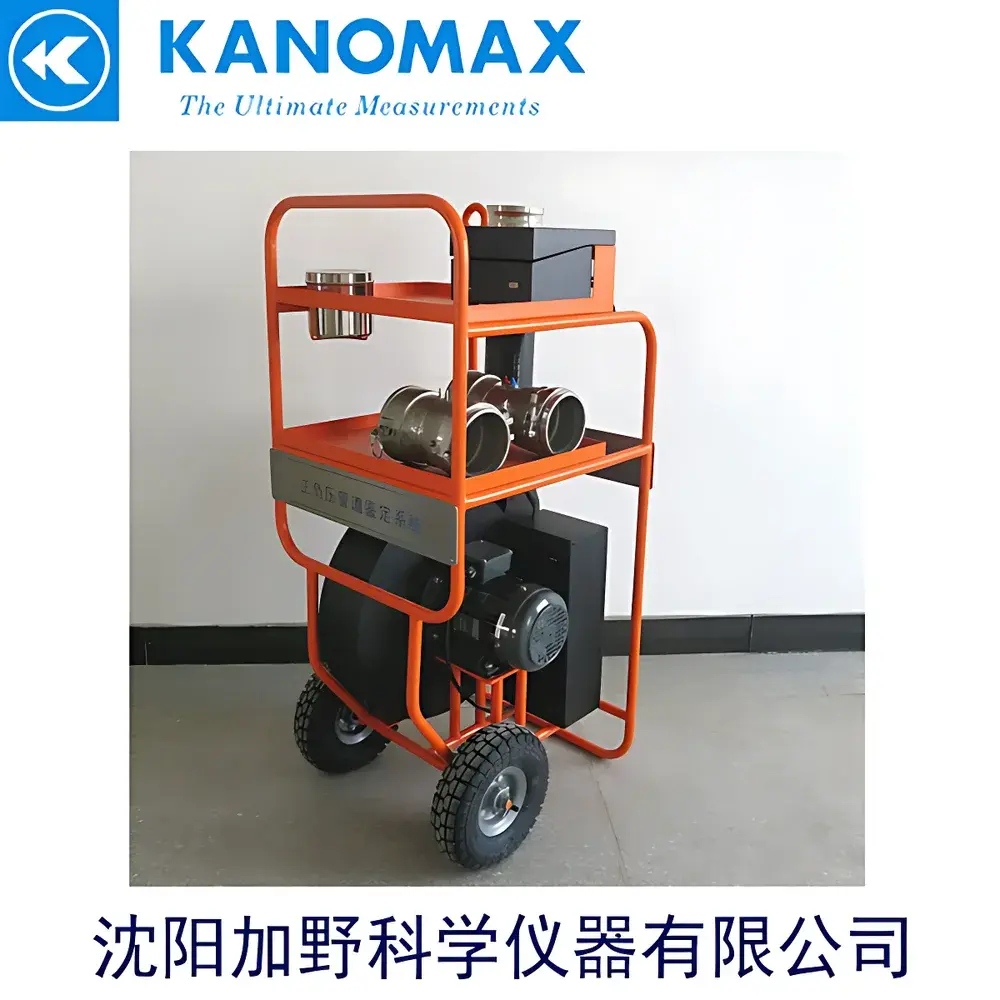
Kanomax DALT6900 Portable Duct Air Leakage Tester
| Brand | Kanomax |
|---|---|
| Origin | China (Liaoning) |
| Model | DALT6900 |
| Flow Range | 36–640 m³/h (nozzle mode: 4–36 m³/h) |
| Accuracy | ±2.5% of reading ±0.1 m³/h (flow), ±1% of reading ±1 Pa (static pressure) |
| Resolution | 0.01 m³/h (flow), 0.1 Pa (pressure), 0.1 °C (temperature), 0.1 kPa (barometric pressure) |
| Static Pressure Range | ±2500 Pa |
| Temperature Range | 0–60 °C |
| Barometric Pressure Range | 70–130 kPa |
| Power Supply | DALT6900-0E: 110–120 V, 1Φ, 50/60 Hz, 16 A |
| DALT6900-1E | 220–240 V, 1Φ, 50/60 Hz, 10 A |
| Net Weight | ~72 kg |
| Dimensions | 540 × 500 × 1200 mm |
| Data Storage | 1000 test records |
Overview
The Kanomax DALT6900 Portable Duct Air Leakage Tester is a precision-engineered instrument designed for quantitative assessment of air leakage in HVAC duct systems under controlled pressurization conditions. It operates on the principle of calibrated orifice flow measurement—applying either positive or negative static pressure to a sealed duct section while measuring volumetric airflow through a certified nozzle bank and auxiliary fan assembly. This method conforms to internationally recognized duct airtightness testing protocols, enabling objective verification of system integrity prior to commissioning or during post-installation quality assurance audits. The DALT6900 is not a qualitative smoke or tracer-gas detector; rather, it delivers traceable, repeatable quantitative data required for compliance with building energy codes, green certification schemes (e.g., LEED EA Prerequisite 1), and mechanical system handover documentation.
Key Features
- Full-range dual-mode airflow measurement: integrated high-capacity fan (36–640 m³/h) combined with precision low-flow nozzles (4–36 m³/h) ensures metrological accuracy across both large main ducts and small branch or terminal sections.
- Simultaneous real-time acquisition of four critical parameters: leakage airflow (m³/h), applied static pressure (Pa), ambient temperature (°C), and local barometric pressure (kPa)—all displayed on a 4.7-inch color TFT touchscreen with intuitive icon-based navigation.
- Compliance-ready test execution: preloaded test logic aligned with EN 1507:2006 (flexible ducts), EN 12237:2002 (rigid ducts), Eurovent 2/2, DW/143, SMACNA HVAC Air Duct Leakage Test Manual, and GB 50243–2002 (Chinese national standard for ventilation and air conditioning engineering).
- Onboard data management: stores up to 1000 complete test records—including date/time stamp, pressure setpoint, measured leakage, pass/fail status per selected standard, and operator ID—with export capability via USB interface for traceability and QA reporting.
- Robust field-deployable architecture: cast-aluminum frame, integrated transport wheels, and modular fan/nozzle assembly enable rapid setup and relocation between test sites without recalibration. Net weight (72 kg) and footprint (540 × 500 × 1200 mm) are optimized for elevator access and rooftop mechanical room deployment.
Sample Compatibility & Compliance
The DALT6900 is validated for use on rectangular, round, and oval ductwork constructed from galvanized steel, aluminum, fiberglass-reinforced plastic (FRP), and flexible insulated ducts—provided the test section is isolated and sealed per SMACNA or EN methodology. It supports both Class A (low-leakage), Class B (medium-leakage), and Class C (high-leakage) duct sealing classifications defined in EN 1507 and EN 12237. All pressure transducers are factory-calibrated against NIST-traceable standards, and the instrument’s measurement uncertainty budget complies with ISO/IEC 17025 requirements for accredited testing laboratories. For regulated environments (e.g., pharmaceutical cleanrooms, hospital HVAC), audit trails and electronic signature support can be implemented via optional software integration compliant with FDA 21 CFR Part 11.
Software & Data Management
Test data are stored internally with timestamp, GPS-assisted location tagging (via optional Bluetooth module), and configurable pass/fail thresholds per standard. The DALT6900 exports CSV-formatted reports compatible with Microsoft Excel, AutoCAD MEP, and CMMS platforms. Kanomax’s optional PC-based DuctTest Manager software enables batch report generation, statistical trend analysis across multiple projects, deviation mapping against design specifications, and automated certificate generation meeting ISO 9001 clause 8.2.4 requirements for inspection and test records. All stored data include immutable metadata: firmware version, calibration due date, and sensor health diagnostics.
Applications
- Pre-commissioning verification of ductwork airtightness in commercial high-rises, hospitals, data centers, and educational facilities.
- Third-party commissioning agent validation for ASHRAE Guideline 0–2019 and ISO 16813-compliant building performance evaluation.
- Periodic maintenance auditing of aging HVAC infrastructure to quantify degradation in seal integrity and estimate energy loss (typical savings: 15–30% fan energy when leakage is reduced from 10% to ≤2% of design airflow).
- Contractor quality assurance documentation submitted to architects, engineers, and building owners as part of closeout packages under AIA A201 General Conditions.
- Research applications in building physics laboratories studying pressure decay dynamics, duct surface permeability, and gasket material aging behavior under cyclic thermal loading.
FAQ
What standards does the DALT6900 directly support for pass/fail determination?
EN 1507:2006, EN 12237:2002, Eurovent 2/2, DW/143, SMACNA HVAC Air Duct Leakage Test Manual, and GB 50243–2002.
Is field recalibration required between tests?
No—factory calibration remains valid for 12 months under normal operating conditions; annual verification using NIST-traceable pressure and flow references is recommended per ISO/IEC 17025.
Can the DALT6900 test both supply and exhaust duct systems?
Yes—it performs bidirectional pressurization (±2500 Pa), enabling leakage quantification on positively pressurized supply ducts and negatively pressurized return/exhaust systems.
How is data integrity maintained during power interruption?
All active test data are written to non-volatile memory every 2 seconds; unsaved records persist through AC power loss and resume upon reboot.
Does the instrument meet EMC and safety directives for EU deployment?
Yes—CE marked per 2014/30/EU (EMC Directive) and 2014/35/EU (Low Voltage Directive); RoHS 3 and REACH compliant.
Related Products







