
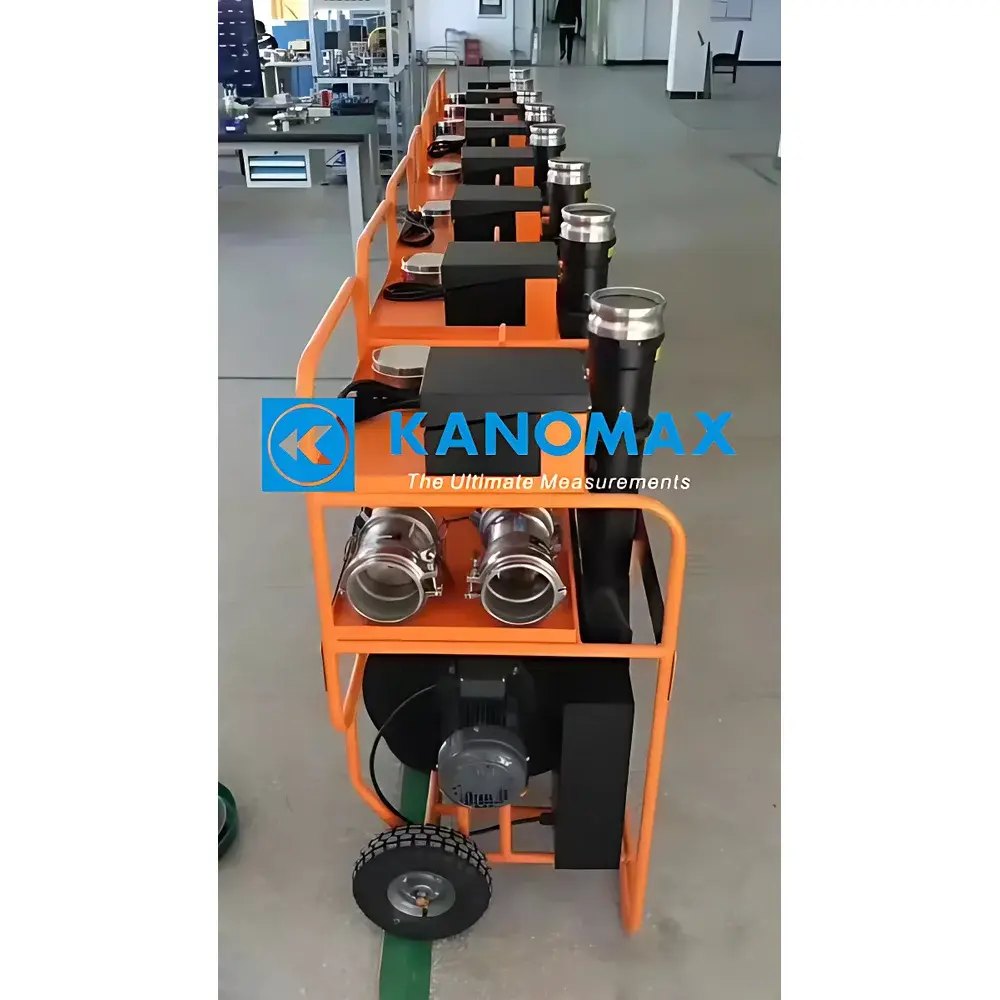
Kanomax DALT6900 Positive/Negative Pressure Duct Leakage Tester
| Brand | Kanomax |
|---|---|
| Origin | Liaoning, China |
| Model | DALT6900 |
| Airflow Range | 36–640 m³/h (nozzle range: 4–36 m³/h) |
| Accuracy | ±2.5% of reading ±0.1 m³/h (airflow), ±1% of reading ±1 Pa (static pressure), ±0.5 °C (temperature), ±2% of reading (atmospheric pressure) |
| Resolution | 0.01 m³/h (airflow), 0.1 Pa (pressure), 0.1 °C (temperature), 0.1 kPa (atmospheric pressure) |
| Static Pressure Range | ±2500 Pa |
| Temperature Range | 0–60 °C |
| Atmospheric Pressure Range | 70–130 kPa |
| Power Supply | DALT6900-0E: 110–120 V, 1-phase, 50/60 Hz, 16 A |
| DALT6900-1E | 220–240 V, 1-phase, 50/60 Hz, 10 A |
| Net Weight | ~72 kg |
| Dimensions | 540 × 500 × 1200 mm |
| Data Storage | 1000 test records |
Overview
The Kanomax DALT6900 Positive/Negative Pressure Duct Leakage Tester is a precision-engineered instrument designed for quantitative assessment of air leakage in HVAC ductwork systems under controlled pressurization conditions. It operates on the principle of calibrated orifice flow measurement—applying either positive or negative differential pressure across a sealed duct section while simultaneously measuring volumetric airflow through standardized nozzles and monitoring system static pressure, ambient temperature, and atmospheric pressure. This dual-mode (±2500 Pa) capability enables compliance verification with international duct airtightness standards, including EN 1507:2006 (flexible ducts), EN 12237:2002 (rigid circular ducts), Eurovent 2/2, DW/143, SMACNA HVAC Air Duct Leakage Test Manual, and GB 50243–2002 (Chinese Code for Acceptance of Ventilation and Air Conditioning Engineering). The instrument delivers traceable, repeatable results essential for commissioning, quality assurance, and post-installation validation in commercial and institutional buildings.
Key Features
- Simultaneous positive and negative pressure testing modes up to ±2500 Pa, supporting bidirectional integrity verification per EN and SMACNA protocols
- Dual-range airflow measurement architecture: primary nozzle bank (4–36 m³/h) for high-resolution low-flow detection and auxiliary fan-driven range (36–640 m³/h) for large-system evaluation
- Integrated environmental compensation: real-time correction of volumetric flow using measured temperature (0–60 °C, ±0.5 °C) and atmospheric pressure (70–130 kPa, ±2% of reading)
- 4.7-inch color LCD touchscreen interface with intuitive workflow navigation, multilingual support (English, Chinese, Spanish), and on-device pass/fail judgment based on user-selected standard thresholds
- Onboard data logging with capacity for 1000 complete test records—including date/time stamp, pressure curve, leakage rate, ambient parameters, and pass/fail status
- Robust mechanical design: aluminum alloy frame, vibration-damped fan assembly, and modular nozzle calibration ports facilitating field verification and NIST-traceable recalibration
Sample Compatibility & Compliance
The DALT6900 is validated for use on rigid and semi-rigid duct systems installed in commercial HVAC applications—including rectangular sheet metal, spiral-wound galvanized steel, fiberglass-reinforced plastic (FRP), and flexible insulated ducts. It supports both sectional testing (individual duct runs) and whole-system evaluation (e.g., AHU-to-diffuser loops). All measurement algorithms and pass/fail logic are aligned with the procedural requirements of ISO/IEC 17025-accredited laboratories and referenced in ASTM E1554 (Standard Test Method for Determining Duct System Airtightness), though the instrument itself is not certified to ASTM E1554 as a standalone test method apparatus. Its pressure and flow accuracy specifications meet the minimum performance criteria outlined in EN 12237 Annex B for Class C testing equipment. The device is routinely deployed by provincial construction quality supervision stations and building science research institutes across China in accordance with GB 50243–2002 Clause 4.2.3.
Software & Data Management
Test data are stored internally in non-volatile memory with full metadata tagging (project ID, duct ID, operator name, standard selected, environmental conditions). Export is supported via USB 2.0 to CSV or PDF report formats compatible with laboratory information management systems (LIMS). The firmware implements audit-trail functionality: all parameter changes, calibration events, and result deletions are timestamped and logged without user-accessible editing. While not FDA 21 CFR Part 11 compliant out-of-the-box, the system supports integration into GxP-aligned environments when paired with validated third-party reporting software that enforces electronic signature and change-control workflows. Firmware updates are delivered via encrypted USB firmware packages with SHA-256 checksum verification.
Applications
- Pre-commissioning verification of ductwork airtightness prior to final insulation and ceiling closure
- Post-construction QA/QC audits mandated by LEED v4.1 EQ Credit: Enhanced Indoor Air Quality Strategies
- Troubleshooting energy inefficiencies in existing HVAC systems by quantifying baseline leakage rates
- Validation of fire damper and control valve sealing integrity under operational pressure differentials
- Supporting ASHRAE Guideline 12-2020 (Managing the Risk of Legionellosis Associated with Building Water Systems) through verification of supply/exhaust isolation integrity
- Training and certification programs for HVAC technicians accredited by national vocational education authorities
FAQ
What standards does the DALT6900 directly support for pass/fail determination?
It embeds calculation logic for EN 1507:2006, EN 12237:2002, Eurovent 2/2, DW/143, SMACNA Standard, and GB 50243–2002—including automatic classification into leakage classes (e.g., SMACNA Class A/B/C or EN Class A/B/C/D) based on measured airflow per unit surface area.
Can the DALT6900 be used for smoke control system duct testing?
Yes—its ±2500 Pa pressure range satisfies the minimum 2500 Pa differential requirement specified in NFPA 92 (2024) Section 5.11.3 for leakage testing of dedicated smoke exhaust ducts.
Is external calibration required before first use?
The unit ships with factory calibration certificates traceable to JCSS (Japan Calibration Service System); however, users must perform zero-pressure and ambient temperature verification using certified reference instruments prior to initial deployment per ISO/IEC 17025 Clause 6.4.
Does the device support remote monitoring or network connectivity?
No Ethernet or Wi-Fi interface is built-in; real-time telemetry requires optional RS-485-to-USB gateway hardware and custom SCADA integration.
What maintenance intervals are recommended for long-term accuracy?
Nozzle assemblies should be inspected quarterly for particulate accumulation; fan motor bearings require lubrication every 24 months; full system recalibration is recommended biennially or after 500 cumulative test hours, whichever occurs first.







