
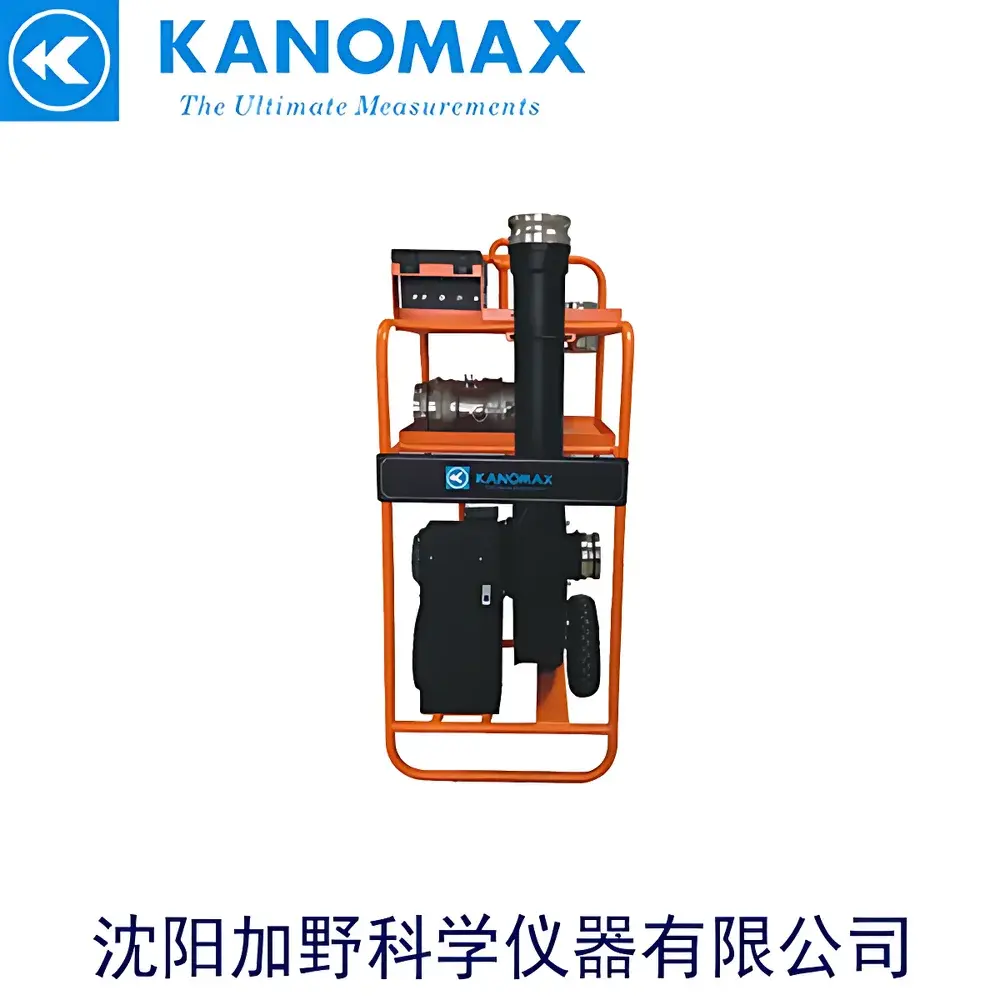
Kanomax DALT6900 Positive/Negative Pressure Duct Leakage Tester
| Brand | Kanomax |
|---|---|
| Origin | Liaoning, China |
| Manufacturer Type | Authorized Distributor |
| Country of Manufacture | China |
| Model | DALT6900 |
| Power Supply | DALT6900-0E (110–120 V, 1Φ, 50/60 Hz, 16 A) / DALT6900-1E (220–240 V, 1Φ, 50/60 Hz, 10 A) |
| Airflow Range | 36–640 m³/h (main duct) |
| Accuracy | ±2.5% of reading ±0.1 m³/h (airflow) |
| Resolution | 0.01 m³/h (airflow) |
| Static Pressure Range | ±2500 Pa |
| Temperature Range | 0–60 °C |
| Atmospheric Pressure Range | 70–130 kPa |
| Data Storage | 1000 test records |
| Display | 4.7-inch color LCD touchscreen |
| Dimensions | 540 × 500 × 1200 mm |
| Net Weight | ~72 kg |
Overview
The Kanomax DALT6900 Positive/Negative Pressure Duct Leakage Tester is a precision-engineered instrument designed for quantitative assessment of air leakage in HVAC duct systems under controlled pressurization conditions. It operates on the principle of differential pressure-driven airflow measurement, utilizing calibrated nozzle banks and a high-stability blower to impose regulated positive or negative static pressures—up to ±2500 Pa—across sealed duct sections. By measuring the volumetric airflow required to maintain a target pressure differential, the system calculates leakage rate in real time according to standardized duct airtightness protocols. This method conforms to fundamental fluid dynamics principles described in ISO 5801 and ASHRAE Fundamentals Chapter 22, ensuring traceable, repeatable results essential for commissioning, code compliance verification, and energy performance certification.
Key Features
- Simultaneous positive and negative pressure testing capability, enabling full evaluation of duct integrity under operational pressure differentials encountered in supply and return air systems
- Dual-range airflow measurement architecture: primary blower (36–640 m³/h) for whole-system testing; precision nozzle bank (4–36 m³/h) for low-leakage applications requiring enhanced resolution
- Integrated environmental sensors for real-time compensation: temperature (0–60 °C, ±0.5 °C), atmospheric pressure (70–130 kPa, ±2%), and static pressure (±2500 Pa, ±1% ±1 Pa)
- 4.7-inch full-color LCD touchscreen interface with intuitive menu navigation, multilingual support (English, Chinese, Spanish), and context-sensitive help prompts
- Onboard data logging for up to 1000 complete test records, each storing timestamp, pressure setpoint, measured leakage rate, ambient conditions, and pass/fail status per applicable standard
- Modular mechanical design optimized for field deployment: cast-aluminum frame, reinforced carrying handles, and tool-free nozzle bank access for rapid calibration verification
Sample Compatibility & Compliance
The DALT6900 is validated for use across rectangular, round, and oval duct geometries fabricated from galvanized steel, aluminum, fiberglass-reinforced polymer (FRP), and flexible duct materials. It supports both sectional testing (e.g., individual duct runs isolated by temporary seals) and whole-system verification (e.g., AHU-connected networks). Its test methodology and reporting outputs align explicitly with internationally recognized duct airtightness standards, including EN 1507:2006 (metallic ducts), EN 12237:2002 (flexible ducts), Eurovent 2/2 (commercial HVAC), DW/143 (UK building regulations), SMACNA HVAC Air Duct Leakage Test Manual (2012 edition), and GB 50243–2002 (China’s Code for Acceptance of Ventilation and Air Conditioning Engineering). All test reports generated include metadata required for third-party audit trails under ISO/IEC 17025-accredited laboratories.
Software & Data Management
Data export is supported via USB 2.0 interface to standard FAT32-formatted flash drives. Exported files are saved in CSV format with UTF-8 encoding, containing column headers compliant with ASTM E1554-22 Annex A1 (Standard Guide for Duct Leakage Testing Reporting). The onboard firmware implements secure data handling: each record includes cryptographic hash signatures to prevent post-test modification, satisfying basic integrity requirements for GLP-aligned documentation. While the device does not include network connectivity or cloud synchronization, its file structure is interoperable with common HVAC commissioning software platforms—including Trane TRACE™, Carrier Hourly Analysis Program (HAP), and IES VE—for automated energy model validation and LEED EA Credit 1 submittals.
Applications
- Pre-commissioning verification of ductwork installed per SMACNA or EN 1507 specifications in commercial office buildings, hospitals, and data centers
- Post-installation QA/QC audits conducted by third-party TAB (Testing, Adjusting, and Balancing) firms and local building inspection authorities
- Energy retrofit assessments where duct leakage contributes to excessive fan power consumption or thermal load imbalance
- Research and development of low-leakage duct sealing materials and jointing techniques under controlled laboratory conditions
- Training and certification programs for HVAC technicians accredited by ASHRAE, RSES, or REFCOM
FAQ
Does the DALT6900 require annual recalibration by an accredited lab?
Yes. Kanomax recommends factory recalibration every 12 months or after 200 test cycles, whichever occurs first, to maintain stated accuracy tolerances. Calibration certificates include NIST-traceable references for airflow, pressure, and temperature channels.
Can the instrument be used for smoke testing or tracer gas methods?
No. The DALT6900 is strictly a quantitative pressurization-based leakage tester. It does not integrate smoke generators, SF₆ detectors, or ultrasonic leak sensors. These complementary qualitative methods must be performed separately.
Is firmware upgrade supported in the field?
Yes. Firmware updates are distributed as signed .bin files via Kanomax’s authorized service portal and installed via USB drive. Each update includes version-controlled release notes and backward-compatible configuration retention.
What safety certifications does the unit hold?
The DALT6900 complies with IEC 61010-1:2010 (Measurement, Control, and Laboratory Equipment – Safety Requirements) and carries CE marking for EMC Directive 2014/30/EU and Low Voltage Directive 2014/35/EU. It is not rated for hazardous (Class I Div 1) locations.
How is pass/fail determination implemented per standard?
Pass/fail logic is user-selectable per standard: EN 1507 defines Class A–D leakage classes based on duct static pressure class and surface area; SMACNA uses “tight”, “medium”, and “leaky” thresholds derived from system operating pressure; GB 50243–2002 specifies maximum allowable leakage volume per square meter of duct surface area at 750 Pa. The instrument applies these algorithms automatically upon selection.
Related Products







