
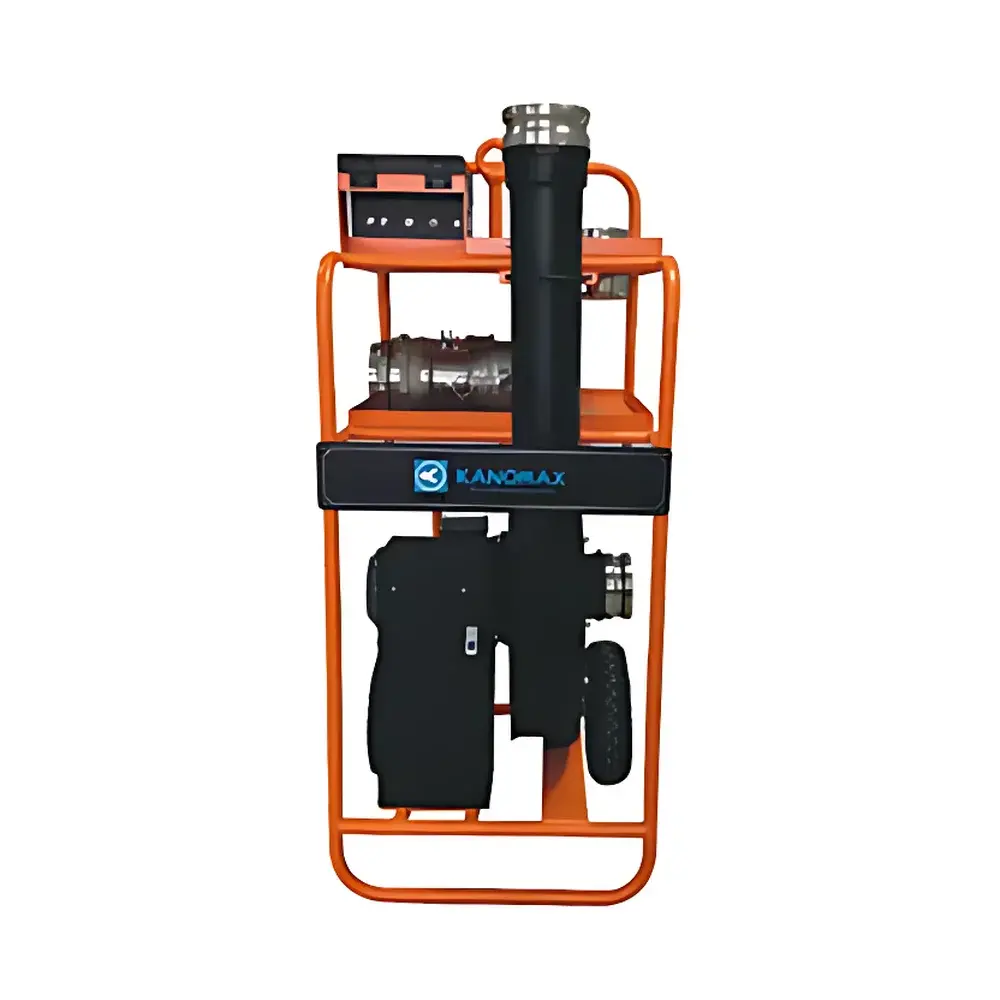
Kanomax DLT200 Series Positive & Negative Pressure Duct Leakage Tester
| Brand | Kanomax |
|---|---|
| Origin | Japan |
| Model | DLT200 / DLT200-I |
| Leak Flow Range (Matrix) | 36–640 m³/h |
| Nozzle Flow Range | 4–36 m³/h |
| Flow Accuracy | ±2.5% of reading ±0.1 m³/h |
| Pressure Range | ±2500 Pa |
| Pressure Accuracy | ±1.5% of reading ±0.25 Pa |
| Temperature Range | 0–60 °C |
| Temperature Accuracy | ±0.5 °C |
| Barometric Pressure Range | 70–130 kPa |
| Barometric Accuracy | ±2% of reading |
| Power Supply | DLT200: 110–120 V, 50/60 Hz, 16 A |
| DLT200-I | 220–240 V, 50/60 Hz, 10 A |
Overview
The Kanomax DLT200 Series Positive & Negative Pressure Duct Leakage Tester is a precision-engineered diagnostic instrument designed for quantitative evaluation of air leakage in HVAC ductwork under controlled pressurization and depressurization conditions. Based on the principle of constant-pressure differential testing—where a calibrated fan induces a stable pressure differential across the duct system while measuring volumetric flow required to maintain that differential—the DLT200 complies with internationally recognized duct airtightness standards including EN 1507:2006, EN 12237:2002, Eurovent 2/2, DW/143, SMACNA HVAC Air Duct Leakage Test Manual, and GB 50243–2002. Its dual-mode capability enables rigorous assessment of both positive-pressure (supply-side) and negative-pressure (return/exhaust-side) integrity, supporting commissioning, retrocommissioning, and post-installation verification in commercial, institutional, and industrial HVAC installations.
Key Features
- High-fidelity dual-range airflow measurement: matrix mode (36–640 m³/h) for whole-system testing and nozzle mode (4–36 m³/h) for localized or low-leakage duct segments—enabling traceable resolution across three orders of magnitude.
- Integrated environmental compensation: simultaneous real-time monitoring of static pressure (±2500 Pa), ambient temperature (0–60 °C), and barometric pressure (70–130 kPa), with all sensor outputs contributing to dynamic flow correction algorithms per ISO 5167 and ASHRAE Guideline 12.
- Self-contained touchscreen interface: 4.7-inch capacitive LCD with intuitive icon-driven navigation, eliminating external PCs during field operation; supports multilingual UI (English, Japanese, Chinese) and on-device data review, annotation, and selective deletion.
- Ruggedized portable architecture: aluminum alloy housing rated IP54 for dust and splash resistance; modular fan assembly with quick-connect couplings and standardized nozzle kits compliant with EN 12237 Annex B.
- Traceable metrology: factory-calibrated transducers with NIST-traceable certificates; pressure and flow accuracy specifications validated per ISO/IEC 17025-accredited procedures at Kanomax’s Yokohama Calibration Laboratory.
Sample Compatibility & Compliance
The DLT200 is compatible with rigid and semi-rigid duct systems constructed from galvanized steel, aluminum, fiberglass-reinforced polymer (FRP), and flexible insulated ducts meeting UL 181 Class 1 or Class 0 ratings. It supports testing of rectangular, round, and oval cross-sections up to 2.5 m in equivalent diameter. All test protocols align with mandatory compliance frameworks: EN 1507 mandates Class A–D leakage classification for ventilation ducts in EU building energy performance certification (EPBD); SMACNA requirements apply to U.S. federal facilities governed by UFC 3-410-01; GB 50243–2002 governs acceptance testing in China’s public infrastructure projects. The instrument’s data logging and audit trail functionality satisfies GLP documentation prerequisites for third-party commissioning reports.
Software & Data Management
Internal memory stores up to 1,000 complete test records—including timestamped pressure curves, leak-flow profiles, environmental metadata, and pass/fail determinations per selected standard. Data export is supported via USB 2.0 to CSV or XML formats compatible with HVAC analytics platforms (e.g., CxAgent, SkySpark). Optional Kanomax DuctTest Manager v3.2 software provides advanced features: automated report generation with embedded compliance statements, comparative analysis across multiple test points, and digital signature support for QA/QC sign-off. All firmware and calibration files are digitally signed to ensure integrity; software update logs comply with FDA 21 CFR Part 11 electronic record requirements where applicable.
Applications
- Pre-occupancy duct leakage verification in LEED-certified buildings and BREEAM-assessed facilities.
- Diagnostic testing of smoke control and pressurization shafts per NFPA 92 and EN 12101-6.
- Commissioning support for VAV box and terminal unit balancing where duct integrity directly impacts airflow stability.
- Energy audit workflows quantifying avoidable fan energy penalties attributable to uncontrolled infiltration/exfiltration.
- Post-renovation validation after duct liner replacement or sealing interventions using mastic or tape-based systems.
FAQ
What duct standards does the DLT200 validate against?
It supports full protocol execution for EN 1507:2006 (rectangular ducts), EN 12237:2002 (circular ducts), Eurovent 2/2 (industrial ventilation), DW/143 (UK Building Regulations), SMACNA HVAC Air Duct Leakage Test Manual (U.S.), and GB 50243–2002 (China).
Is field recalibration required between tests?
No. The DLT200 employs auto-zeroing pressure sensors and thermally stabilized flow elements; daily verification using the included zero-check port and reference manometer is sufficient per ISO 5801 Annex E.
Can test data be integrated into CMMS or BIM platforms?
Yes. Exported CSV files contain structured fields (e.g., TestID, Standard, PressureSetpoint, MeasuredLeakage, PassStatus) compatible with common CMMS APIs and Autodesk Navisworks clash-detection workflows.
What electrical configurations are supported globally?
DLT200 (110–120 V, 50/60 Hz, 16 A) for North America and Japan; DLT200-I (220–240 V, 50/60 Hz, 10 A) for EU, UK, Australia, and most Asian markets—both conform to IEC 61000-6-3 EMC and IEC 61010-1 safety standards.
How is measurement uncertainty reported in compliance documentation?
Each test report includes expanded uncertainty (k=2) calculated per GUM (JCGM 100:2008) incorporating contributions from flow meter repeatability, pressure transducer drift, temperature-induced density variation, and operator-defined test boundary conditions.







