
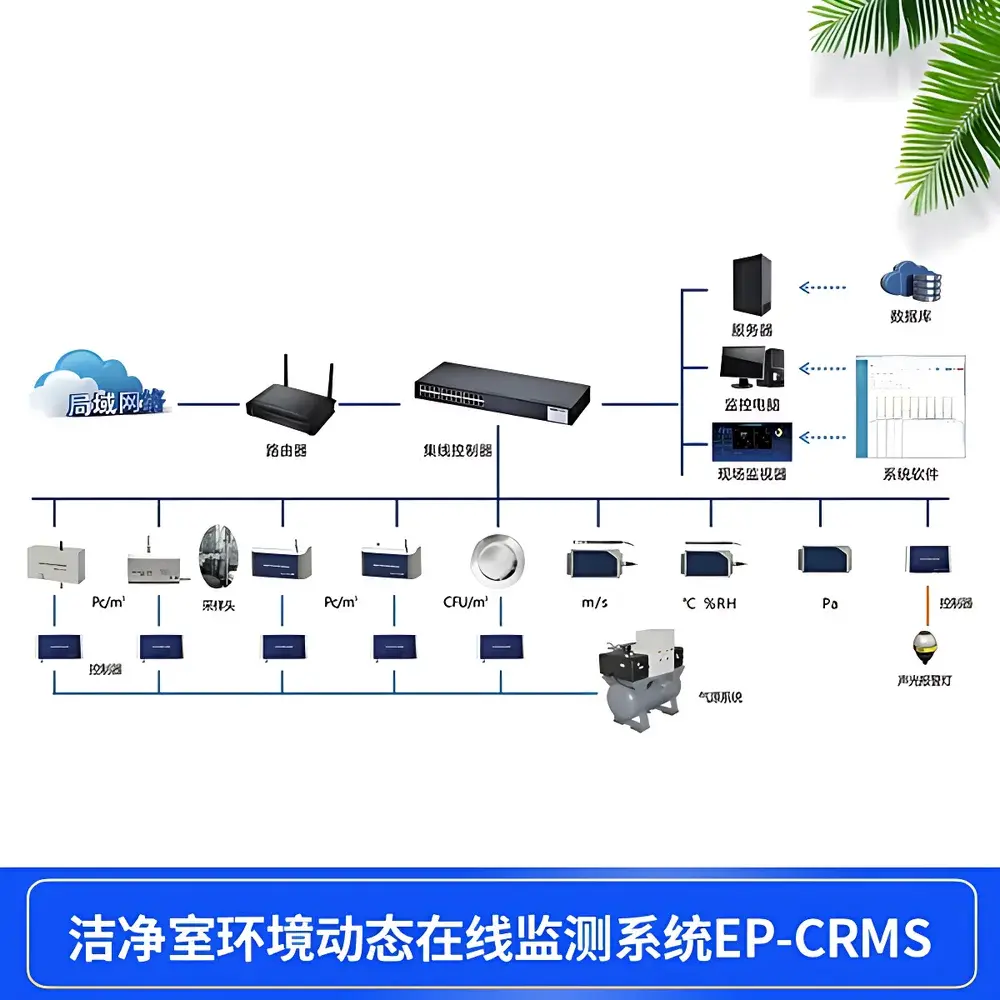
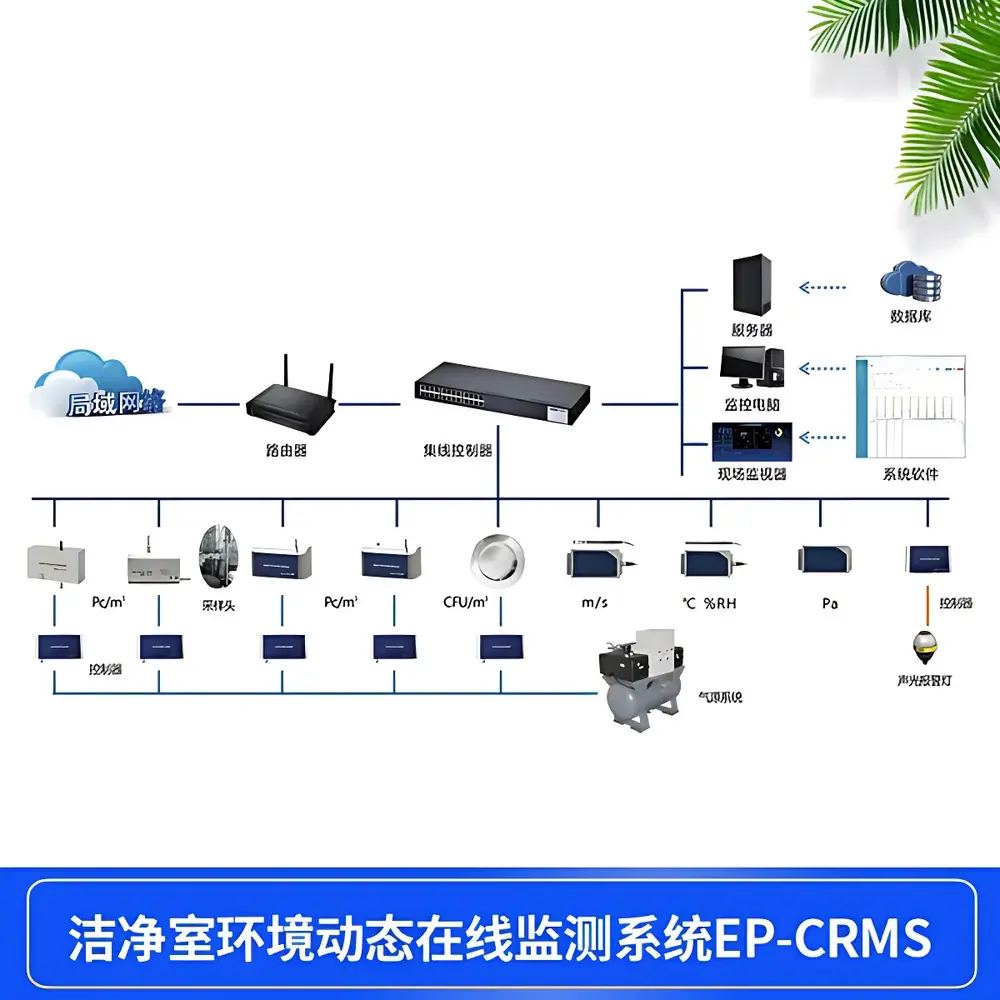
Kanomax EP-CRMS Continuous Real-Time Monitoring System for Cleanroom Airborne Particles
| Brand | Kanomax |
|---|---|
| Origin | Liaoning, China |
| Manufacturer Type | Authorized Distributor |
| Country of Origin | China |
| Model | EP-CRMS |
| Instrument Type | Online Particle Monitoring System |
| Flow Rate | High-Flow (28.3 L/min standard) |
| Flow Accuracy | <1 count deviation per 5 min |
| Timing Accuracy | ±1 s over 6-min sampling |
| Repeatability | ≤±10% FS |
| Size Distribution Error | ≤±30% |
| Indication Error | <±30% FS |
| Compliance | ISO 21501-4, JIS B 9921, ISO 14698-1, FDA 21 CFR Part 11, EU GMP Annex 1, GB/T 16292–16293, GB 50591-2010 |
| Data Storage | Up to 2,000 sample records per sensor |
| Communication | RS485 (Modbus RTU/TCP), optional 4–20 mA |
| Power Supply | DC 9–28 V or AC 100–240 V (50–60 Hz) |
| Laser Source | Long-life semiconductor diode (MTBF >100,000 h) |
Overview
The Kanomax EP-CRMS Continuous Real-Time Monitoring System is an integrated, multi-parameter environmental surveillance platform engineered for Grade A/B cleanroom environments in pharmaceutical, biotechnology, and medical device manufacturing facilities. It operates on the principle of laser light scattering particle counting (per ISO 21501-4 and JIS B 9921), combined with calibrated impaction-based viable particle sampling (per ISO 14698-1), synchronized environmental parameter acquisition (air velocity, temperature, humidity, differential pressure, noise, and illuminance), and centralized data governance. Unlike standalone particle counters, the EP-CRMS functions as a validated, networked infrastructure—supporting continuous 24/7 operation across multiple monitoring points, with deterministic traceability, real-time alarm logic, and full compliance with regulatory data integrity requirements including FDA 21 CFR Part 11, EU GMP Annex 1, and Chinese GMP 2010.
Key Features
- Multi-sensor architecture: Simultaneous acquisition from Kanomax particle counters (models 3714, 3715, 3718, 3719), FKC-0S viable air samplers, KL31 flow controllers, and environmental sensors (0845/0846/0847 series), all addressable via Modbus RTU/TCP.
- Dual-redundant vacuum system: Dry, oil-free rotary vane pumps configured in active/standby mode with automatic failover—ensuring uninterrupted sampling during maintenance or pump failure.
- Isokinetic sampling assurance: Stainless steel (SUS316) isokinetic probes and internally coated sampling tubing conforming to GB 50591-2010, minimizing particle loss and bias in high-velocity laminar airflow zones.
- Real-time volumetric control: KL31 controllers monitor and regulate airflow to guarantee precise 1 m³ cumulative sampling volume per cycle for both particulate and microbial sampling—critical for statistical validity under ISO 14698-1.
- Regulatory-grade data integrity: Full audit trail with timestamped, immutable records of user logins, configuration changes, alarm events, data exports, and electronic signatures—fully compliant with ALCOA+ principles and 21 CFR Part 11 requirements.
- Fail-safe data continuity: On-device buffer storage (2,000 records per sensor), automatic cache recovery after power interruption, and configurable local/remote database redundancy prevent data loss during network outages.
Sample Compatibility & Compliance
The EP-CRMS supports standardized particle detection across six calibrated size channels (0.3, 0.5, 1.0, 3.0, 5.0, and 10.0 µm) with counting efficiency validated per ISO 21501-4. Viable sampling employs a 50 L/min impactor with ≥98% collection efficiency at ≥12 m/s jet velocity, meeting ISO 14698-1 Annex B performance criteria. All environmental sensors are factory-calibrated and traceable to national metrological standards; temperature/humidity accuracy is ±0.2 °C / ±2% RH (20–28 °C / 30–85% RH), differential pressure resolution is 0.01 Pa, and air velocity accuracy is ±0.05 m/s (0.3–0.5 m/s range). The system architecture satisfies validation requirements for Installation Qualification (IQ), Operational Qualification (OQ), Performance Qualification (PQ), and Risk Assessment (RA) per ICH Q9 and EU GMP Annex 15. It has been deployed in A/B-grade critical process zones—including isolators, filling lines, lyophilizers, and tunnel sterilizers—where dynamic contamination control is mandated.
Software & Data Management
The central EP-CRMS software suite provides role-based access control (administrator, QA, operator, IT), configurable alarm thresholds (alert, action, intervention), and automated report generation (daily/weekly/monthly/yearly summaries). Data visualization includes time-series plots, UCL trend charts, histogram distributions, and tabular export in native Excel (.xlsx) or secure PDF formats—with embedded digital signatures and version-controlled revision history. All system events—including sensor calibration due dates, firmware updates, and user-initiated data purges—are logged with immutable timestamps and operator identifiers. The software supports structured database archiving (SQL Server or PostgreSQL), encrypted backup to NAS or cloud storage, and seamless integration with MES, SCADA, and LIMS platforms via OPC UA or RESTful API adapters. Electronic signature workflows comply with 21 CFR Part 11 Subpart C requirements, including identity verification, intent confirmation, and record linkage integrity.
Applications
- Continuous Grade A/B cleanroom monitoring in sterile drug manufacturing (e.g., aseptic filling, lyophilization, isolator operations)
- Environmental qualification and routine surveillance of critical process equipment (tunnel ovens, autoclaves, depyrogenation tunnels)
- Support for media fill investigations and root cause analysis of microbiological excursions
- Validation of HVAC system performance and filter integrity testing (with optional aerosol photometer integration)
- Compliance reporting for regulatory inspections (FDA, EMA, NMPA, PMDA) and third-party certification (ISO 13485, ISO 9001)
- Long-term trend analysis of airborne contamination patterns correlated with personnel activity, gowning practices, or maintenance cycles
FAQ
Does the EP-CRMS support FDA 21 CFR Part 11 compliance?
Yes—the system implements electronic signature workflows, audit trail logging, role-based access controls, and data encryption aligned with Part 11 Subpart C requirements for closed systems.
Can additional monitoring points be added post-installation?
Yes—modular sensor addressing and daisy-chain RS485 topology allow scalable expansion without hardware or software reconfiguration.
What is the maximum particle concentration the system can measure accurately?
Depending on sensor model, the upper limit ranges from 500,000 to 2,000,000 counts per cubic foot, with linearity verified per ISO 21501-4 up to 50% of full scale.
How is calibration traceability maintained?
All sensors ship with NIST-traceable calibration certificates; field recalibration is supported using Kanomax-certified reference instruments—including aerosol generators, wind tunnels, and humidity/temperature chambers—aligned with JJF 1190–2019 and GB/T 6167–2007.
Is the system compatible with existing facility SCADA or MES platforms?
Yes—via native Modbus TCP, OPC UA, or custom REST API integration, enabling bidirectional data exchange and automated equipment interlocks (e.g., halt filling line upon particle excursion).







