
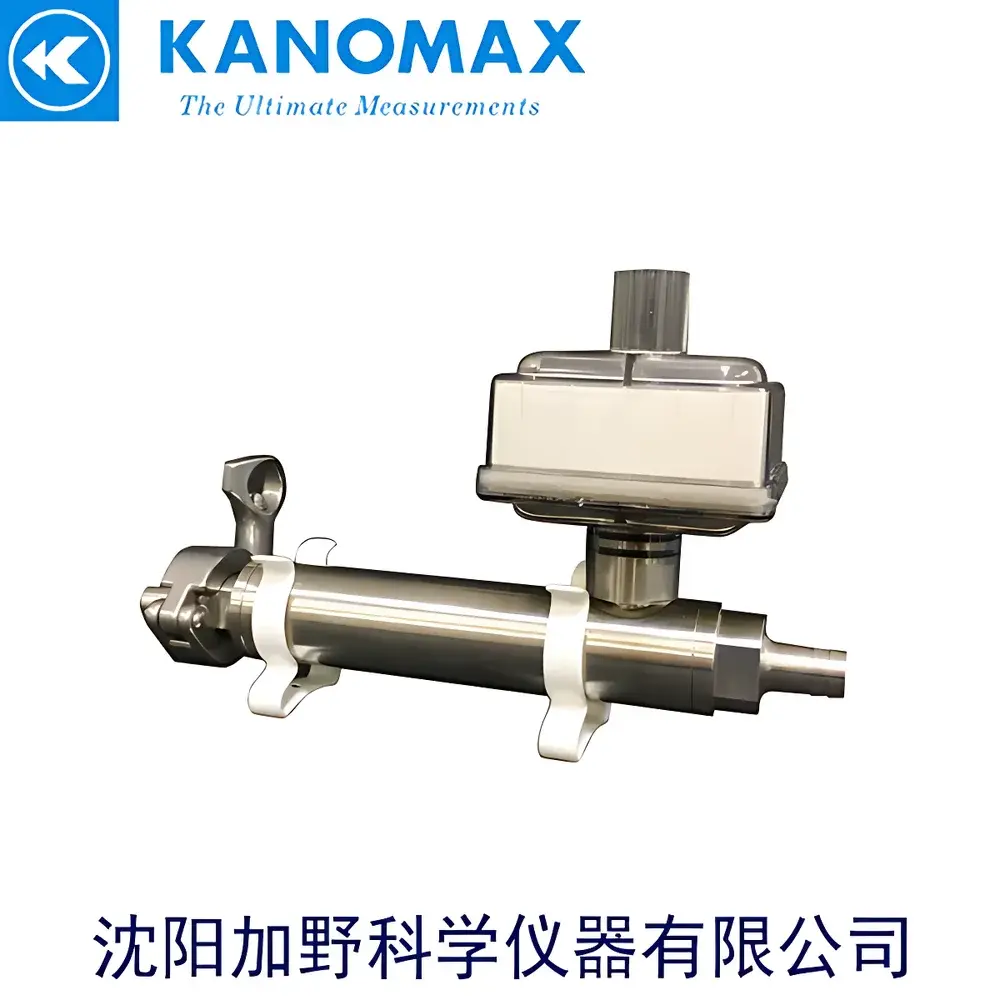
Kanomax High-Pressure Diffuser for Particle Counters – 50 L/min & 100 L/min Models
| Brand | Kanomax |
|---|---|
| Flow Rates | 50 L/min & 100 L/min |
| Operating Pressure Range | 18–125 psi (50 L/min) |
| Ambient Conditions | 10–35°C, 0–85% RH (non-condensing) |
| Material | Stainless Steel |
| Inlet Connection | Ø12.7 mm stainless steel tubing with 25 mm clamp |
| Outlet Connection | 1/2" ID hose barb |
| Dimensions | Ø30 mm × 185 mm (body only) |
| Weight | ~1.0 kg |
| Gas Compatibility | Clean, dry air and non-toxic inert gases |
| Compliance Context | Designed to support ISO 14644-1, ISO 14698-1, EU GMP Annex 1, and USP <797>/<800> environmental monitoring workflows |
Overview
The Kanomax High-Pressure Diffuser is an engineered flow conditioning device specifically designed for integration into compressed gas sampling systems used in cleanroom environmental monitoring and pharmaceutical manufacturing compliance. It operates on the principle of controlled pressure reduction and laminar flow diffusion—converting high-pressure, turbulent inlet gas streams into stable, low-velocity, uniformly distributed outlet flows suitable for precision instrumentation. This physical conditioning is critical when interfacing with optical particle counters (e.g., Kanomax LPC-3910 and LPC-3920) and active airborne microbial samplers, where unregulated pressure or flow pulsation can induce measurement drift, sensor saturation, or mechanical stress on internal optics and impactor plates. The diffuser ensures metrological integrity by eliminating flow-induced artifacts—such as particle re-entrainment, electrostatic charge variation, or shear-induced agglomeration—that compromise count accuracy and size distribution fidelity per ISO 21501-4 and JIS B 9921.
Key Features
- Two calibrated flow configurations: 50 L/min and 100 L/min models, each optimized for matching nominal instrument intake specifications without external flow controllers.
- Wide operational pressure range: 18–125 psi for the 50 L/min variant; 21–125 psi for the 100 L/min variant—enabling compatibility with standard plant air systems and nitrogen supply lines across regulated facilities.
- Stainless steel construction (AISI 316-grade body and fittings) ensures corrosion resistance, particulate-free surface finish, and long-term stability under repeated sterilization cycles (e.g., VHP or IPA wipe-down).
- Integrated diffuser geometry provides pressure drop attenuation and flow homogenization via multi-stage orifice and annular expansion zones—verified through computational fluid dynamics (CFD) modeling to maintain Reynolds number < 2,300 downstream of the outlet.
- Compact cylindrical form factor (Ø30 mm × 185 mm) facilitates installation in tight utility corridors, glovebox feedthroughs, or mobile monitoring carts without compromising structural rigidity or thermal mass stability.
Sample Compatibility & Compliance
The diffuser supports clean, dry compressed air and non-toxic inert gases—including nitrogen, argon, and helium—within defined dew point limits (≤ −40°C露点). It is not rated for use with reactive, flammable, or humidified gases. Its design aligns with critical regulatory expectations for environmental monitoring infrastructure: it enables compliant sampling per EU GMP Annex 1 (2022 revision), which mandates “validated and calibrated sampling systems capable of delivering representative, undisturbed airflow to particle and microbiological detection devices.” When deployed upstream of Kanomax LPC-3910 (50 L/min) or LPC-3920 (100 L/min), the system satisfies data integrity requirements under FDA 21 CFR Part 11 and EU Annex 11 when paired with audit-trail-enabled software platforms. No internal seals or polymers contact the gas path—eliminating extractables that could interfere with USP viable particle enumeration.
Software & Data Management
As a passive hardware component, the Kanomax High-Pressure Diffuser does not incorporate embedded firmware, sensors, or digital interfaces. Its performance verification is conducted externally using traceable flow calibrators (e.g., primary-standard bell prover or NIST-traceable thermal mass flow meters) and documented in equipment qualification protocols (IQ/OQ/PQ). Calibration records—including pressure vs. flow curves, leak test results (<1 × 10⁻⁶ mbar·L/s He), and material certification (EN 10204 3.1)—are maintained as part of the facility’s master validation file. Integration into electronic batch records (EBR) or LIMS is achieved indirectly via instrument-level data logging from the connected particle counter, with diffuser serial number and calibration status referenced in metadata fields per ALCOA+ principles.
Applications
- ISO Class 5–8 cleanroom compressed air line monitoring per ISO 8573-1:2010 (Class 1–2 for particles, Class 2–3 for water and oil).
- In-line sampling for aseptic processing isolators and RABS environments requiring continuous particle trend analysis.
- Validation of HVAC terminal filter integrity during smoke studies and airflow visualization tests.
- Supporting media fill simulation environmental monitoring campaigns where consistent volumetric flow is essential for statistical confidence in microbial recovery rates.
- Portable clean process gas verification in biotech manufacturing suites prior to equipment commissioning.
FAQ
Can this diffuser be used with non-Kanomax particle counters?
Yes—provided the instrument accepts 1/2″ ID inlet tubing and operates within the specified flow rate and pressure envelope. However, full metrological equivalence requires verification against the manufacturer’s stated inlet conditions.
Is the diffuser certified for use in sterile manufacturing areas?
It carries no standalone regulatory certification, but its materials, design, and qualification data support inclusion in sterile area validation packages per EU GMP Annex 1 and PIC/S PI 007-6.
Does it require periodic recalibration?
No recalibration is needed, but periodic integrity verification (leak testing, visual inspection for pitting or galling) is recommended per facility SOPs, typically every 6–12 months or after any physical impact.
Can it be autoclaved?
No—stainless steel construction permits VHP (vaporized hydrogen peroxide) and ethanol/IPA surface decontamination, but thermal cycling above 80°C may affect dimensional stability and sealing interface tolerances.
What documentation is supplied with the unit?
Each unit ships with a Certificate of Conformance, material test report (MTR), dimensional inspection record, and a pressure-flow performance curve derived from factory acceptance testing.
Related Products







