
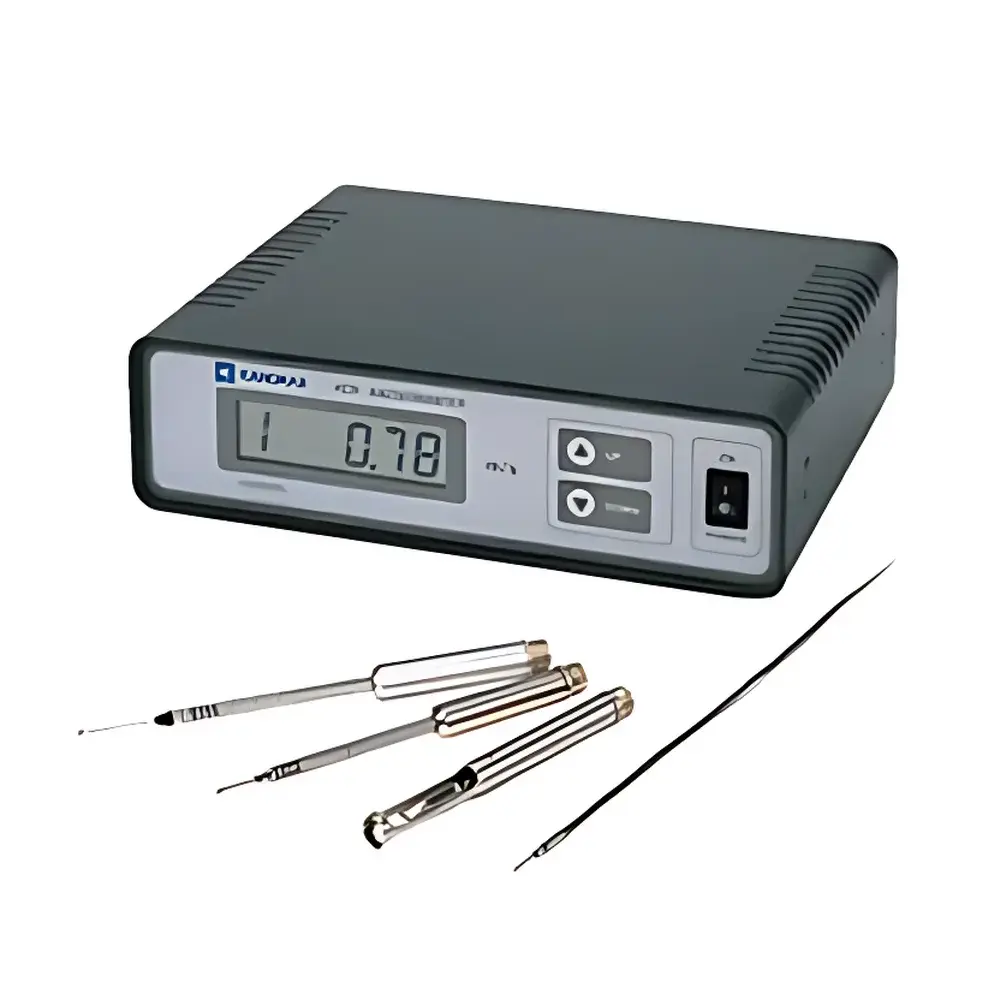
Kanomax KA12 Four-Channel Thermal Anemometer
| Brand | Kanomax |
|---|---|
| Origin | Japan |
| Model | KA12 |
| Instrument Type | Thermal Anemometer |
| Measurement Range | 0–50.0 m/s |
| Resolution | 0.01 m/s (0–9.99 m/s), 0.1 m/s (10–50.0 m/s) |
| Operating Temperature | 5–40 °C |
| Operating Humidity | 2.0–98.0 %RH |
| Analog Output Options | 0–5 V DC or 4–20 mA |
| Channel Count | 4 independent measurement channels |
| Probe Compatibility | 10 interchangeable thermal anemometer probes (e.g., KA01, KA02, KA03 series) |
Overview
The Kanomax KA12 Four-Channel Thermal Anemometer is a precision-engineered environmental monitoring instrument designed for simultaneous, real-time measurement of air velocity across four independent channels. Utilizing constant-temperature anemometry (CTA) — a well-established thermal sensing principle — the KA12 maintains a heated sensor element at a fixed temperature differential relative to ambient air; convective heat loss is directly correlated to local airflow velocity. This method ensures high sensitivity at low velocities (<1 m/s) and stable linearity up to 50.0 m/s, making the system suitable for both laminar and turbulent flow characterization in controlled and semi-controlled environments. The KA12 is not a handheld spot-check device but a benchtop or rack-mountable data acquisition platform intended for continuous process monitoring, HVAC commissioning, cleanroom validation, and laboratory airflow mapping where multi-point spatial resolution and temporal consistency are critical.
Key Features
- Four synchronized analog input channels with galvanically isolated signal conditioning to prevent cross-talk and ground-loop interference.
- Support for ten standardized Kanomax thermal probe models (including KA01, KA02, KA03, KA04, KA05, KA06, KA07, KA08, KA09, and KA10), each calibrated individually and traceable to JIS Z 8000 and ISO/IEC 17025-accredited reference standards.
- Configurable analog output per channel: user-selectable 0–5 V DC or 4–20 mA signals, enabling direct integration with PLCs, SCADA systems, or building management systems (BMS) without external signal converters.
- Internal sampling rate up to 10 Hz per channel, with onboard buffer memory capable of storing up to 16,384 data points per channel before transfer to host software.
- Rugged aluminum alloy chassis with IP20-rated enclosure, optimized for stable operation in non-hazardous indoor environments compliant with IEC 61000-4 electromagnetic immunity standards.
Sample Compatibility & Compliance
The KA12 accommodates a broad range of Kanomax thermal anemometer probes, differing in stem diameter (from 1.6 mm to 8 mm), length (100–1000 mm), and sensor configuration (single-point, dual-point, or 3-axis variants). Probes are rated for use in non-corrosive, particle-free air streams within the specified operating humidity (2.0–98.0 %RH) and temperature (5–40 °C) ranges. While the instrument itself does not carry intrinsic safety certification, its analog outputs meet IEC 61000-6-2/6-4 immunity and emission requirements. For regulated environments — including pharmaceutical cleanrooms (ISO 14644-1 Class 5–8), HVAC performance verification (ASHRAE 111, ISO 16813), and GLP-compliant airflow studies — the KA12 supports audit-ready documentation when used with Kanomax’s validated software suite and calibrated probes bearing NIST-traceable calibration certificates.
Software & Data Management
The KA12 operates with Kanomax’s proprietary KAN-LOG software (Windows-based, compatible with Windows 10/11 64-bit). The software provides real-time channel visualization, configurable averaging intervals (1 s to 3600 s), statistical summary generation (mean, min/max, standard deviation), and time-series export in CSV, Excel (.xlsx), and XML formats. It supports full audit trail functionality, including user login tracking, parameter change logging, and report timestamping — features aligned with FDA 21 CFR Part 11 requirements when deployed with electronic signature modules and system access controls. Raw data files include embedded metadata: probe serial numbers, calibration expiration dates, channel gain settings, and environmental condition stamps.
Applications
- HVAC system balancing and duct traverse surveys per ASHRAE Guideline 12 and ISO 16813.
- Cleanroom unidirectional airflow uniformity testing and ISO 14644-3 Annex B compliance verification.
- Biological safety cabinet (BSC) and fume hood face velocity mapping during qualification and periodic re-certification.
- Industrial ventilation system assessment, including local exhaust capture velocity validation.
- Academic and industrial aerodynamics research requiring synchronized multi-point velocity acquisition in wind tunnels or environmental chambers.
FAQ
Can the KA12 be used outdoors or in high-humidity environments beyond 98% RH?
No. The instrument and its thermal probes are rated for indoor use only, with maximum operational humidity at 98.0 %RH. Prolonged exposure above this threshold may cause condensation on sensor elements, leading to drift or permanent damage.
Is probe calibration included with purchase?
Each probe ships with a factory calibration certificate traceable to JCSS (Japan Calibration Service System) standards. Annual recalibration is recommended and supported by Kanomax-certified service centers globally.
Does the KA12 support digital communication protocols such as Modbus or Ethernet/IP?
No. The KA12 communicates exclusively via USB 2.0 for configuration and data download, and analog outputs (0–5 V / 4–20 mA) for real-time process interfacing. It does not feature native digital fieldbus interfaces.
Can multiple KA12 units be synchronized for large-scale monitoring?
Yes — using external TTL trigger signals and shared timebase synchronization via the optional KAN-SYNC module, up to eight KA12 units can be coordinated for phase-aligned multi-node deployments.
What is the typical uncertainty of velocity measurement across the full range?
At 23 °C and 50 %RH, typical expanded uncertainty (k=2) is ±(0.05 m/s + 2% of reading) for 0–10 m/s, and ±(0.1 m/s + 3% of reading) for 10–50 m/s, based on probe-specific calibration reports.







