
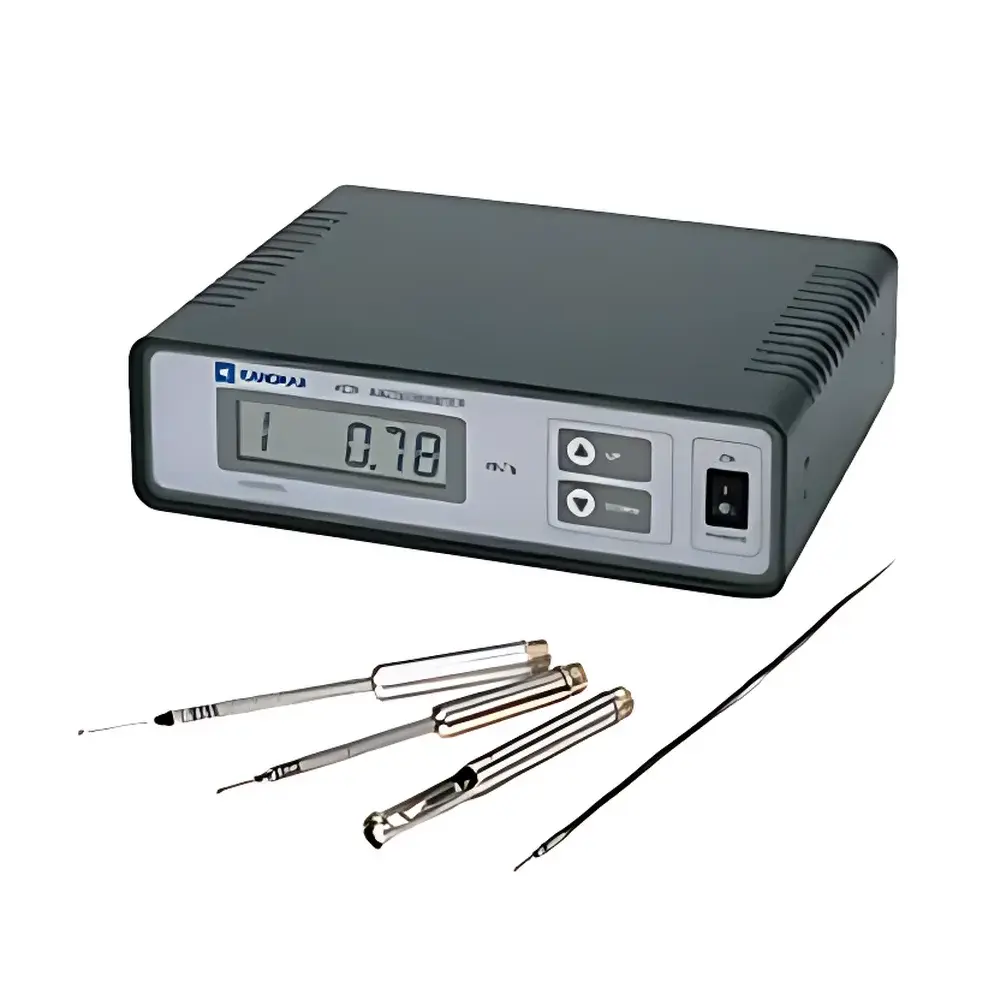
KANOMAX KA12 Quad-Channel Thermal Anemometer
| Brand | KANOMAX |
|---|---|
| Origin | Japan |
| Model | KA12 |
| Instrument Type | Thermal Anemometer |
| Wind Speed Range | 0–50.0 m/s |
| Resolution | 0.01 m/s (0–9.99 m/s), 0.1 m/s (10–50 m/s) |
| Operating Temperature | 5–40 °C |
| Operating Humidity | 2.0–98.0 %RH |
| Power Supply | AC 220 V |
| Dimensions | 200 × 260 × 70 mm |
| Weight | 2.6 kg |
| Communication Interface | RS-232C |
| Analog Output | 0–5 V or 4–20 mA |
| EMI Filtering | Integrated |
| Display | LCD with manual channel selection |
Overview
The KANOMAX KA12 Quad-Channel Thermal Anemometer is an industrial-grade, multi-point airflow measurement system engineered for precision, stability, and long-term reliability in controlled environmental and HVAC validation settings. Based on constant-temperature anemometry (CTA), the KA12 measures wind speed by detecting convective heat loss from a heated sensor element—typically a platinum or thin-film thermistor—whose resistance change correlates linearly with local air velocity under calibrated conditions. Unlike cup or vane anemometers, thermal sensing enables sub-second response times, high sensitivity at low flow rates (<0.1 m/s), and minimal flow disturbance—critical for laminar flow hoods, cleanroom ISO Class 5–8 monitoring, duct traverses, and fume hood face velocity verification per ANSI/ASHRAE 110 and ISO 14644-3. The quad-channel architecture allows concurrent acquisition from four independent probes, eliminating sequential scanning delays and enabling real-time spatial profiling of airflow uniformity across grilles, filters, or work surfaces.
Key Features
- Simultaneous four-channel acquisition with independent signal conditioning per channel, supporting synchronized logging and differential analysis.
- Modular probe compatibility—including straight, bent, telescopic, and high-temperature variants—enabling adaptation to ducts, biosafety cabinets, gloveboxes, and confined spaces.
- High-resolution LCD interface with manual channel cycling; no touchscreen required, ensuring robustness in lab or production-floor environments.
- Integrated EMI filtering and wide-input AC power supply (220 V ±10 %, 50/60 Hz), certified to IEC 61326-1 for electromagnetic compatibility in industrial laboratories.
- Standard RS-232C serial interface compliant with EIA/TIA-232-F, supporting ASCII-based command protocols for integration into SCADA, LabVIEW, or custom Python-based data acquisition systems.
- Optional analog outputs (0–5 V DC or 4–20 mA) configurable per channel, facilitating connection to PLCs, chart recorders, or building management systems (BMS) without external signal conditioners.
Sample Compatibility & Compliance
The KA12 is designed for gaseous media only—primarily ambient air, nitrogen, compressed air, and other non-corrosive, non-particulate-laden gases within specified humidity and temperature limits (5–40 °C, 2.0–98.0 %RH). It is not rated for explosive atmospheres (ATEX/IECEx), high-dust environments, or saturated steam. Probe selection must align with application-specific constraints: standard stainless-steel probes are suitable for general HVAC use; PTFE-sheathed variants accommodate mildly corrosive exhaust streams; and high-temp probes (up to 150 °C) require optional calibration certificates traceable to JCSS (Japan Calibration Service System). The instrument meets ISO/IEC 17025-relevant metrological requirements when used with factory-calibrated probes and supports audit-ready documentation for GLP and GMP-regulated facilities, including calibration certificate retention and probe interchangeability logs.
Software & Data Management
While the KA12 operates as a standalone instrument, its RS-232 interface enables bidirectional communication with host software for configuration, real-time streaming, and batch export. Compatible platforms include KANOMAX’s proprietary KA-Link PC utility (Windows-based), which provides time-stamped CSV export, channel masking, moving-average filtering, and pass/fail threshold alerts aligned with ISO 14644-1 velocity acceptance criteria (e.g., 0.45 ±20 % m/s for unidirectional airflow). For regulated environments, third-party middleware (e.g., NI DIAdem, MATLAB Production Server) may be deployed to enforce 21 CFR Part 11-compliant electronic signatures, audit trails, and data integrity controls—provided the host system implements appropriate user access levels, electronic record retention policies, and backup protocols.
Applications
- HVAC commissioning and routine performance verification in pharmaceutical cleanrooms and hospital isolation rooms.
- Face velocity mapping of chemical fume hoods per ANSI/ASHRAE 110-2016 and EN 14175-3.
- Duct traverse surveys for air balancing in commercial buildings (per SMACNA and ASHRAE Fundamentals).
- Validation of laminar airflow units (LAFUs) and isolators during PQ/UQ phases under EU Annex 1 and FDA guidance.
- Environmental chamber airflow characterization during stability testing (ICH Q1A–Q5E).
- Research-grade boundary layer studies in aerodynamic test benches where multi-point temporal correlation is essential.
FAQ
Can the KA12 measure air velocity in hazardous or explosive environments?
No. The KA12 and its standard probes are not intrinsically safe or ATEX-certified. Use only in non-hazardous locations per IEC 60079-0.
Is NIST-traceable calibration included with purchase?
Factory calibration is traceable to JCSS standards. NIST-traceable certificates are available upon request at additional cost and require separate probe calibration.
Does the KA12 support automatic data logging without a PC?
No internal memory or SD card slot is provided. Continuous logging requires external PC or PLC interfacing via RS-232 or analog output.
What is the maximum cable length between probe and main unit?
Standard probe cables are 2 m. Extended-length versions (up to 10 m) are available; signal integrity must be verified per probe model due to thermal drift and noise susceptibility.
Can I mix different probe types across the four channels?
Yes—each channel accepts any KANOMAX KA-series thermal probe, but individual calibration coefficients must be entered manually per channel to maintain accuracy.







