
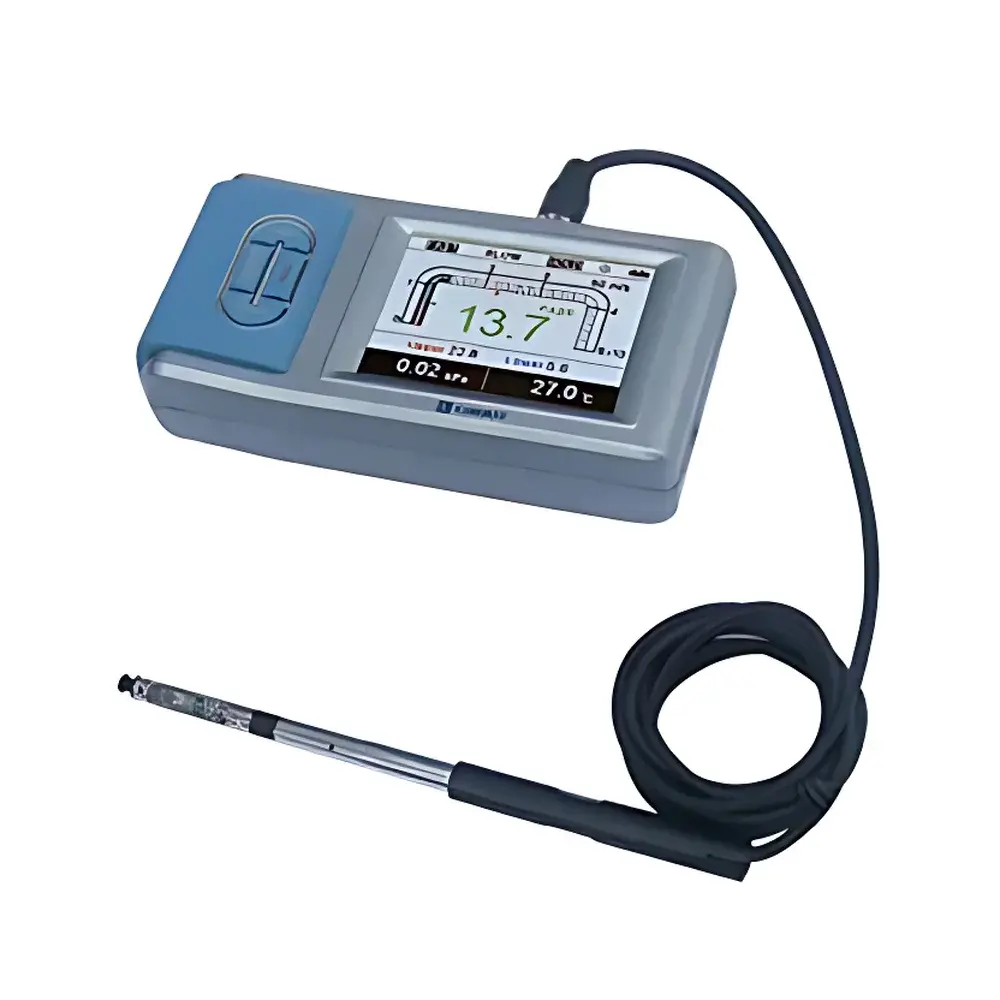
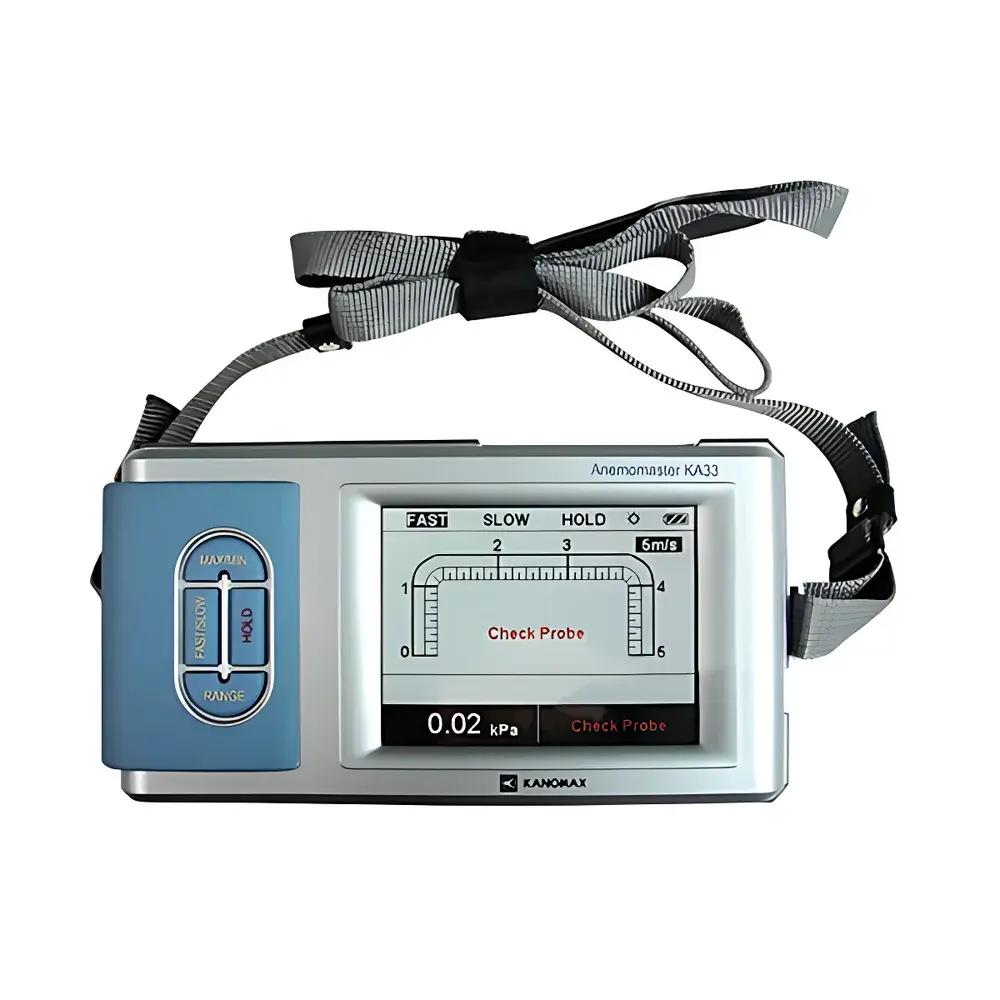
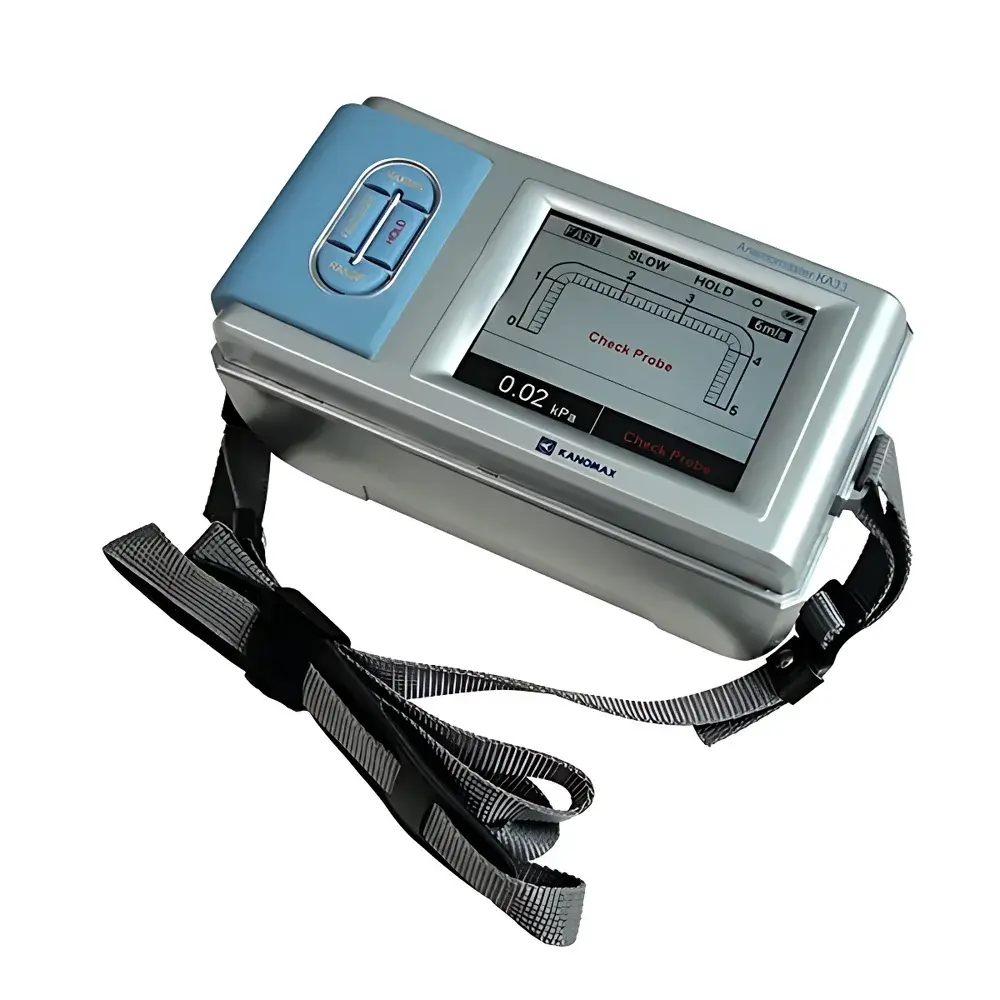
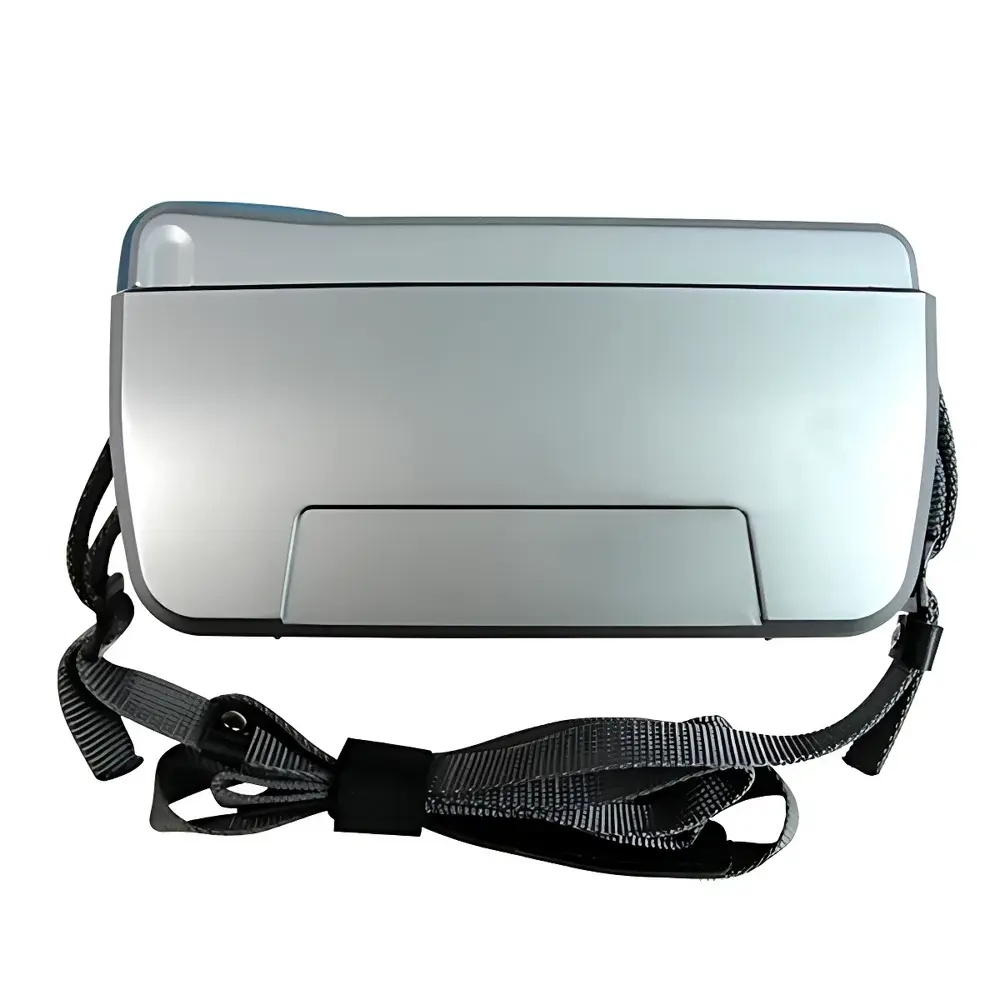
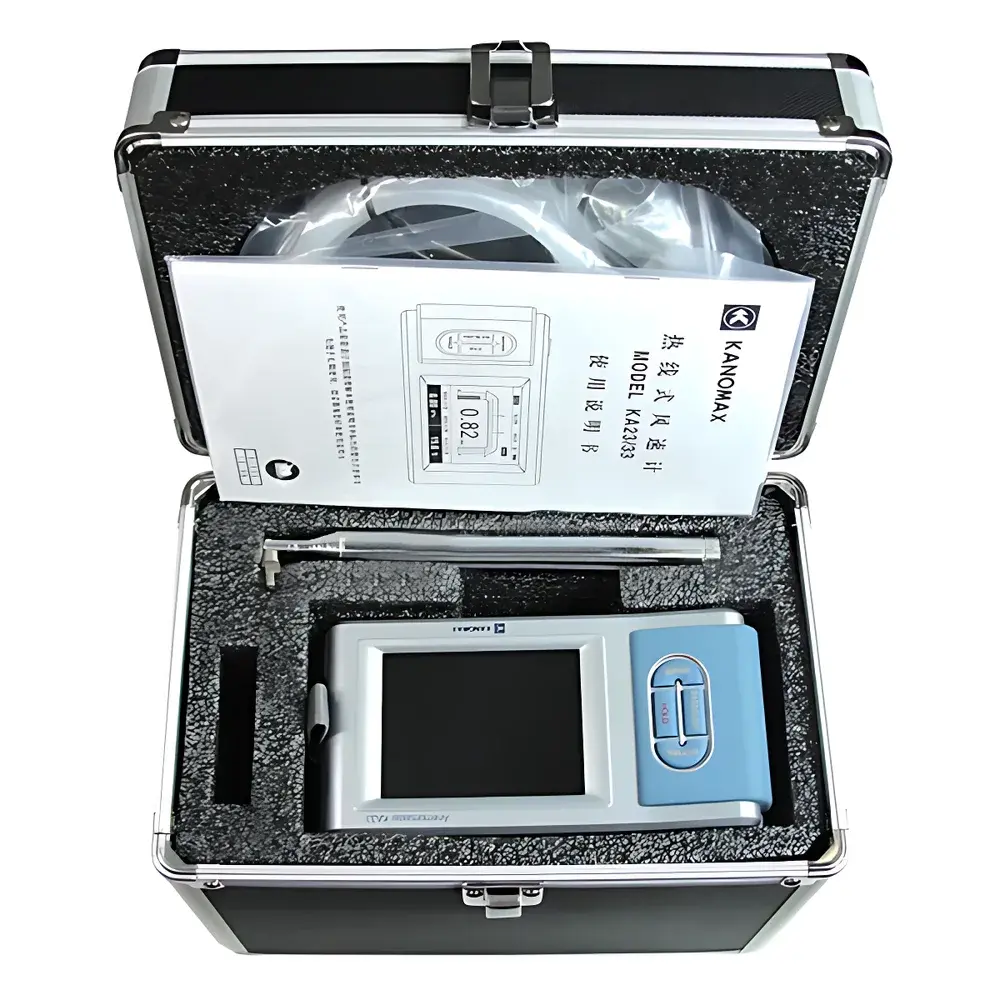
Kanomax KA23/KA33 Hot-Wire Anemometer
| Brand | Kanomax |
|---|---|
| Origin | Japan |
| Model | KA23 / KA33 |
| Instrument Type | Hot-Wire Anemometer |
| Velocity Range | 0.01–50.0 m/s |
| Resolution | 0.01 m/s (0.00–9.99 m/s), 0.1 m/s (10.0–50.0 m/s) |
| Accuracy | ±2% FS |
| Temperature Range | −20–100 °C |
| Temperature Accuracy | ±0.3 °C (−20–0 °C, 60–100 °C: ±0.5 °C) |
| Pressure Range | 0.00–±5.00 kPa |
| Pressure Accuracy | ±0.1 kPa |
| Humidity Range | 2.0–98.0% RH |
| Dimensions (Main Unit) | 157 × 42 × 80 mm (W × H × D) |
| Weight | ~450 g (incl. batteries) |
| Power | 4 × AA alkaline batteries or 5 V / 2 A AC adapter |
Overview
The Kanomax KA23 and KA33 are precision hot-wire anemometers engineered for reliable, real-time measurement of air velocity, temperature, and differential pressure in laboratory, HVAC, cleanroom, and industrial process environments. Based on constant-temperature anemometry (CTA), these instruments employ a thermally sensitive platinum-coated wire sensor whose heat dissipation correlates directly with local airflow velocity—enabling high-sensitivity detection across a broad dynamic range (0.01–50.0 m/s). Unlike cup or vane anemometers, the hot-wire principle delivers rapid response times (<100 ms), minimal flow disturbance, and excellent low-velocity resolution—critical for laminar flow verification, duct balancing, fume hood validation, and ISO 14644-3 compliance testing. Both models operate under ambient conditions ranging from −20 °C to +100 °C and relative humidity levels between 2.0% and 98.0% RH, with built-in temperature compensation circuitry ensuring stable calibration performance across variable thermal environments.
Key Features
- Simultaneous measurement of air velocity, temperature, and differential pressure in a single handheld unit
- Dual-display interface: digital numeric readout paired with analog bar-graph visualization for intuitive trend monitoring
- Three-level adjustable backlight for enhanced readability in low-light or high-glare conditions
- User-configurable upper/lower alarm thresholds for pass/fail wind-speed qualification in QA/QC workflows
- Interchangeable probe design—standard straight and retractable telescopic probes (Φ15 mm max diameter, 140–235 mm extension) maintain traceable accuracy without recalibration
- Onboard statistical functions: real-time calculation and display of maximum, minimum, and average velocity over user-defined sampling intervals
- Rugged, ergonomic housing (157 × 42 × 80 mm) with IP54-rated ingress protection against dust and splashing water
- Power flexibility: operation via four AA alkaline cells (typical runtime >20 h) or optional 5 V / 2 A AC adapter for continuous benchtop use
Sample Compatibility & Compliance
The KA23/KA33 is validated for use with clean, non-corrosive, non-particulate-laden air at standard atmospheric pressure (±5.00 kPa differential range). It is not intended for use in explosive atmospheres, saturated steam, or aggressive chemical vapors. The instrument complies with IEC 61000-4 electromagnetic compatibility standards and meets JIS B 7554 (Japanese Industrial Standard for anemometers) for metrological performance. While not certified to ISO/IEC 17025 as a standalone calibration system, its factory calibration is traceable to NMIJ (National Metrology Institute of Japan) standards. Data logging outputs support GLP-compliant documentation when integrated with external timestamped acquisition systems.
Software & Data Management
Although the KA23/KA33 does not include embedded Bluetooth or USB host functionality, it supports analog output (0–1 V or 0–5 V) for connection to programmable logic controllers (PLCs), data loggers, or SCADA platforms. Optional PC interface cables (sold separately) enable serial communication (RS-232) for periodic data export in CSV format. All internal measurements—including timestamps (when externally synchronized), min/max/avg values, and alarm status—are retained in volatile memory during active operation. For regulated environments requiring audit trails, integration with validated third-party software (e.g., LabVIEW or custom Python-based acquisition tools) facilitates 21 CFR Part 11–compliant electronic records when paired with appropriate user access controls and electronic signatures.
Applications
- HVAC system commissioning and TAB (Testing, Adjusting, Balancing) per ASHRAE Guideline 1
- Cleanroom airflow uniformity and velocity mapping per ISO 14644-3 Annex B
- Fume hood face velocity verification per ANSI/ASHRAE 110 and EN 14175
- Biological safety cabinet inflow/exhaust velocity checks per NSF/ANSI 49
- Industrial drying tunnel and oven air distribution profiling
- Environmental chamber airflow characterization in pharmaceutical stability testing
- Educational fluid dynamics labs requiring portable, repeatable velocity sensing
FAQ
What is the difference between the KA23 and KA33 models?
The KA23 is configured for basic velocity and temperature measurement; the KA33 adds integrated differential pressure sensing (±5.00 kPa) and enhanced data logging capability.
Can the probe be calibrated independently of the main unit?
Yes—each probe carries its own calibration coefficient stored in EEPROM, enabling plug-and-play interchangeability without loss of accuracy.
Is this instrument suitable for outdoor meteorological use?
No. It is designed for controlled indoor or semi-sheltered environments; unfiltered ambient particulates, rain, or direct solar exposure may compromise sensor longevity and measurement fidelity.
Does the device meet FDA or EU GMP requirements for environmental monitoring?
While not pre-certified for GMP, its metrological traceability, stability, and repeatability support qualification within GxP frameworks when incorporated into a documented IQ/OQ/PQ protocol.
How often should field verification be performed?
Kanomax recommends zero-point and span verification using a NIST-traceable reference anemometer at least daily before critical measurements or after mechanical shock or thermal cycling.
Related Products







