
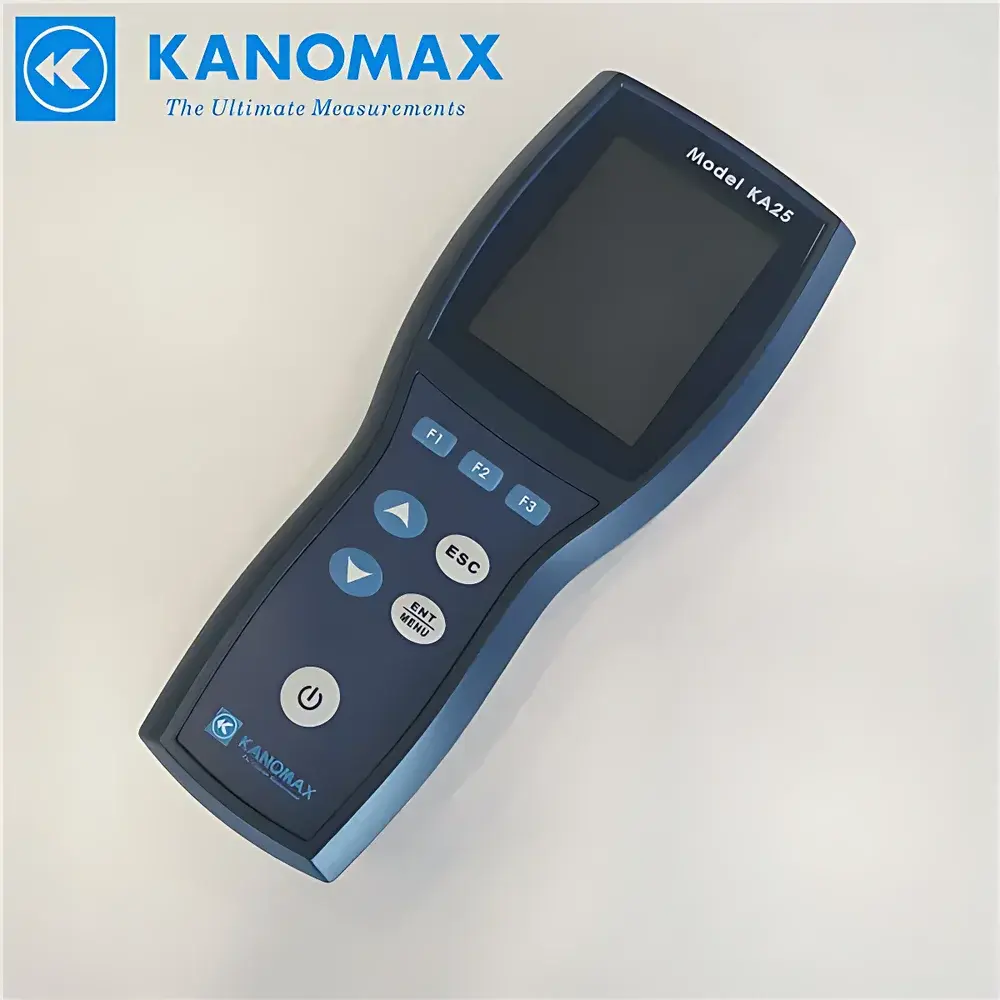
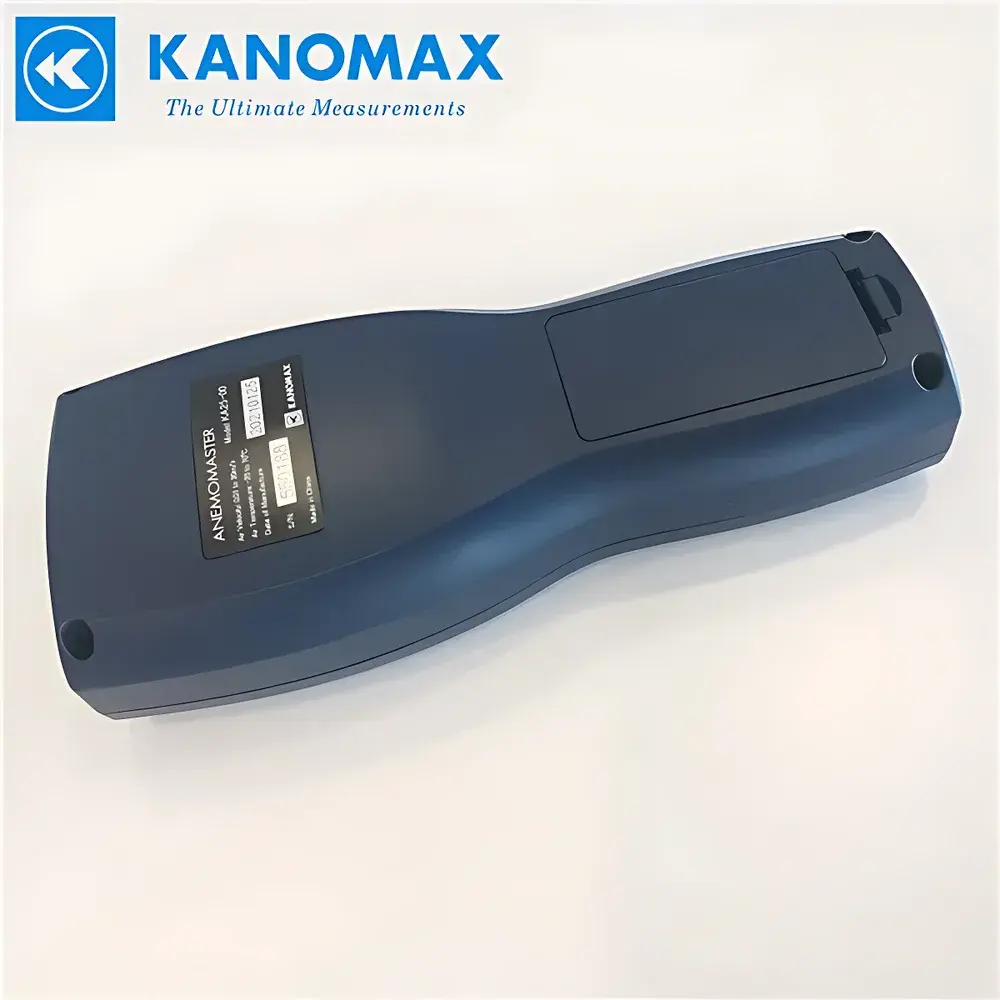
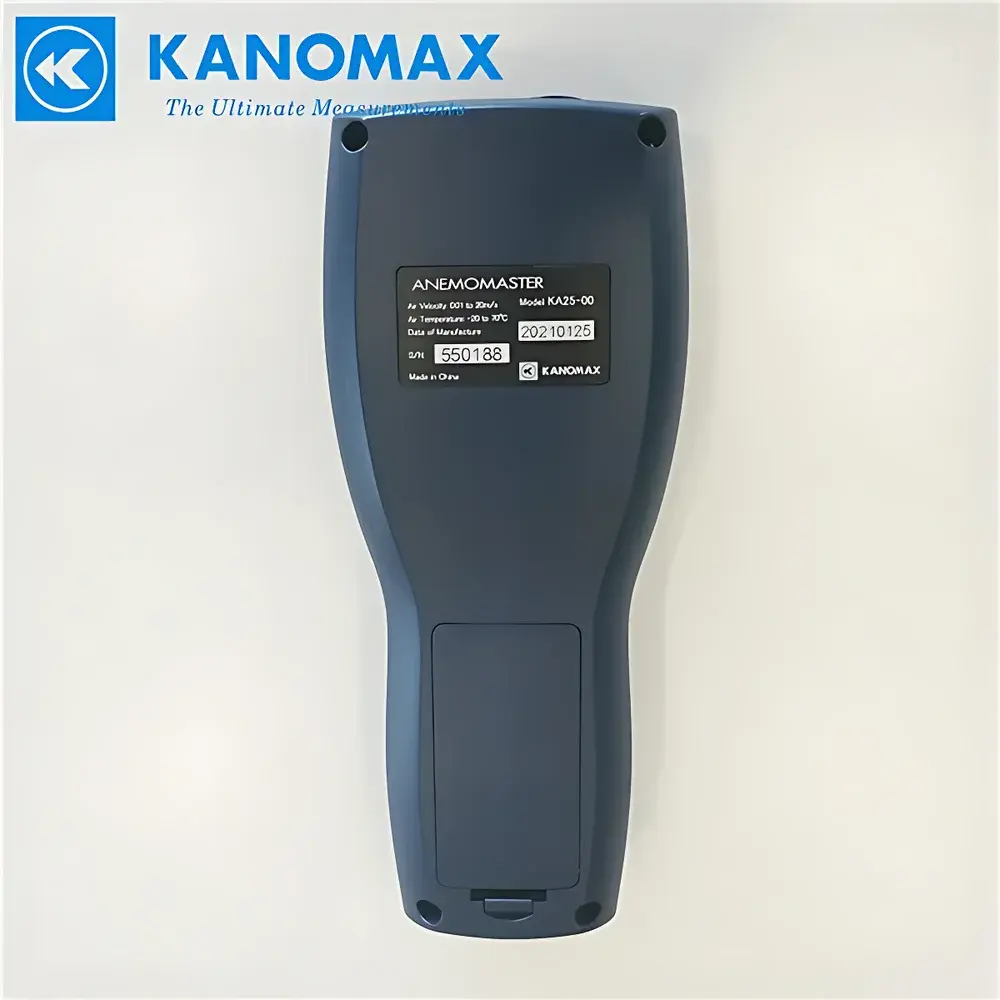
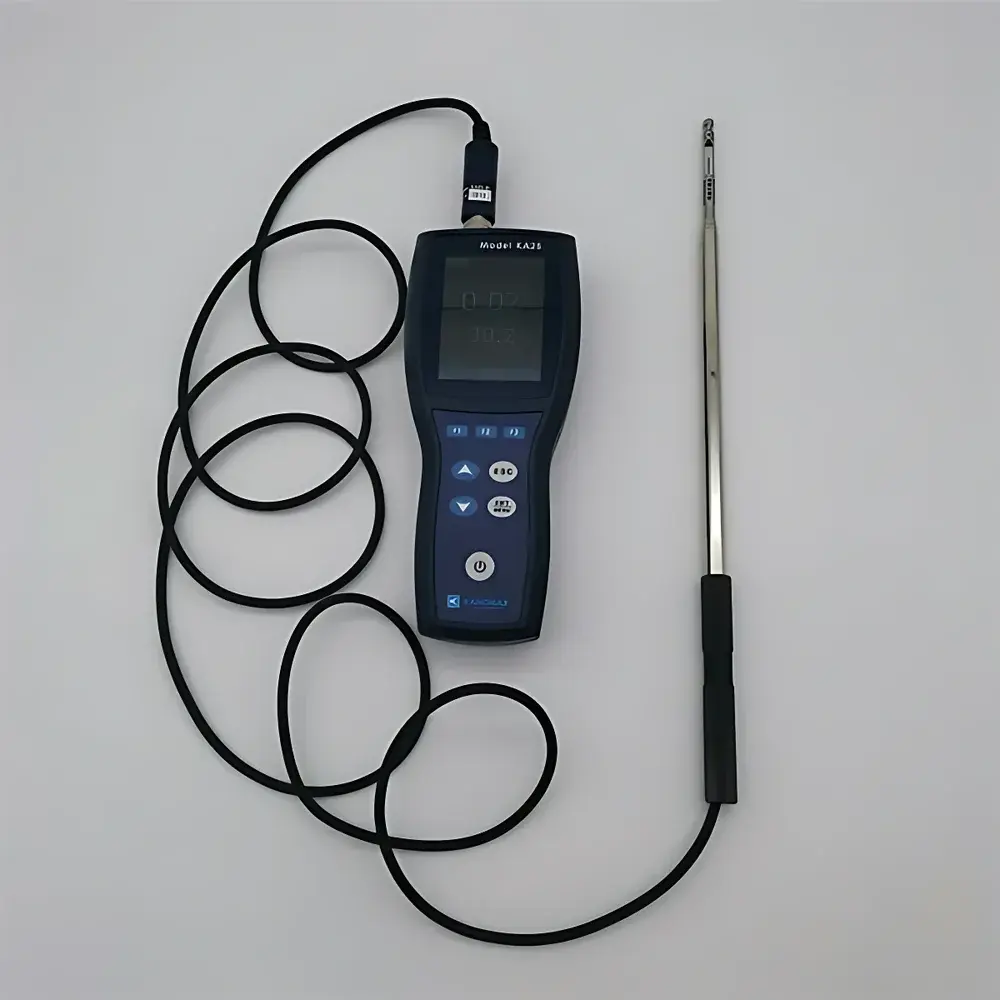
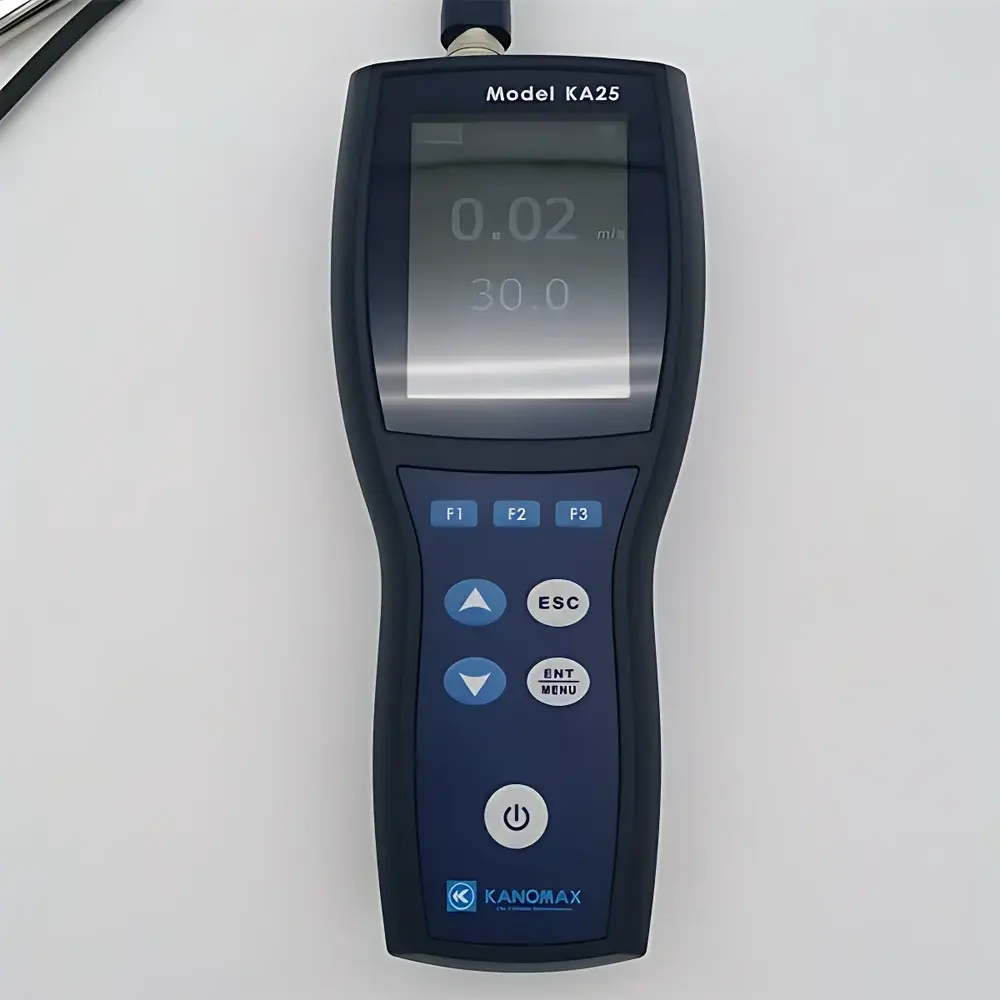
Kanomax KA25 Portable Thermal Anemometer
| Brand | Kanomax |
|---|---|
| Origin | Japan |
| Model | KA25 |
| Instrument Type | Thermal Anemometer |
| Resolution | 0.01 m/s |
| Measurement Range | 0.01–20.0 m/s |
| Accuracy | ±(3% of reading + 0.03 m/s) |
| Operating Temperature | −20 to 70 °C |
| Operating Humidity | 2–98% RH |
| Temperature Accuracy | ±0.5 °C (at v > 0.5 m/s) |
| Temperature Resolution | 0.1 °C |
| Response Time (Wind Speed) | ~1 s (90% response at 1 m/s) |
| Response Time (Temperature) | ~30 s (90% response at 1 m/s) |
| Pipe Shape Compatibility | Rectangular & Circular |
| Pipe Dimension Input Range | 0.1–255.0 cm |
| Air Volume Calculation | Yes (m³/h) |
| Data Hold Function | Yes |
| Time Constant Settings | 1 s / 5 s / 10 s / 20 s |
| Statistical Functions | Min / Avg / Max |
| Auto Power-Off | 3 / 5 / 10 min selectable |
| Display | 3-level backlight LCD |
| Power Supply | 4 × AA alkaline batteries |
| Battery Life | ~15 h (1 m/s, 20 °C) |
| Body Dimensions | 200 × 85 × 40 mm |
| Probe Dimensions | Ø6 mm (sensor) / Ø14 mm (handle) × 294–1060 mm (telescoping & bendable) |
| Cable Length | 2000 mm |
| Body Operating Temp. | 5–40 °C |
| Probe Operating Temp. | −20–70 °C |
| Storage Temp. | −20–60 °C |
| Weight | ~220 g (without batteries) |
| Standard Accessories | Main unit, telescoping probe, protective carrying case, quick-start guide, batteries |
Overview
The Kanomax KA25 Portable Thermal Anemometer is a precision-engineered handheld instrument designed for reliable, real-time measurement of air velocity and ambient temperature in HVAC commissioning, indoor air quality (IAQ) assessment, cleanroom validation, and industrial ventilation audits. Based on constant-temperature anemometry (CTA), the KA25 employs a fine-wire platinum resistance sensor heated above ambient temperature; airflow cools the sensor proportionally, enabling highly responsive and linear wind speed quantification across its full 0.01–20.0 m/s range. Unlike cup or vane anemometers, thermal sensing provides superior low-velocity resolution—critical for laminar flow verification, duct traverse studies, and fume hood face velocity checks per ASHRAE 110 and ISO 14644-3. The integrated temperature sensor (±0.5 °C accuracy above 0.5 m/s) supports simultaneous environmental monitoring, while built-in air volume computation eliminates manual calculation errors when cross-sectional area and average velocity are entered.
Key Features
- Telescoping and flexible probe (Ø6 mm sensor tip, Ø14 mm handle) with 294–1060 mm extension range—enables deep duct access and ergonomic positioning without compromising sensor alignment.
- Real-time statistical processing: automatic capture and display of minimum, maximum, and arithmetic mean values over user-defined intervals—essential for ISO 14644-1 particle concentration correlation and GMP-compliant airflow mapping.
- Selectable time constant (1 s / 5 s / 10 s / 20 s) allows optimization between dynamic response (e.g., turbulent jet profiling) and signal smoothing (e.g., steady-state duct surveys).
- Direct volumetric airflow calculation (m³/h) with support for both rectangular and circular duct geometries; pipe dimensions entered in centimeters (0.1–255.0 cm) trigger automatic cross-sectional area derivation.
- Three-level adjustable backlight LCD ensures legibility in low-light environments such as ceiling plenums or mechanical rooms; data hold function freezes readings during remote probe placement.
- Auto power-off (configurable at 3/5/10 minutes) and battery level indicator extend operational uptime; powered by four standard AA alkaline cells (~15 hours typical use at 1 m/s, 20 °C).
Sample Compatibility & Compliance
The KA25 is validated for use with clean, non-corrosive, non-particulate-laden air—making it suitable for ISO Class 5–8 cleanrooms, laboratory exhaust systems, and office HVAC networks. It is not rated for saturated steam, explosive atmospheres (ATEX), or high-dust environments without external filtration. While the instrument itself does not carry formal CE or UKCA marking for medical device use, its metrological performance aligns with calibration traceability requirements under ISO/IEC 17025-accredited laboratories. For regulatory documentation, users may generate audit-ready records—including timestamped min/avg/max logs—supporting compliance with FDA 21 CFR Part 11 (when paired with validated data export workflows), EU GMP Annex 1 (airflow uniformity verification), and ASHRAE Guideline 12 (infection control ventilation testing).
Software & Data Management
The KA25 operates as a standalone field instrument with no proprietary software dependency. All measurements are displayed and stored locally on the device’s internal memory; numerical results—including instantaneous velocity, temperature, computed airflow, and statistics—are viewable directly on the LCD. Data export requires manual transcription or optional third-party USB-to-serial adapters (not supplied). For integration into digital QA/QC platforms, users commonly pair the KA25 with spreadsheet-based templates compliant with ASTM D1078 (air velocity measurement practices) or internal SOPs requiring GLP-style metadata annotation (operator ID, location tag, calibration date). Firmware updates are not supported—the design prioritizes long-term stability and field robustness over connectivity features.
Applications
- HVAC system balancing and TAB (Testing, Adjusting, Balancing) per SMACNA and NEBB standards.
- Cleanroom airflow visualization and uniformity mapping in pharmaceutical and microelectronics manufacturing.
- Fume hood and biosafety cabinet face velocity verification (OSHA 1910.1450, ANSI/AIHA Z9.5).
- Indoor air quality (IAQ) baseline surveys per ASHRAE Standard 62.1 and EN 16798-1.
- Educational laboratory experiments in fluid dynamics and thermodynamics where portability and repeatability are essential.
- Preventive maintenance inspections of exhaust stacks, supply diffusers, and return grilles.
FAQ
What calibration standards does the KA25 conform to?
The KA25 is factory-calibrated against NIST-traceable reference anemometers in controlled wind tunnels. Users should perform periodic verification using a certified reference standard—typically every 6–12 months depending on usage frequency and criticality of application.
Can the KA25 measure airflow in exhaust ducts with high particulate content?
No. The thermal sensor is susceptible to contamination and drift when exposed to oil mist, dust, or condensate. Use only in clean air streams; install inline particulate filters if upstream contamination is unavoidable.
Is the probe waterproof or intrinsically safe?
The probe is not IP-rated for immersion or ingress protection, nor is it certified for hazardous locations. Avoid exposure to rain, condensation, or flammable vapors.
Does the KA25 support data logging over extended periods?
No. It lacks internal time-stamped logging memory. For continuous monitoring, consider the Kanomax 6162 or 6501 series with SD card storage and PC interface.
How is traceability maintained during field use?
Each unit ships with a factory calibration certificate listing serial number, date, and deviation values at multiple points across the velocity range. Users must retain this document alongside their own calibration verification records to satisfy ISO 9001 or ISO 13485 audit requirements.
Related Products







