
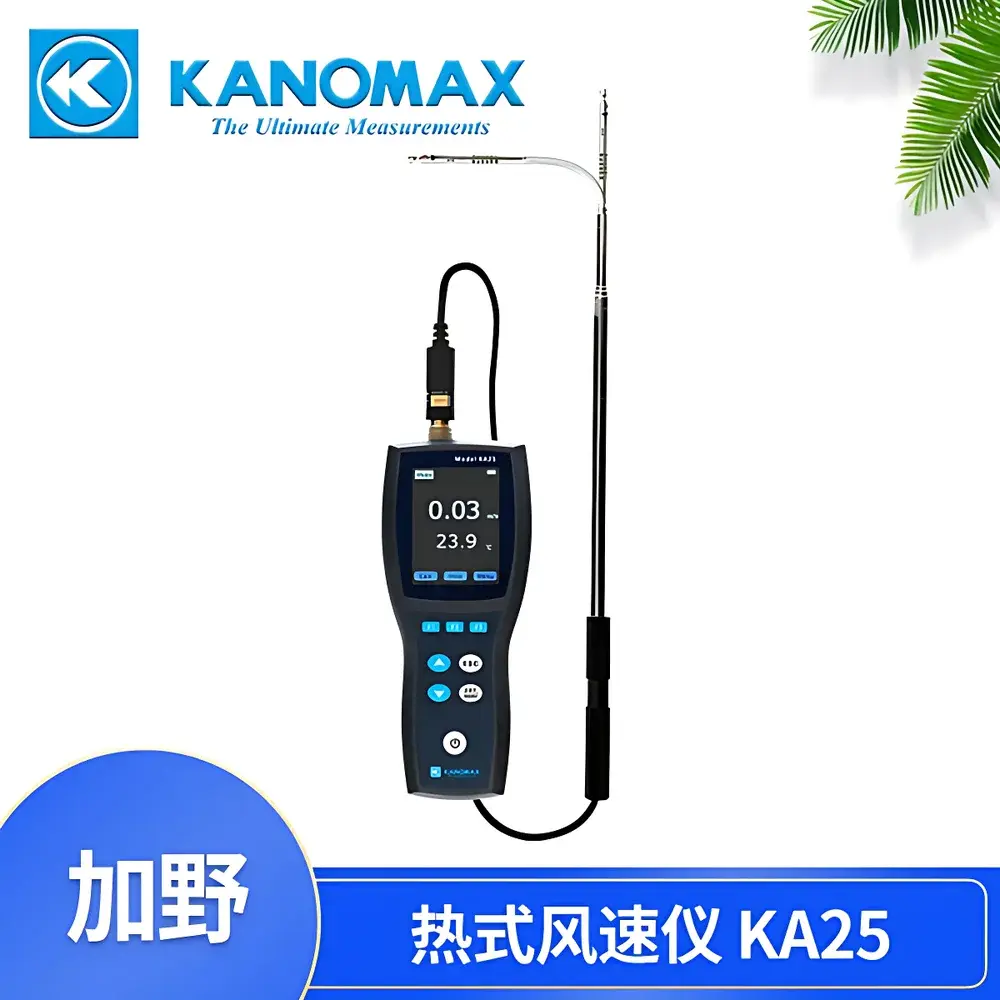
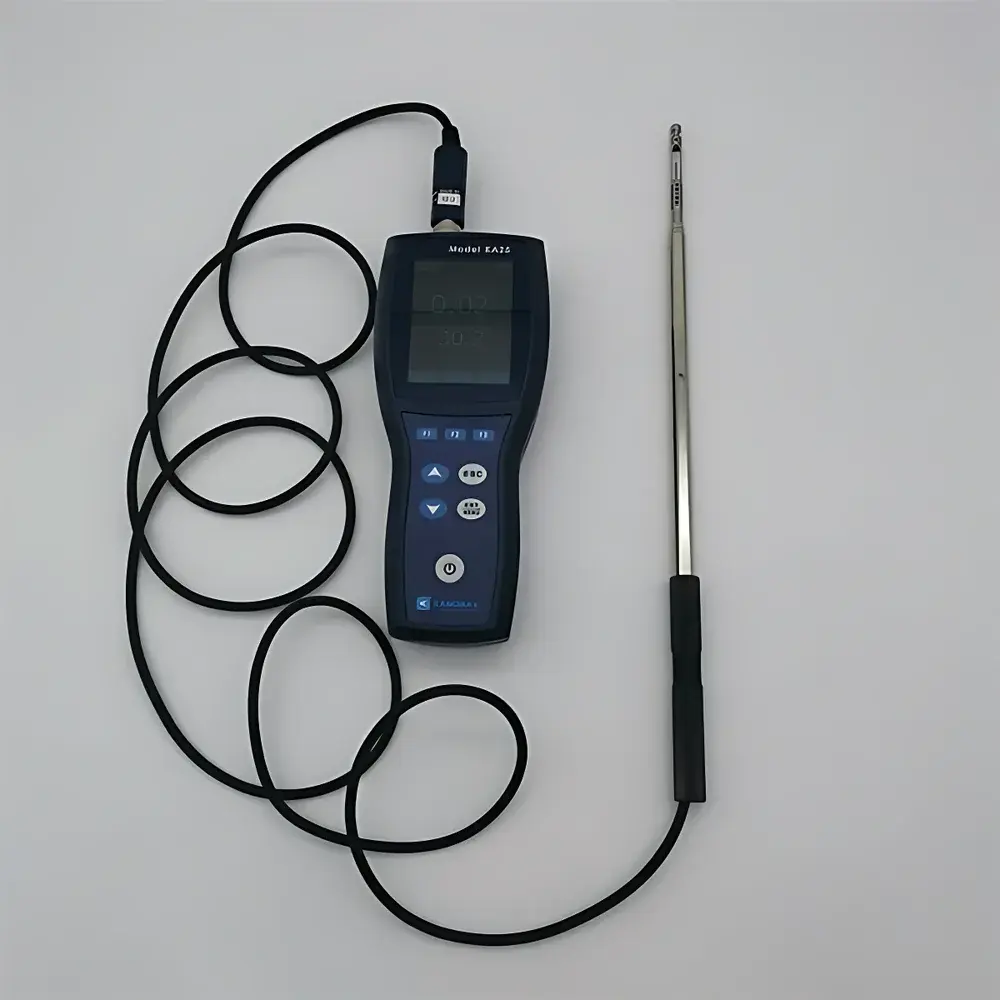
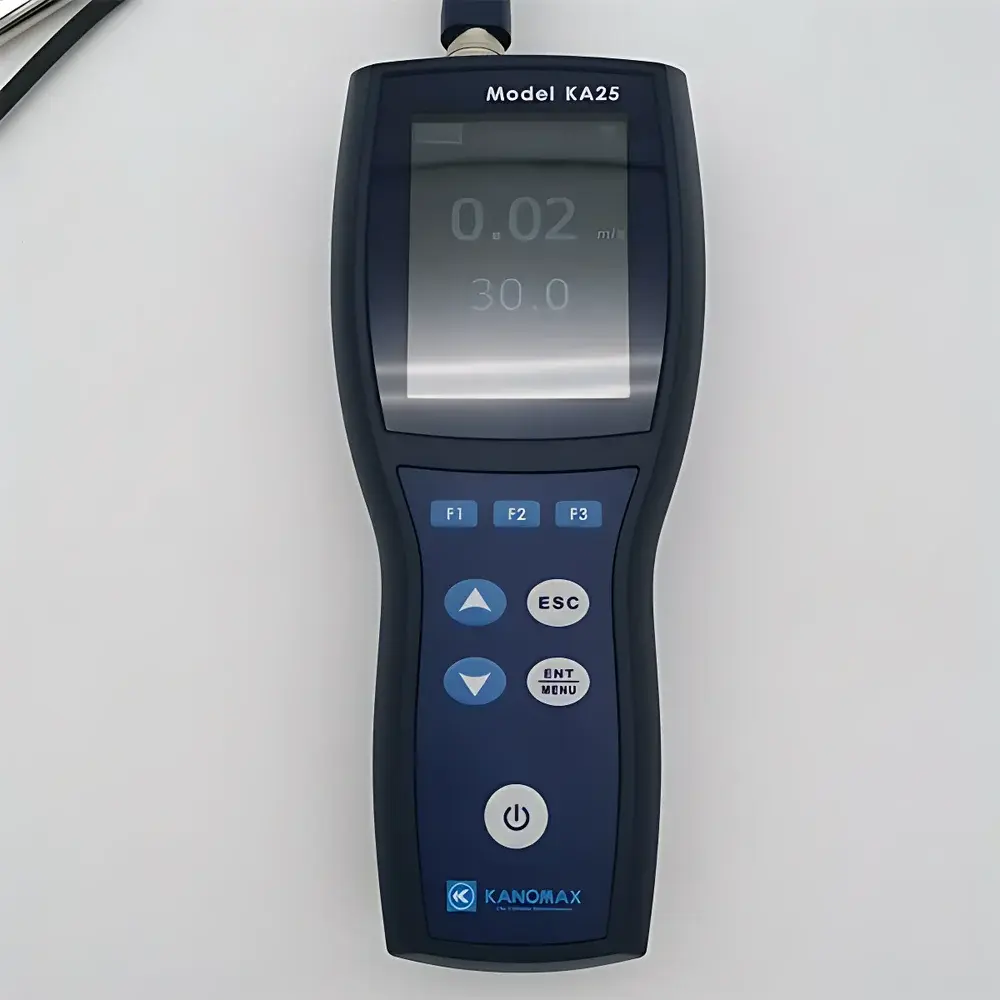
Kanomax KA25 Thermal Anemometer for Cleanroom Environmental Monitoring
| Brand | Kanomax |
|---|---|
| Origin | Liaoning, China |
| Manufacturer Type | Authorized Distributor |
| Country of Origin | China |
| Model | KA25 |
| Instrument Type | Thermal Anemometer |
| Velocity Range | 0.01–20.0 m/s |
| Velocity Accuracy | ±(3% of reading + 0.03 m/s) |
| Velocity Resolution | 0.01 m/s |
| Temperature Range | −20–70 °C |
| Temperature Accuracy | ±0.5 °C (at v > 0.5 m/s) |
| Temperature Resolution | 0.1 °C |
| Airflow Calculation | Up to 1 m³/h (based on user-input duct dimensions) |
| Response Time (90%) | ~1 s (velocity, at 1 m/s), ~30 s (temperature, at 1 m/s) |
| Duct Types Supported | Rectangular and circular |
| Duct Dimension Input Range | 0.1–255.0 cm |
| Data Hold Function | Yes |
| Time Constant Settings | 1 s / 5 s / 10 s / 20 s |
| Display | 3-level backlight LCD |
| Power | 4 × AA alkaline batteries |
| Battery Life | Approx. 15 hours (1 m/s, 20 °C) |
| Operating Temp (Body) | 5–40 °C |
| Operating Temp (Probe) | −20–70 °C |
| Storage Temp | −20–60 °C |
| Body Dimensions | 200 × 85 × 40 mm |
| Probe Dimensions | Ø6 mm (sensor) / Ø14 mm (handle) × 294–1060 mm (telescoping & flexible) |
| Cable Length | 2000 mm |
| Weight | ~220 g (body only, no batteries) |
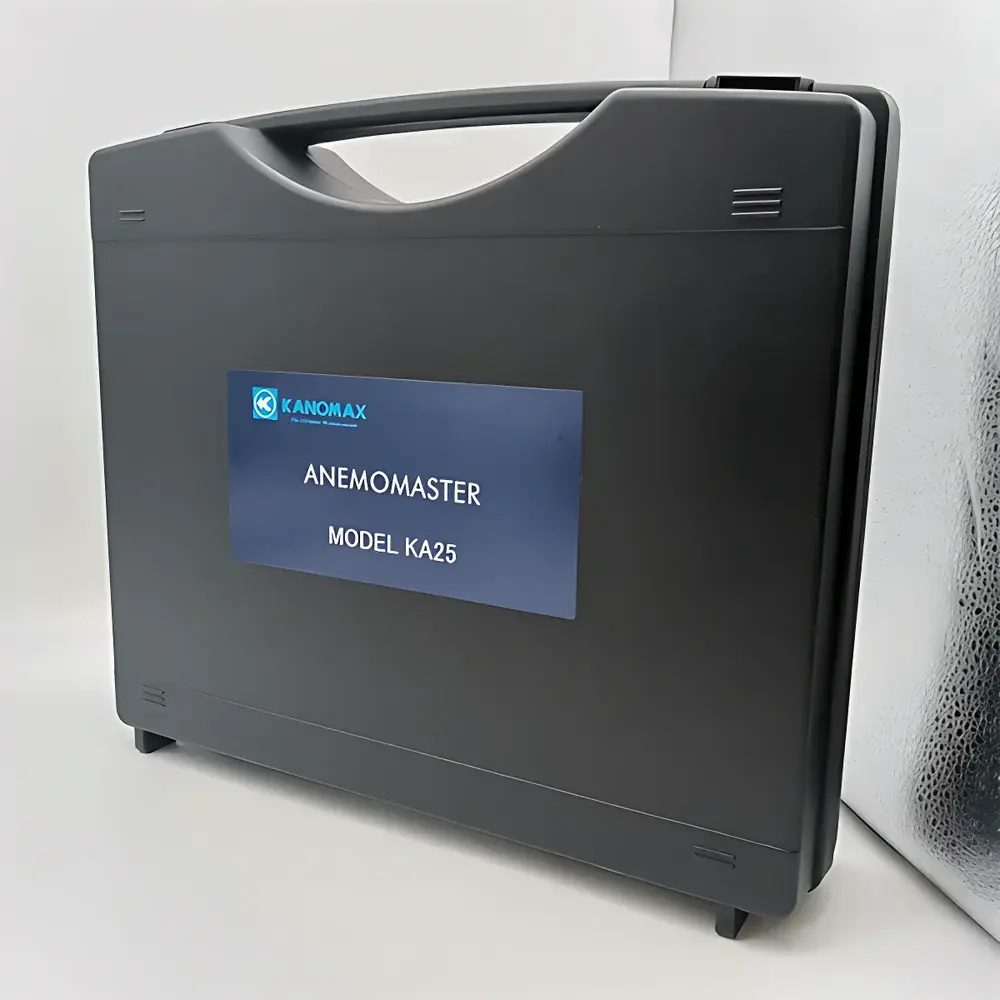
| Standard Accessories | Main unit, telescoping/flexible probe, carrying case, quick-start manual, batteries |
Overview
The Kanomax KA25 Thermal Anemometer is a precision-engineered instrument designed specifically for airflow validation and routine monitoring in regulated clean environments—including ISO Class 5–8 pharmaceutical cleanrooms, microelectronics fabrication zones, aseptic processing suites, and controlled laboratory hoods. It operates on constant-temperature anemometry (CTA) principles: a heated thermistor sensor dissipates heat proportionally to local air velocity, enabling direct, real-time measurement of low-velocity laminar and turbulent flows without mechanical moving parts. Its calibrated range (0.01–20.0 m/s) meets the stringent requirements of EU GMP Annex 1 (2022), ISO 14644-3:2019, and FDA Guidance for Aseptic Processing, where uniformity and stability of unidirectional airflow—particularly below 0.45 m/s—are critical for particle control and contamination risk mitigation.
Key Features
- Simultaneous dual-parameter measurement: air velocity and temperature, with independent calibration traceability for both channels.
- Telescoping and bendable probe (Ø6 mm sensing tip, Ø14 mm handle, 294–1060 mm extended length) enables access to high-mounted diffusers, HEPA filter outlets, and confined ductwork without disassembly.
- On-device airflow calculation: users input duct geometry (rectangular or circular) and dimensions (0.1–255.0 cm); the instrument computes volumetric flow rate (m³/h) in real time using standardized cross-sectional area algorithms.
- Configurable time constant (1 s / 5 s / 10 s / 20 s) allows optimization for transient vs. steady-state measurements—essential when characterizing airflow recovery after door openings or equipment operation.
- Statistical data logging: automatic capture and display of minimum, maximum, and average values over user-defined intervals; supports manual data hold and auto power-off (3/5/10 min).
- Robust environmental tolerance: probe rated for −20–70 °C enables use in cold storage rooms, sterilization tunnels, and ambient-controlled manufacturing spaces.
Sample Compatibility & Compliance
The KA25 is validated for use with clean, non-corrosive, particle-free air—consistent with ISO 14644-1 particle concentration limits for Class 5–8 environments. It is not suitable for humidified, oily, or chemically aggressive airstreams. While the instrument itself does not carry CE marking for medical devices, its metrological performance aligns with ASTM D1072–21 (Standard Test Method for Air Velocity Measurement) and supports compliance with ISO 14644-3 Annex B (Air Velocity Uniformity Testing). When deployed as part of a documented qualification protocol (IQ/OQ/PQ), it satisfies regulatory expectations for periodic requalification under EU GMP and PIC/S guidelines. Traceable calibration certificates (NIST-traceable reference standards) are available upon request.
Software & Data Management
The KA25 operates as a standalone field instrument with no proprietary PC software dependency. All measurement data remain on-device and are viewable via the backlit LCD interface. No internal memory or USB export capability is provided; therefore, manual transcription or external digital logging (e.g., via tablet-based SOP checklists) is required for long-term record retention. The absence of electronic data storage ensures full compliance with 21 CFR Part 11 “paper-based” workflows where audit trails are maintained manually—and eliminates cybersecurity or firmware update liabilities common in connected instruments. Battery status, duct type, and active time constant are continuously displayed, reducing operator error during multi-point surveys.
Applications
- ISO 14644-3 airflow uniformity mapping across cleanroom ceiling grids and laminar flow workstations.
- HEPA/ULPA filter face velocity verification per EU GMP Annex 1 §4.39 and ISO 14644-3 Table C.1.
- Supply/exhaust grille balancing in HVAC systems serving sterile manufacturing areas.
- Environmental monitoring during media fill simulations and process simulation studies.
- Validation of airflow patterns in biosafety cabinets (Class II A2/B2) and laminar flow hoods.
- Routine QC checks in semiconductor clean fabs where sub-0.1 m/s laminar flow stability must be confirmed.
FAQ
Is the KA25 suitable for ISO Class 5 (Grade A) laminar airflow verification?
Yes—its 0.01 m/s resolution and ±(3% + 0.03 m/s) accuracy at low velocities meet the technical requirements for Grade A zone monitoring, provided measurements are performed per ISO 14644-3 Annex B and documented within a validated procedure.
Can the probe be sterilized or autoclaved?
No—the probe is not autoclavable or chemically sterilizable. For aseptic applications, it must be cleaned using approved non-abrasive disinfectants (e.g., 70% IPA) and verified for residual contamination prior to entry into classified zones.
Does the instrument support GLP/GMP-compliant calibration records?
Yes—Kanomax-certified calibration reports (including as-found/as-left data, uncertainty budgets, and NIST-traceable references) can be supplied separately for integration into quality management systems.
What is the recommended recalibration interval?
Annual recalibration is advised under routine use; however, frequency should be justified by risk assessment, usage intensity, and historical performance data per ISO/IEC 17025:2017 Clause 7.8.3.
Is the KA25 compliant with FDA 21 CFR Part 11?
As a non-networked, non-electronic-record device, it falls outside the scope of Part 11 requirements. Its paper-based output model inherently satisfies traditional ALCOA+ data integrity principles when used with controlled forms and handwritten entries.
Related Products







