
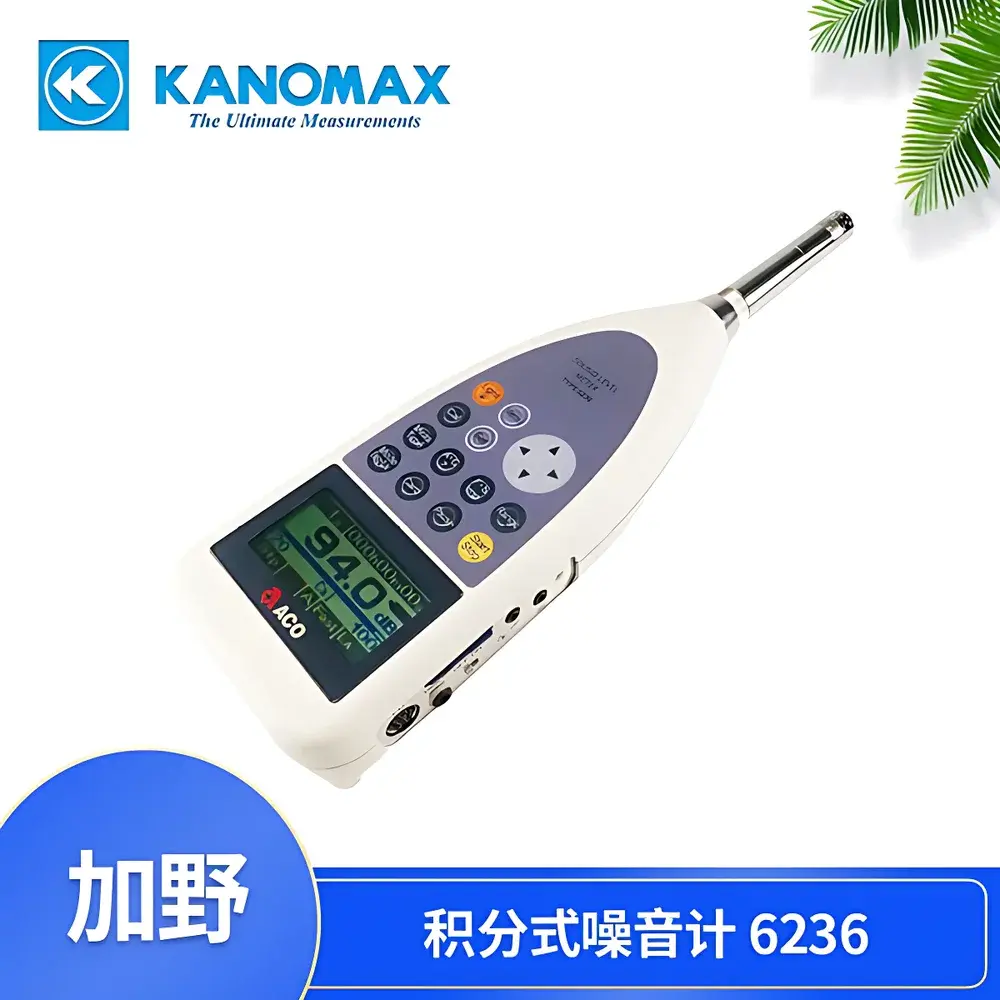
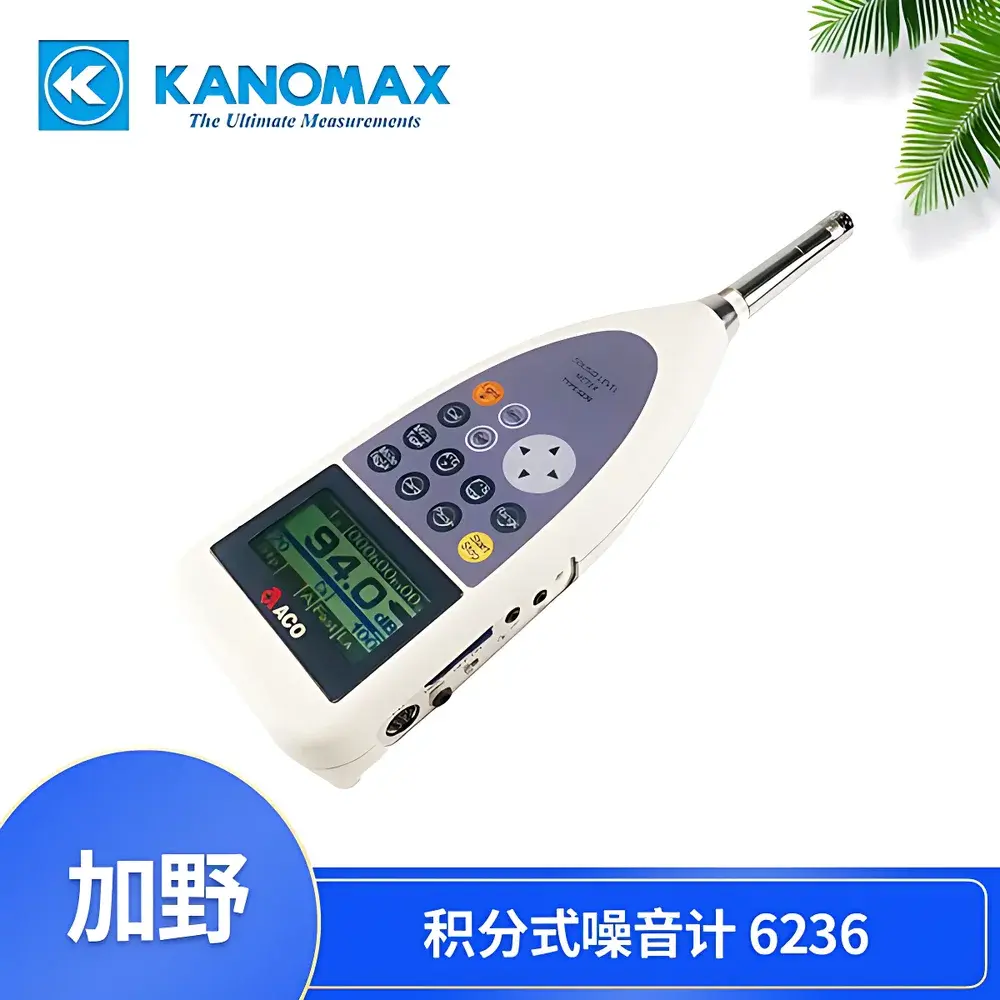
Kanomax Model 6236 Type 1 Precision Integrating Sound Level Meter
| Brand | Kanomax |
|---|---|
| Origin | Japan |
| Model | 6236 |
| Instrument Type | Handheld Integrating Sound Level Meter |
| Frequency Range | 20–8,000 Hz |
| Measurement Ranges | 28–130 dB(A), 30–130 dB(C), 38–130 dB(Z) |
| Self-Noise | 0.1 dB |
| Accuracy | ±0.1 dB |
| Maximum Measurement Duration | 199 h 59 min 59 s |
| Microphone | Type 7146NL (Sensitivity: −28 dB re 1 V/Pa, free-field) |
| Conformance | IEC 61672-1:2013 Class 1, ANSI S1.4-2014 Type 1 |
| Time Weighting | Fast / Slow |
| Frequency Weighting | A / C / Z |
| Power Supply | 4 × AA batteries (≈9 h operation) or AC adapter |
| Dimensions & Weight | 86 × 285 × 46 mm, ≈450 g |
Overview
The Kanomax Model 6236 is a Class 1 integrating sound level meter engineered for high-accuracy environmental noise assessment in compliance with international metrological standards. It operates on the principle of electret condenser microphone transduction—utilizing the Type 7146NL precision microphone with calibrated free-field response—to convert acoustic pressure fluctuations into stable electrical signals. The instrument implements real-time digital signal processing (DSP) to compute time-weighted (Fast/Slow), frequency-weighted (A/C/Z), and statistically integrated metrics—including Leq (equivalent continuous sound level), Lmax/Lmin, Lpeak, single-event noise (SEL), and time-percentile levels (L10, L50, L90). Its design targets long-duration field deployments, supporting uninterrupted logging up to 199 hours, 59 minutes, and 59 seconds—making it suitable for 24/7 community noise monitoring, construction site compliance verification, and urban acoustic mapping per ISO 1996-1 and ISO 1996-2.
Key Features
- Class 1 performance per IEC 61672-1:2013 and ANSI S1.4-2014, certified for regulatory-grade environmental noise surveys.
- Triple-frequency weighting modes (A, C, Z) with selectable time constants (Fast: 125 ms; Slow: 1 s) to support diverse assessment protocols—from human-perceived loudness (A-weighted) to low-frequency energy analysis (Z-weighted).
- High-resolution backlit LCD display with dynamic analog bar graph for real-time visual feedback during measurement acquisition.
- Modular program card architecture enables rapid configuration for standardized test routines: e.g., traffic noise (ISO 1996-2 Annex B), industrial facility boundary monitoring (ISO 1996-1), or railway noise event analysis (EN 15663).
- Low self-noise floor of 0.1 dB ensures reliable detection of faint ambient signals without electronic interference—critical for rural baseline studies or quiet zone verification.
- Robust mechanical housing (86 × 285 × 46 mm, 450 g) optimized for handheld ergonomics and field durability, with IP54-rated ingress protection against dust and water splashes.
Sample Compatibility & Compliance
The Model 6236 is designed for outdoor and indoor environmental sampling across heterogeneous acoustic environments—including residential zones, transportation corridors, industrial perimeters, and protected natural areas. It supports direct integration with tripod mounts and windshields (optional accessories) for meteorologically robust measurements per ISO 1996-2:2017 Annex A. All calibration and data acquisition workflows comply with GLP-aligned traceability requirements: microphone sensitivity is factory-traceable to NMIJ (National Metrology Institute of Japan), and internal calibration checks conform to IEC 61260-1:2014 for octave-band verification. The device meets statutory requirements for noise ordinance enforcement in EU member states (Directive 2002/49/EC), U.S. EPA Method 202, and China’s GB 3096-2008 standard for ambient noise limits.
Software & Data Management
Data export is supported via USB interface to PC-based analysis software (Kanomax Sound Analysis Suite, compatible with Windows 10/11). Raw time-series datasets (sampled at 2 kHz) and statistical summaries are stored in CSV and proprietary .KSL formats, preserving full metadata—including date/time stamps, GPS coordinates (when paired with external GNSS module), microphone serial number, and calibration history. Audit trails include operator ID, session start/stop timestamps, and firmware version—enabling full 21 CFR Part 11-compliant record retention when deployed under quality management systems (QMS). Exported files are directly importable into third-party tools such as MATLAB, Python (SciPy/Acoustics libraries), and noise modeling platforms (SoundPLAN, CadnaA).
Applications
- Regulatory compliance monitoring for municipal noise ordinances and national environmental protection agencies.
- Pre- and post-construction noise impact assessments aligned with ISO 14001 environmental management frameworks.
- Long-term trend analysis of urban soundscapes using Leq and Lden metrics over diurnal, weekly, or seasonal cycles.
- Occupational hygiene screening in mixed-use developments where residential and commercial activities coexist.
- Acoustic validation of noise barrier efficacy along highways and rail infrastructure projects.
- Baseline characterization for environmental impact statements (EIS) and EIA reporting under NEPA or equivalent national legislation.
FAQ
Is the Model 6236 suitable for occupational noise exposure assessment (e.g., OSHA or ISO 9612)?
No—it is configured for environmental noise, not personal dosimetry. For workplace exposure, Kanomax offers the Model 4430 series with octave-band analysis and dose calculation per ISO 9612:2017.
Does the device support real-time octave-band or 1/3-octave analysis?
No—octave analysis requires external FFT modules or dedicated analyzers such as the Kanomax 4440. The 6236 focuses on integrated broadband metrics.
Can measurement data be timestamped with GPS location?
Yes—via optional Bluetooth GNSS receiver (e.g., u-blox NEO-M8N module), enabling georeferenced noise mapping in GIS-compatible formats.
What is the recommended calibration interval?
Annual accredited calibration is advised per ISO/IEC 17025; field verification with a Class 1 pistonphone (e.g., Kanomax 9410) should be performed before each measurement campaign.
Is the battery life extended when using AC power?
Yes—AC adapter operation eliminates battery drain and enables continuous logging beyond the 9-hour battery limit, essential for multi-day stationary monitoring.







