
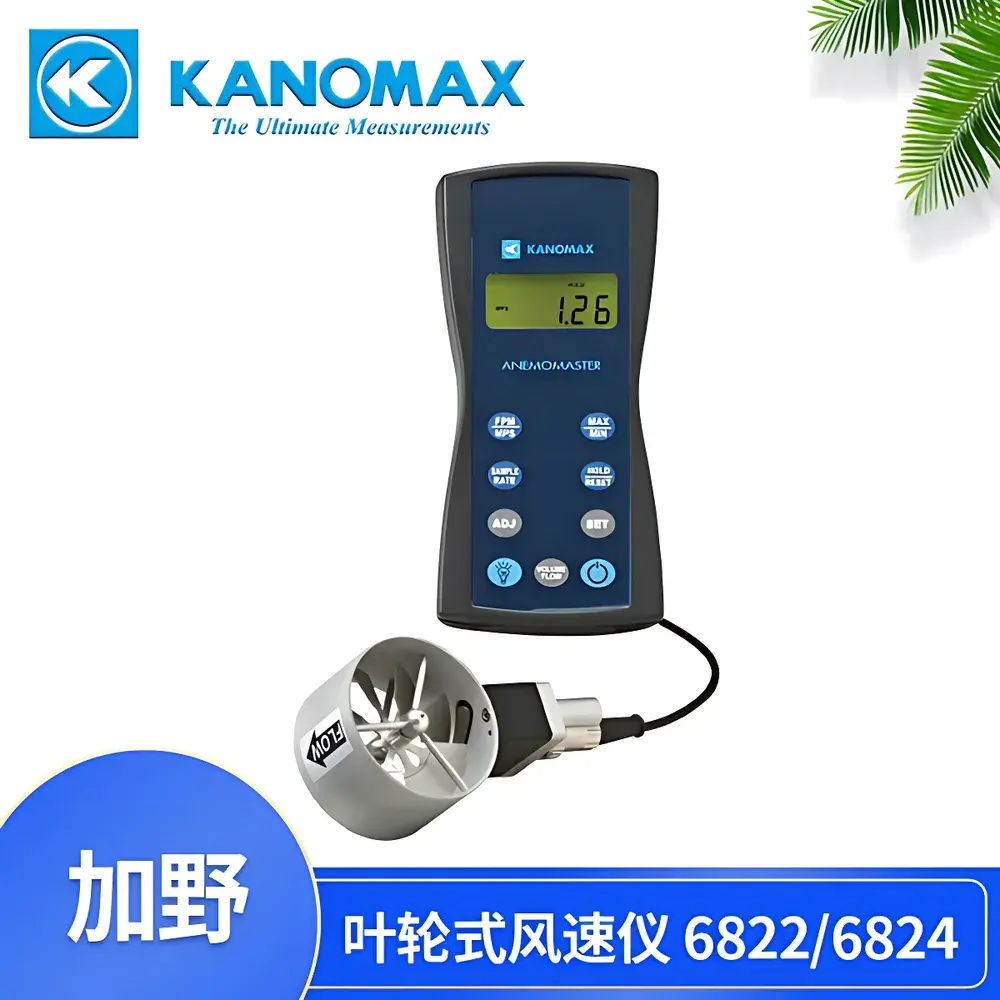
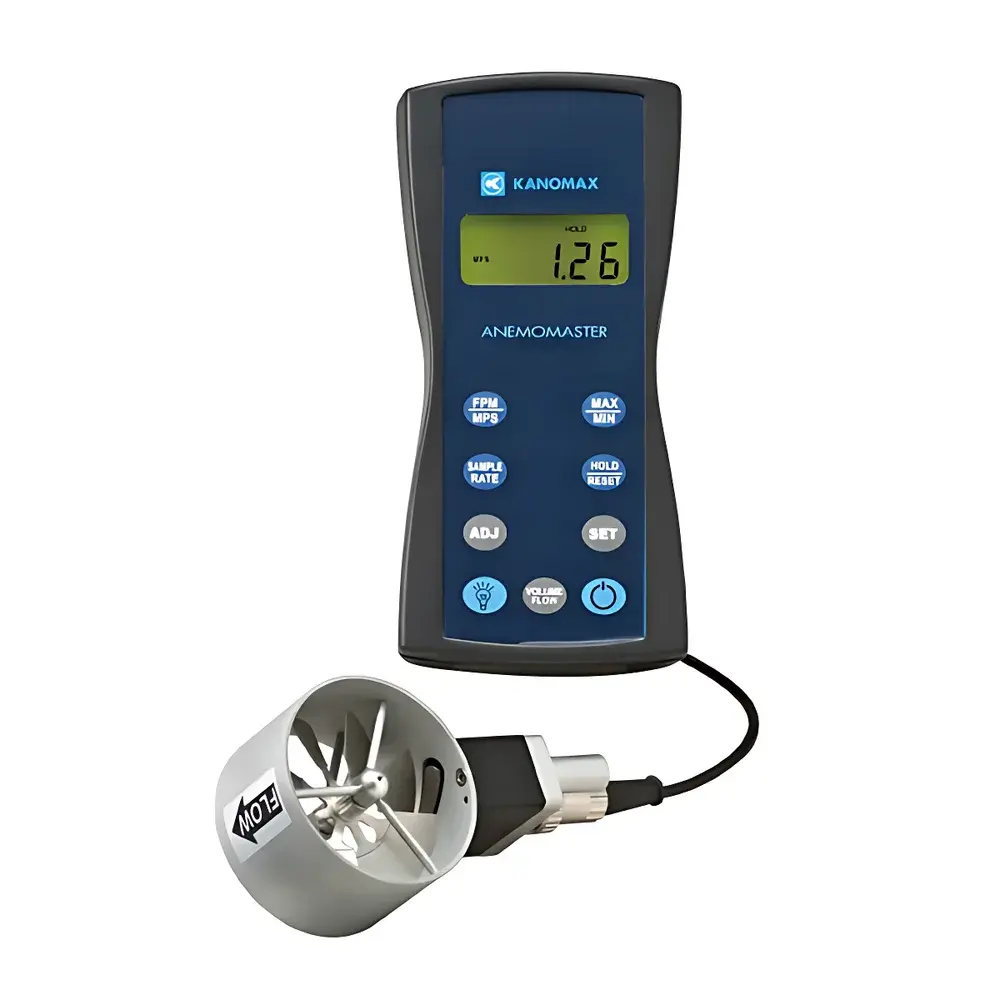
Kanomax Model 6822/6824 Vane Anemometer for Cleanroom Environmental Monitoring
| Brand | Kanomax |
|---|---|
| Origin | Liaoning, China |
| Model | 6822 / 6824 |
| Instrument Type | Vane Anemometer |
| Velocity Range | 0.2–20.0 m/s |
| Accuracy | ±3% of reading or ±0.1 m/s (whichever is greater) |
| Temperature Range | −20–100 °C |
| Temperature Accuracy | ±1.0 °C |
| Airflow Range | 0–9,999 CFM |
| Probe Diameter | 70 mm |
| Power Source | Alkaline batteries |
| Battery Life | ~150 hours |
| Dimensions (W×H×D) | 81 × 165 × 38 mm |
| Weight | 175 g (including batteries) |
Overview
The Kanomax Model 6822 and 6824 vane anemometers are precision-engineered instruments designed for reliable air velocity, temperature, and volumetric airflow measurement in controlled environments—particularly cleanrooms, HVAC validation zones, laminar flow hoods, and pharmaceutical manufacturing suites. These devices operate on the principle of rotational torque induction: airflow impinges on a calibrated axial vane rotor, whose angular velocity is linearly proportional to incident airspeed. The integrated thermistor sensor provides simultaneous temperature measurement, enabling real-time correction of density-dependent airflow calculations. Unlike hot-wire or thermal anemometers, the vane design offers superior mechanical robustness, resistance to particulate fouling, and stable performance across wide temperature gradients (−20 °C to +100 °C), making them especially suitable for ductwork, exhaust grilles, and HEPA filter outlet testing where particle-laden or thermally variable airstreams are common.
Key Features
- Vane-based sensing architecture ensures long-term stability and minimal drift under repeated exposure to airborne particulates typical in ISO Class 5–8 cleanrooms.
- Dual-parameter capability: simultaneous measurement of air velocity (0.2–20.0 m/s) and ambient temperature (−20–100 °C) with independent accuracy specifications (±3% of reading or ±0.1 m/s for velocity; ±1.0 °C for temperature).
- Onboard airflow computation engine accepts user-defined duct geometry (rectangular, circular, or irregular cross-sections) and automatically calculates volumetric flow rate in cubic feet per minute (CFM), eliminating manual conversion errors.
- Compact handheld form factor (81 × 165 × 38 mm) and lightweight construction (175 g with batteries) facilitate single-handed operation during ISO 14644-3 compliant airflow mapping protocols.
- Long-duration field operation supported by alkaline battery power with estimated service life exceeding 150 hours—critical for multi-point qualification studies requiring uninterrupted data capture.
- Probe features a 70 mm diameter low-inertia vane assembly optimized for directional sensitivity and rapid response to transient airflow changes near diffusers and supply outlets.
Sample Compatibility & Compliance
The Model 6822/6824 is compatible with standard cleanroom commissioning workflows including ISO 14644-1 particle counting correlation, EU GMP Annex 1 airflow uniformity assessment, and FDA Process Validation Guidance (2011) for environmental monitoring. Its operational range aligns with typical cleanroom supply air velocities (0.3–0.5 m/s for unidirectional flow; up to 15 m/s for ducted return systems). The instrument does not require calibration traceability to NIST or UKAS for routine use; however, it supports periodic verification against accredited reference standards per ISO/IEC 17025–compliant laboratory procedures. While not intrinsically rated for hazardous locations, its non-sparking vane assembly and absence of heating elements render it suitable for general-purpose cleanroom and industrial hygiene applications.
Software & Data Management
Data output is provided via LCD display only—no USB, Bluetooth, or analog output interfaces are included in base configuration. All measurements are displayed in real time with selectable units (m/s, ft/min, °C, °F, CFM). For regulated environments, users may manually record readings into electronic logbooks compliant with 21 CFR Part 11 requirements when paired with validated documentation systems. Though the device lacks built-in audit trail functionality, its consistent repeatability (verified through internal consistency checks per ASTM D5466–22 Annex A1) supports GLP/GMP-aligned recordkeeping practices when used within defined SOPs.
Applications
- Air velocity profiling across HEPA/ULPA filter banks during installation qualification (IQ) and operational qualification (OQ).
- Supply and return air balancing in ISO-classified spaces per ISO 14644-3 Annex B.
- Validation of laminar airflow cabinets (LFAs) and biosafety cabinets (BSCs) per NSF/ANSI 49.
- Thermal comfort and ventilation rate assessment in pharmaceutical production areas under EU GMP Chapter 3.
- Preventive maintenance checks on HVAC terminal units and VAV boxes where particulate resilience and temperature tolerance are prioritized over microsecond-level temporal resolution.
FAQ
Does this instrument meet ISO 14644-3 requirements for cleanroom airflow measurement?
Yes—the Model 6822/6824 satisfies the minimum performance criteria outlined in ISO 14644-3:2019 Table C.1 for vane anemometers used in class 5–8 environments, particularly regarding velocity range, accuracy, and probe geometry.
Can the device measure airflow in metric units (e.g., m³/h)?
No—the onboard calculation engine outputs only CFM. Metric conversion must be performed externally using standardized air density assumptions.
Is calibration certification included with purchase?
A factory calibration report is supplied, but it is not issued by an ISO/IEC 17025 accredited body. Users requiring accredited calibration must arrange third-party services.
What is the recommended recalibration interval?
Kanomax recommends annual verification against a traceable reference standard, or after any physical impact or exposure to condensation or corrosive vapors.
Is the probe suitable for use inside ducts with high particulate loading?
Yes—the sealed vane assembly resists clogging from non-adhesive airborne particles up to ISO 12103-1 A4 test dust concentrations, though routine visual inspection and cleaning are advised.







