
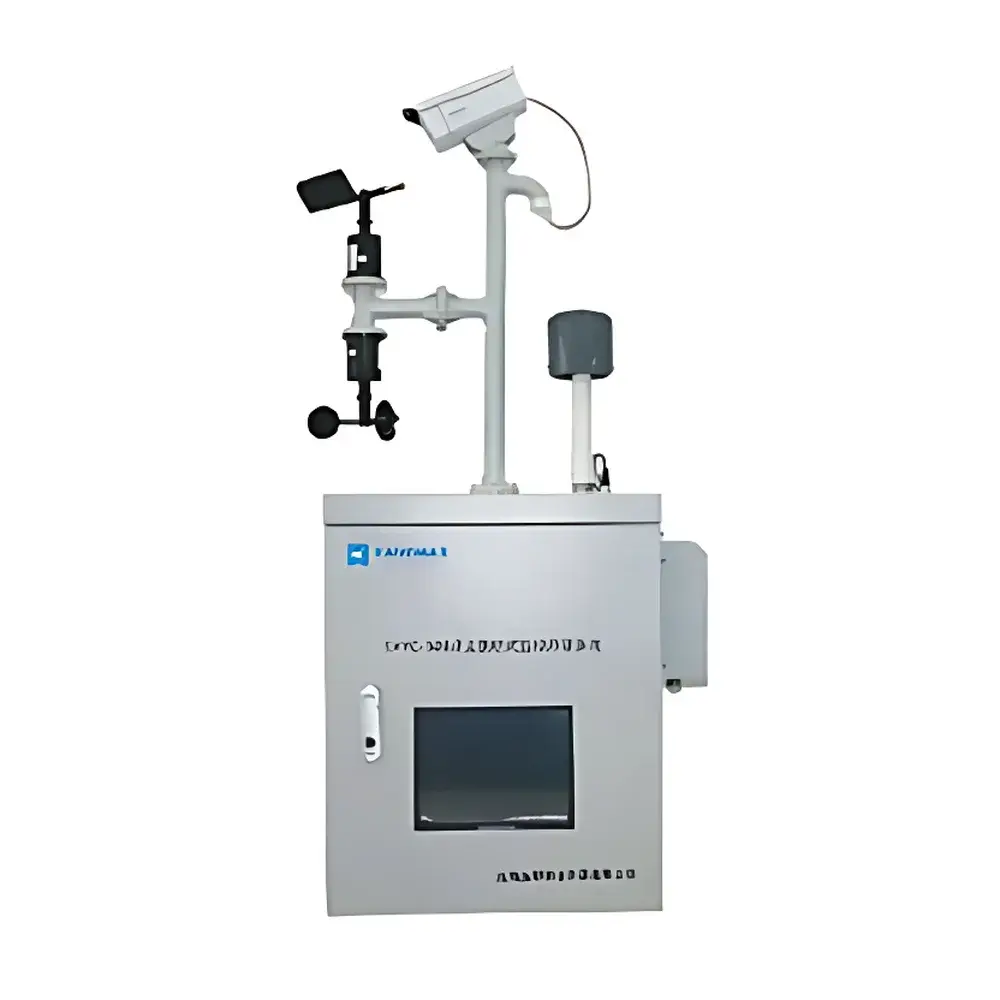
Kanomax SXYC-508 Perimeter-Based Dust Monitoring and Early-Warning System
| Brand | Kanomax |
|---|---|
| Origin | Japan |
| Model | SXYC-508 |
| Measurement Range | 0.01–10.00 mg/m³ |
| Resolution | 0.01 mg/m³ |
| Accuracy | ±10% |
| Relative Error | ≤±2% |
| Safety Classification | Non-explosion-proof |
| Compliance Standard | HJ/T 212–2005 |
| Detection Principle | Beta-ray attenuation (integrated gravimetric reference via filter sampling) |
Overview
The Kanomax SXYC-508 Perimeter-Based Dust Monitoring and Early-Warning System is an integrated environmental monitoring platform engineered for continuous, real-time assessment of airborne particulate matter (PM) concentrations—primarily PM2.5 and total suspended particulates (TSP)—in outdoor industrial and urban settings. Unlike standalone optical scattering-based monitors, the SXYC-508 employs a hybrid measurement architecture: real-time beta-ray attenuation detection provides high-stability mass concentration data, while optional gravimetric filter sampling enables traceable calibration against reference methods per ISO 12103-1 and EPA Method IO-4. The system is configured as a perimeter fence deployment—multiple sensor nodes installed at strategic boundary locations—to support spatial source attribution, plume tracking, and localized emission accountability. Designed for long-term unattended operation in construction sites, material stockyards, municipal roadworks, and peri-urban industrial zones, it delivers regulatory-grade data suitable for compliance reporting under China’s GB 3095–2012 and ambient air quality management frameworks.
Key Features
- Perimeter-integrated architecture with synchronized multi-node deployment for directional dust source localization and cross-wind dispersion analysis
- Dual-mode particulate measurement: real-time beta-ray absorption (β-ray attenuation) coupled with optional gravimetric filter sampling for periodic mass calibration
- Integrated environmental sensor suite: co-located PM2.5 monitor, acoustic noise sensor (30–130 dB(A)), and meteorological five-parameter module (temperature, relative humidity, atmospheric pressure, wind speed, wind direction)
- Onboard IP66-rated HD camera with motion-triggered image capture and timestamped georeferenced metadata for visual verification of exceedance events
- Automatic self-cleaning function for optical path and sampling inlet—programmable manual, scheduled, or remote-triggered purge cycles using clean compressed air
- Embedded data acquisition unit with dual-storage redundancy (internal flash + removable SD card) and seamless failover during network interruption
- Integrated backup power management: smart lithium-iron-phosphate battery supporting ≥72 h continuous operation during grid outage
Sample Compatibility & Compliance
The SXYC-508 is validated for ambient aerosol matrices typical of construction-related dust (e.g., silica-rich soil particles, cement clinker, crushed aggregate), road resuspension dust, and coal/unprocessed mineral handling emissions. Its beta-ray detector exhibits minimal sensitivity drift across temperature ranges from −20 °C to +50 °C and relative humidity up to 90% RH (non-condensing). All firmware and data transmission protocols comply with HJ/T 212–2005 for environmental online monitoring equipment—ensuring structured data packet formatting, heartbeat signaling, and exception reporting. The system supports audit-ready data logging with immutable timestamps and operator action logs, meeting GLP-aligned documentation requirements for third-party verification. While not intrinsically safe or explosion-proof, its non-hazardous area classification aligns with IEC 60079-0 general-purpose environmental monitoring applications.
Software & Data Management
Data from the SXYC-508 is transmitted via 4G LTE (with fallback to Ethernet or RS-485) to central environmental information platforms using TCP/IP-based HJ/T 212-compliant protocol stacks. The onboard firmware includes configurable alarm thresholds, hysteresis logic to suppress transient spikes, and automatic event tagging (e.g., “PM2.5 > 35 µg/m³ for 15 min”). Raw and processed datasets are stored with ISO 8601 timestamps and include metadata on instrument status (flow rate, temperature, cleaning cycle execution, battery voltage). Remote firmware updates and parameter reconfiguration are supported over TLS-secured channels. Integration with national or municipal environmental supervision platforms—including China’s National Environmental Monitoring Network (NEMN)—is achieved through standardized API interfaces and XML/JSON payload mapping.
Applications
- Real-time compliance monitoring at construction site perimeters per local扬尘管控 regulations (e.g., Beijing Municipal Regulation No. 250, Shanghai Construction Dust Control Ordinance)
- Dynamic emission source identification in mixed-use industrial parks using multi-node concentration gradient analysis
- Long-term baseline studies for urban background PM2.5 trends adjacent to high-traffic corridors or logistics hubs
- Validation reference for low-cost optical sensor networks deployed across municipal districts
- Post-remediation verification at brownfield redevelopment sites requiring documented particulate suppression efficacy
FAQ
Does the SXYC-508 meet international calibration traceability requirements?
Yes—the integrated filter sampling module allows collection of mass-loaded filters compatible with laboratory gravimetric analysis per ISO 10174 and US EPA Method 201A, enabling direct traceability to NIST-traceable mass standards.
Can the system operate autonomously during extended power outages?
Yes—it features an intelligent power management subsystem with LiFePO4 backup battery rated for ≥72 hours of nominal operation at −10 °C to +40 °C, including active sensing, data logging, and periodic 4G transmission.
Is remote firmware update capability available without physical access?
Yes—secure over-the-air (OTA) updates are supported via authenticated HTTPS/TLS connections; all update packages are cryptographically signed and verified prior to installation.
How is meteorological data synchronized with particulate measurements?
All sensors—including PM, noise, and weather modules—are hardware-synchronized via a common internal clock with microsecond-level timestamp alignment, ensuring temporally coherent multivariate correlation analysis.
What cybersecurity measures are implemented for data transmission?
Communications use TLS 1.2+ encryption, device authentication via X.509 certificates, and role-based access control (RBAC) on the central platform—fully aligned with GB/T 22239–2019 (China’s Multi-Level Protection Scheme Level 3) for environmental IoT infrastructure.
Related Products







