
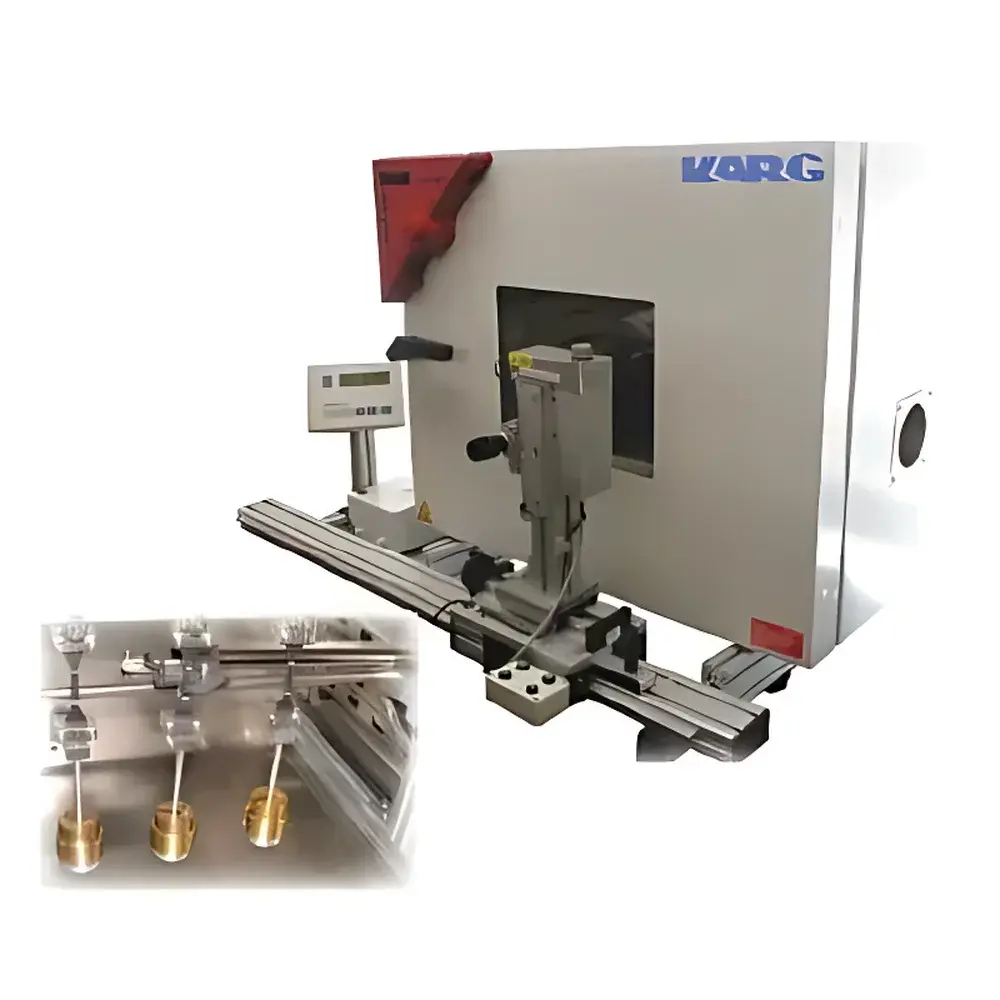
Karg HST 53-3 Heat Extension Tester
| Brand | Karg |
|---|---|
| Origin | Germany |
| Model | HST 53-3 |
| Temperature Control Range | Room Temperature +5°C to 300°C |
| Internal Chamber Volume | 53 L |
| Internal Dimensions (W×H×D) | 400 × 400 × 330 mm |
| External Dimensions (W×H×D) | 635 × 620 × 575 mm |
| Timer Range | 0–99 hours |
| Power Supply | 220 V AC ±10% |
| Compliance | DIN EN 60811-2-1 |
Overview
The Karg HST 53-3 Heat Extension Tester is an engineered laboratory instrument designed for the standardized evaluation of thermomechanical deformation behavior in polymeric insulation and sheathing materials used in electric cables and optical fiber cables. It operates on the principle of controlled thermal loading under constant mechanical stress—specifically, a defined tensile force applied to standardized test specimens while maintained at elevated temperatures within a precision-heated chamber. This methodology directly quantifies elongation under heat and load, followed by permanent set after cooling—key parameters specified in DIN EN 60811-2-1 for assessing crosslinking efficacy, thermal stability, and long-term service integrity of cable compounds. The system integrates a robust vertical loading frame with calibrated weights, a digitally regulated convection oven, and a high-stability specimen support structure—all housed in a rigid steel enclosure with insulated double-wall construction to ensure uniform temperature distribution and minimal thermal drift.
Key Features
- Precision-engineered convection heating chamber with forced-air circulation, delivering ±1.0°C temperature uniformity across the full working volume (53 L) per DIN EN 60811-2-1 Annex A requirements.
- Digital PID temperature controller with real-time monitoring, adjustable ramp rates, and programmable hold profiles—enabling precise replication of standard test sequences (e.g., 20 min preheat at 200°C, followed by 15 min extension under load).
- Mechanically stable loading assembly featuring stainless-steel guide rods, hardened steel weight hangers, and traceable calibrated masses (typically 20 N or 50 N, depending on specimen cross-section), ensuring repeatable application of nominal stress.
- Integrated digital timer with 1-second resolution and non-volatile memory retention—capable of continuous operation up to 99 hours for extended aging or multi-stage thermal-mechanical protocols.
- Chamber interior constructed from corrosion-resistant aluminized steel with smooth, crevice-free surfaces to prevent polymer residue accumulation and facilitate cleaning between test cycles.
- Front-access door with dual-layer safety glass viewport and automatic power cutoff interlock, compliant with IEC 61000-6-2/6-4 electromagnetic compatibility and EN 61010-1 safety standards.
Sample Compatibility & Compliance
The HST 53-3 accommodates standard dumbbell-shaped specimens (Type 1 or Type 2 per ISO 527-2) cut from extruded cable insulation or jacketing layers, with typical widths of 4–6 mm and thicknesses of 1–3 mm. Specimen clamping utilizes parallel-faced, knurled aluminum grips to minimize slippage during thermal expansion. The instrument fully supports the test procedure outlined in DIN EN 60811-2-1:2013 (identical to IEC 60811-2-1), including measurement of initial gauge length (20 mm), extension under load at specified temperature, and residual elongation after cooling to room temperature. It is also suitable for comparative testing per ASTM D1238 (Melt Flow Index correlation), UL 1581 Section 1060 (heat distortion), and VDE 0472 Part 811—making it deployable in QC labs operating under ISO/IEC 17025-accredited quality systems.
Software & Data Management
While the base HST 53-3 operates via standalone hardware controls, optional Karg TestLink™ interface module enables RS-485 or USB connectivity to Windows-based laboratory PCs. The accompanying software provides automated test logging—including timestamped temperature profiles, elapsed time counters, operator ID entry, and digital image capture of specimen deformation (via optional USB microscope integration). All data files are stored in CSV and PDF formats with embedded metadata (test standard, specimen ID, environmental conditions), supporting audit readiness for GLP and GMP environments. Electronic records comply with FDA 21 CFR Part 11 requirements when configured with user authentication, electronic signatures, and immutable audit trails.
Applications
- Verification of crosslinking degree in XLPE, EPR, and silicone rubber cable compounds.
- Quality control of thermoplastic sheathing materials (PVC, LSZH, TPU) during incoming raw material inspection.
- Failure analysis of field-failed cables exhibiting thermal softening or cold flow under sustained load.
- Development validation of flame-retardant formulations where thermal dimensional stability impacts circuit integrity.
- Third-party certification testing for CE marking, UL recognition, and VDE approval submissions.
FAQ
What standards does the HST 53-3 explicitly support?
DIN EN 60811-2-1:2013, IEC 60811-2-1, and VDE 0472-811. Optional calibration certificates are available traceable to PTB (Physikalisch-Technische Bundesanstalt).
Is external exhaust ventilation required?
Yes—continuous fume extraction is recommended when testing halogenated polymers above 180°C; the unit includes a 60 mm rear-mounted duct port compatible with standard lab exhaust manifolds.
Can the instrument be used for cold-set measurements?
Yes—after thermal extension, specimens remain clamped during natural cooling to ambient temperature inside the chamber; residual elongation is measured manually using a calibrated vernier scale or integrated digital caliper (optional accessory).
What maintenance intervals are recommended?
Biannual verification of temperature uniformity (per DIN EN 60811-2-1 Annex A), annual recalibration of load weights, and quarterly inspection of door gasket integrity and fan performance.
Is remote monitoring supported?
Via optional Karg TestLink™ Ethernet gateway, enabling real-time chamber temperature and timer status viewing through secure HTTPS web interface—compatible with enterprise LIMS integration.



