
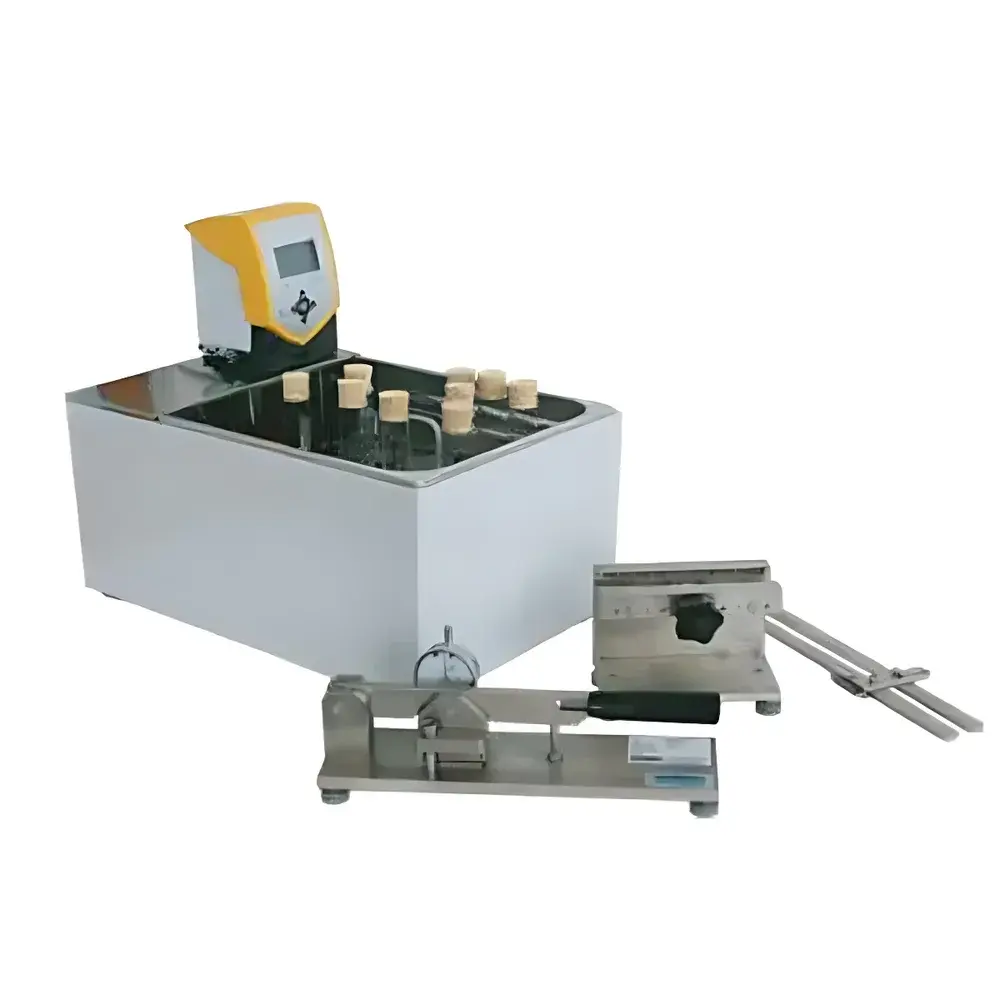
Karg SC-1693 Environmental Stress Cracking Tester
| Brand | Karg |
|---|---|
| Origin | Germany |
| Model | SC-1693 |
| Temperature Range | 50–100 °C |
| Test Compliance | ASTM D1693 |
| Notch Dimensions | 19.0 ± 0.5 mm (length) × 0.50 ± 0.05 mm (depth) |
| Specimen Dimensions | 38.0 ± 2.5 mm × 13.0 ± 0.08 mm (rectangular) |
| Notch Geometry | U-shaped cross-section |
| Test Vessel | Borosilicate glass tubes |
| Heating System | Precision thermostatic bath with ±0.3 °C stability |
| Control Interface | Integrated digital controller with timer and temperature logging |
Overview
The Karg SC-1693 Environmental Stress Cracking (ESC) Tester is a precision-engineered instrument designed for the standardized evaluation of environmental stress cracking resistance in polyethylene (PE), ethylene copolymers, and related thermoplastic resins. ESC is a time-dependent failure mechanism wherein the combined action of tensile stress and a surface-active chemical environment leads to brittle crack propagation—often below the material’s yield strength. The SC-1693 implements the core methodology of ASTM D1693, which specifies the bent-strip test method: specimens are notched to induce controlled surface stress concentration, bent into a U-shaped geometry, and immersed in a selected aggressive medium (e.g., Igepal CO-630 surfactant solution) within temperature-regulated glass test tubes. Failure is defined as visible crack initiation or propagation at the notch root, observed at predetermined intervals over durations ranging from hours to weeks. This apparatus provides a reproducible, traceable platform for comparative material ranking, formulation screening, and quality assurance in polymer manufacturing and R&D laboratories.
Key Features
- Thermostatically controlled bath with high-stability PID regulation (±0.3 °C over 50–100 °C range), ensuring strict adherence to ASTM D1693 temperature classes (Class A/B: 50 °C; Class C: 100 °C)
- Dedicated U-notch preparation system featuring precision-ground carbide blades and calibrated depth stops, delivering consistent 0.50 ± 0.05 mm notch depth across 19.0 ± 0.5 mm length
- Adjustable specimen bending jig with calibrated curvature radius to generate uniform bending strain without plastic deformation
- Modular stainless-steel sample holder rack accommodating up to 24 borosilicate glass test tubes (standard 16 × 150 mm), each independently positioned for unobstructed visual inspection
- Integrated digital controller with programmable soak timers, real-time temperature display, and non-volatile event logging (timestamped start/stop and interval markers)
- CE-marked electrical architecture compliant with EN 61010-1 for laboratory equipment safety
Sample Compatibility & Compliance
The SC-1693 is validated for use with ASTM D1693-compliant rectangular specimens measuring 38.0 ± 2.5 mm × 13.0 ± 0.08 mm, cut from compression-molded or extruded plaques per ASTM D4703. It supports all standard ESC test environments—including aqueous surfactant solutions (Igepal CO-630, Triton X-100), alcohols, and hydrocarbon mixtures—as specified in Annex A1 of ASTM D1693. The system meets essential requirements for GLP (Good Laboratory Practice) execution: temperature calibration traceable to NIST-certified references, mechanical alignment verifiable via gauge blocks and optical alignment tools, and documentation-ready test records. While not inherently 21 CFR Part 11 compliant, the controller’s event log output may be exported for integration into validated LIMS or ELN systems supporting electronic signature and audit trail requirements.
Software & Data Management
The SC-1693 operates via an embedded microcontroller interface with no proprietary software dependency. All operational parameters—including setpoint temperature, total test duration, and inspection interval—are configured directly on the front-panel keypad. Temperature readings are logged at 1-minute intervals to internal memory (retention >30 days) and exportable via USB-C to CSV format for post-test analysis in Excel, MATLAB, or statistical process control (SPC) platforms. The event log captures timestamped entries for test initiation, temperature stabilization confirmation, and manual inspection triggers—providing auditable evidence of protocol adherence. No cloud connectivity or remote access functionality is included, preserving data sovereignty and minimizing cybersecurity exposure in regulated environments.
Applications
- Comparative ESC resistance ranking of HDPE, LDPE, LLDPE, and ethylene–vinyl acetate (EVA) formulations
- Quality control testing of resin batches prior to pipe, geomembrane, or blow-molded container production
- Accelerated aging studies correlating ESC performance with long-term field behavior in buried PE infrastructure
- Development support for stabilizer packages, antioxidant systems, and molecular weight distribution optimization
- Failure analysis of field-exposed components exhibiting brittle fracture under low applied stress
- Supporting ISO 16770 (plastics — determination of environmental stress cracking resistance) and ISO 22315 (polyolefin pipes — ESC testing) method adaptations
FAQ
What standards does the SC-1693 fully support?
The instrument is engineered to execute ASTM D1693 (Standard Test Method for Environmental Stress-Cracking of Ethylene Plastics) in its entirety—including specimen preparation, bending geometry, environmental exposure, and failure assessment protocols.
Can the SC-1693 be used for materials beyond polyethylene?
Yes—while optimized for ethylene-based resins, it is routinely applied to PP, EVOH, and certain engineering thermoplastics when referenced against modified test conditions described in ASTM D5397 or ISO 16770 Annex B.
Is calibration documentation provided with the unit?
Each SC-1693 ships with a factory calibration certificate for the bath temperature sensor (traceable to DAkkS-accredited reference standards) and mechanical verification report for notch depth and specimen dimensions.
How is specimen bending strain quantified?
Bending is performed using a fixed-radius mandrel; strain is calculated per ASTM D1693 Annex A2 using nominal specimen thickness and mandrel diameter—no external strain gauges or load cells are required.
What maintenance is required for long-term reliability?
Annual verification of bath temperature uniformity (per ASTM E220), periodic replacement of silicone oil (if used), and biannual cleaning of glass tube holders and notch blade assemblies with isopropanol and lint-free wipes.



