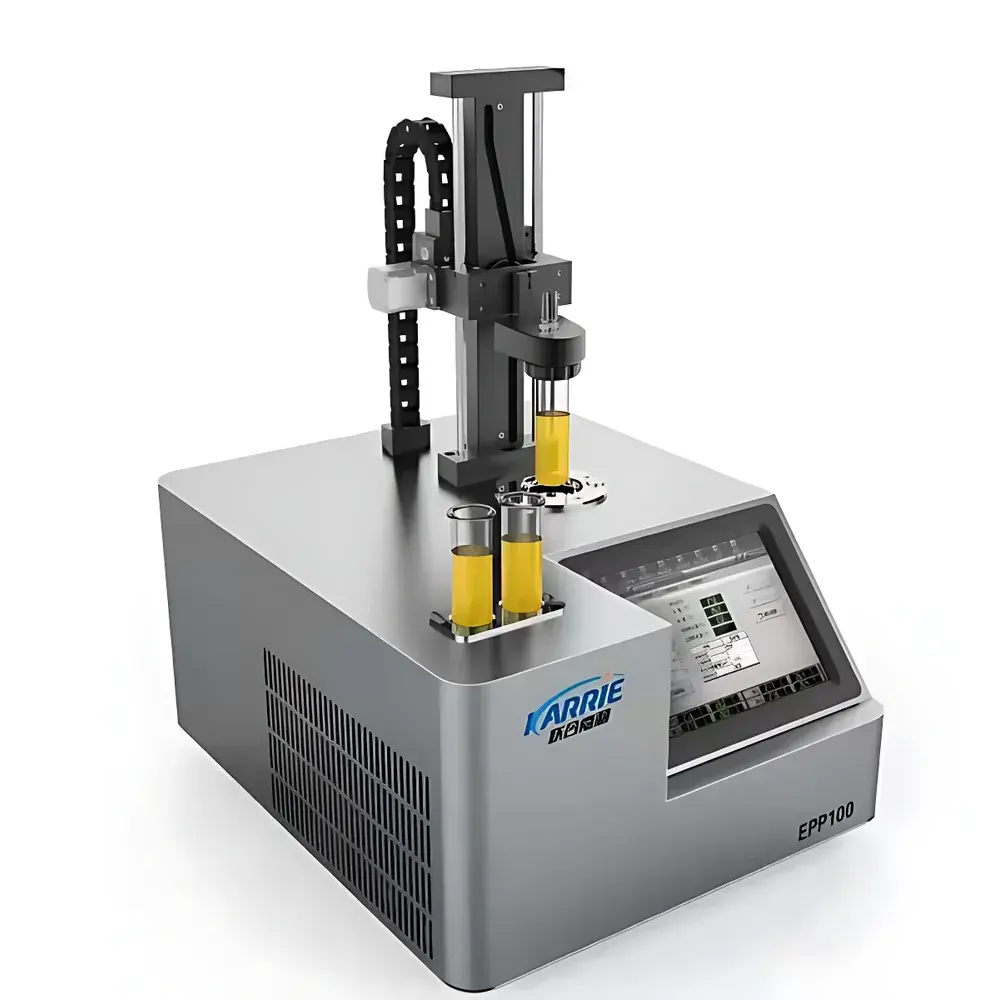
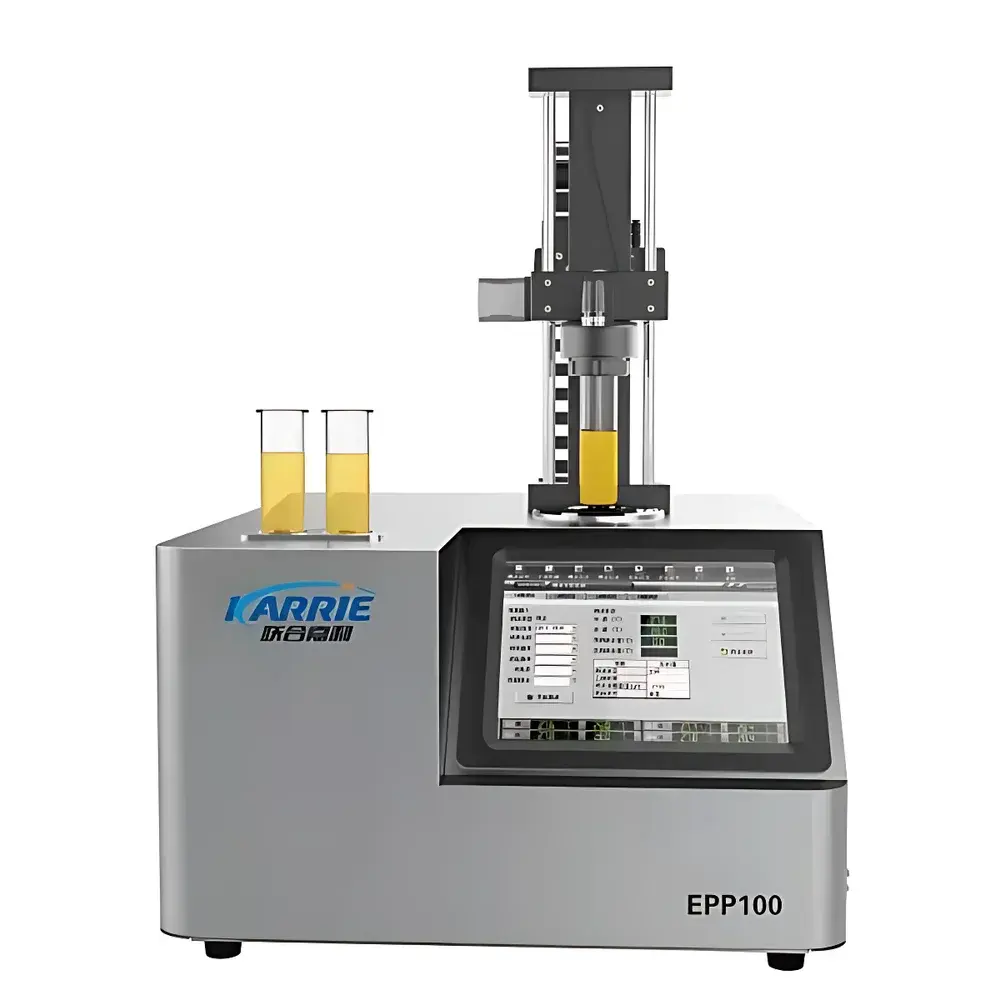
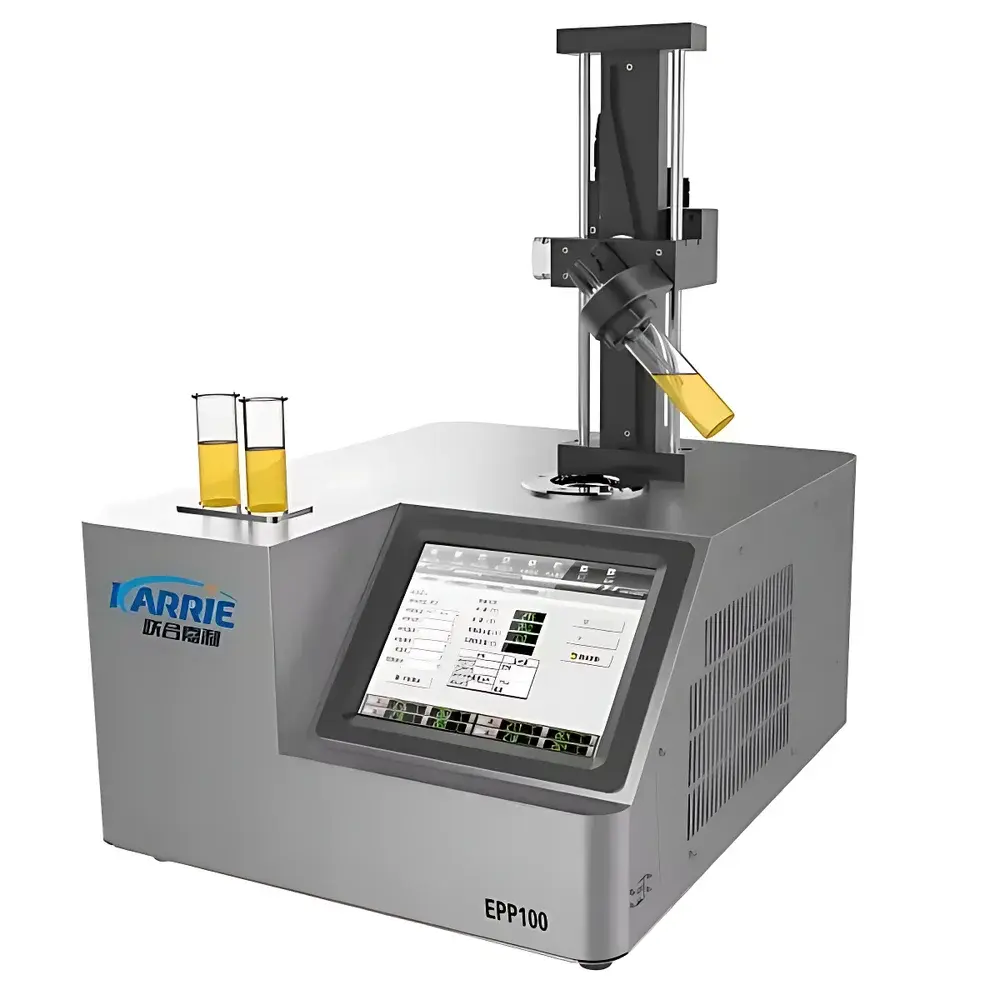
Karrie EPP100 Fully Automated Single-Bath Pour Point Tester
| Brand | Karrie |
|---|---|
| Model | EPP100 |
| Standard Compliance | GB/T 3535, ISO 3016, ASTM D97, ASTM D5950, ASTM D5853 |
| Cooling Method | Integrated Compressor Refrigeration |
| Temperature Range | –68 °C to 45 °C (Test), –81 °C to 70 °C (Bath) |
| Temperature Control Accuracy | ±0.1 °C |
| Repeatability | ≤1 °C |
| Reproducibility | ≤2 °C |
| Display | 10.4″ Color LCD (800 × 600) |
| Power Supply | AC 220 V, 50 Hz |
| Rated Power | 1500 W |
| Dimensions (L×W×H) | 500 × 550 × 600 mm |
| Weight | 45 kg |
| Interface Options | USB, RS-232, RJ45 Ethernet, Optional Wi-Fi |
| Data Storage Capacity | >10,000 test records with time/sample/operator-based query |
Overview
The Karrie EPP100 Fully Automated Single-Bath Pour Point Tester is an engineered solution for precise, standardized determination of the pour point of petroleum products—including diesel fuels, lubricating oils, base stocks, and residual fuels—according to internationally recognized methodologies. Based on the principle of progressive cooling and manual or automated tilt observation, the instrument identifies the lowest temperature at which a sample remains mobile under specified conditions, as defined by ASTM D97 (manual tilt), ASTM D5950 (automated tilt sequence), ISO 3016, and GB/T 3535. Unlike multi-bath systems, the EPP100 employs a single, high-stability refrigerated bath with integrated compressor-based cooling, enabling rapid thermal response and tight control across an extended operational range from –81 °C to +70 °C. Its design emphasizes traceable thermometry, mechanical repeatability, and full procedural transparency—critical requirements for laboratories operating under GLP, ISO/IEC 17025, or refinery QA/QC protocols.
Key Features
- Integrated compressor refrigeration system delivering stable bath temperatures from –81 °C to +70 °C, with real-time PID-controlled regulation achieving ±0.1 °C accuracy.
- Automated tilt mechanism compliant with ASTM D5950, executing programmable inclination sequences at user-defined temperature intervals (1–3 °C steps) to detect cessation of flow.
- 10.4-inch color TFT-LCD touchscreen interface (800 × 600 resolution) supporting intuitive navigation via touch, keyboard, or external mouse—no external PC required for basic operation.
- Configurable pre-heating function for the test bath, allowing users to define pre-heat activation status, target temperature, and duration prior to sample loading.
- Comprehensive parameter customization: start temperature, detection frequency, maximum test cycles, and alarm thresholds are all programmable per test sequence.
- Onboard calibration verification tools for bath temperature sensors, supporting routine metrological validation without third-party intervention.
- Rugged construction using selected imported components—including precision temperature sensors, corrosion-resistant bath materials, and industrial-grade compressors—for long-term reliability in continuous laboratory use.
Sample Compatibility & Compliance
The EPP100 is validated for use with transparent and opaque petroleum liquids having kinematic viscosities up to 1000 mm²/s at 40 °C, including distillate fuels, engine oils, hydraulic fluids, and crude fractions. It strictly adheres to the physical test procedures outlined in ASTM D97 (standard manual method), ASTM D5950 (automated tilt sequence), ISO 3016 (petroleum products—determination of pour point), and GB/T 3535 (Chinese national standard). All hardware and firmware implementations support audit-ready operation: timestamped test logs, operator ID tagging, and immutable result storage ensure compliance with FDA 21 CFR Part 11 when connected to validated LIMS environments via Ethernet or optional Wi-Fi. The system meets electromagnetic compatibility (EMC) requirements per IEC 61326-1 and electrical safety standards per IEC 61010-1.
Software & Data Management
The embedded operating system provides local data management without dependency on external software. Over 10,000 test records can be stored onboard, each containing full metadata: date/time stamp, sample ID, operator name, method selection (ASTM D97 vs. D5950), bath temperature profile, observed pour point, and pass/fail status. Search functionality supports compound queries by time range, sample identifier, operator, or test outcome. Export options include CSV via USB flash drive or direct network transmission through TCP/IP (RJ45) or serial (RS-232) interfaces. Optional Wi-Fi module enables seamless integration into enterprise laboratory information management systems (LIMS), supporting HL7 or ASTM E1384-compliant data exchange. Audit trail generation—including user login history, parameter changes, and result modifications—is enabled by default and cannot be disabled.
Applications
- Refinery quality assurance: monitoring pour point shifts during blending, additive treatment, or thermal degradation studies.
- Lubricant formulation labs: evaluating low-temperature fluidity of base oils and finished products against OEM specifications (e.g., SAE J300, API categories).
- Independent testing laboratories accredited to ISO/IEC 17025: delivering certified pour point reports for regulatory submissions or contractual compliance.
- Research institutions studying wax crystallization kinetics in paraffinic crudes or biofuel blends using controlled cooling ramp profiles.
- Field service teams performing on-site cold-flow property verification prior to winter-grade fuel distribution.
FAQ
What standards does the EPP100 fully support?
It is fully compliant with ASTM D97, ASTM D5950, ASTM D5853, ISO 3016, and GB/T 3535—covering both manual tilt and automated sequential tilt methodologies.
Can the instrument perform tests below –60 °C?
Yes—the bath cooling capability extends to –81 °C, though the official test range per ASTM D97 and ISO 3016 is limited to –68 °C to +45 °C for valid pour point determination.
Is remote monitoring or control possible?
Yes—via built-in Ethernet (RJ45), optional Wi-Fi, or RS-232, enabling remote status viewing, test initiation, and data retrieval through standard TCP/IP or Modbus RTU protocols.
How is temperature calibration verified?
The system includes a dedicated bath temperature calibration mode that allows comparison against NIST-traceable reference thermometers; calibration offsets are stored non-volatilely and applied automatically during testing.
What maintenance is required for the compressor cooling system?
No routine refrigerant servicing is needed—the sealed compressor unit is rated for ≥15,000 hours of continuous operation; annual inspection of condenser airflow and dust filter cleaning is recommended.