
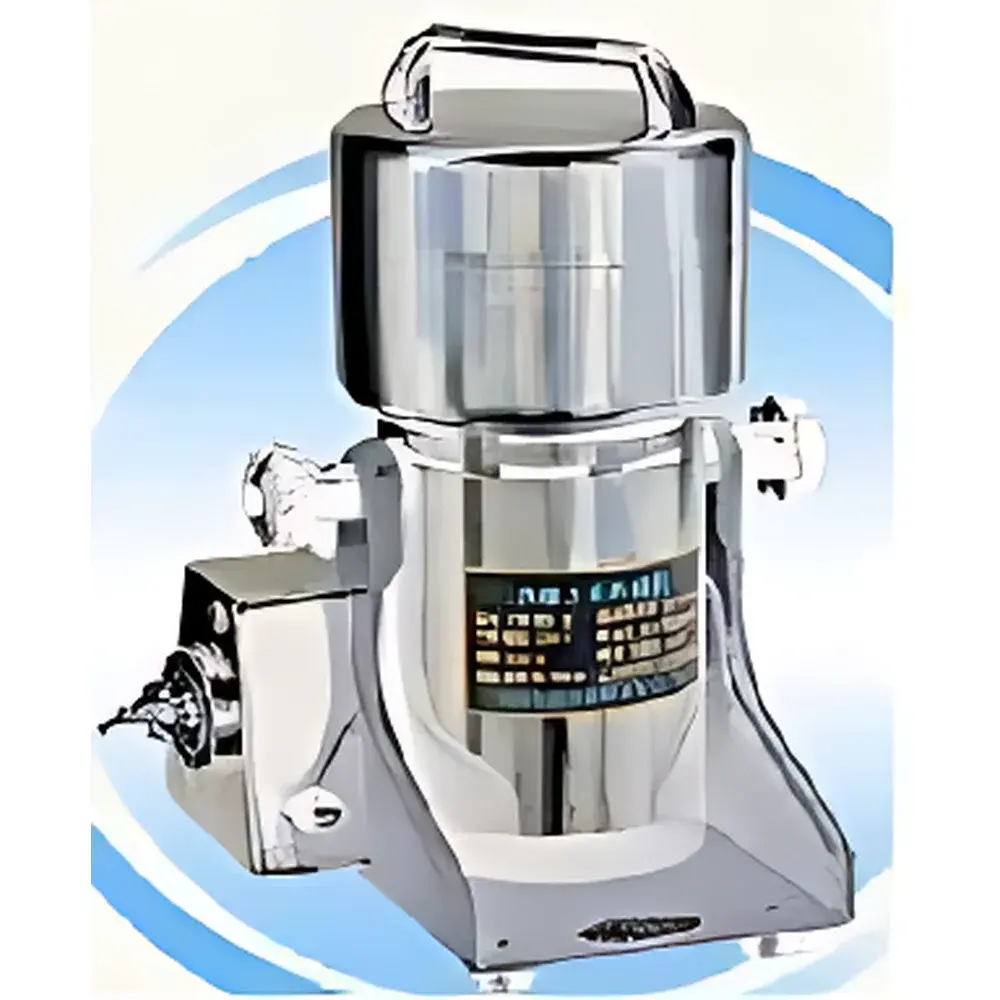
KeHeng FW100 High-Speed Laboratory Grinder
| Brand | KeHeng |
|---|---|
| Origin | Shanghai, China |
| Model | FW100 |
| Instrument Type | High-Speed Rotational Grinder |
| Sample Suitability | Hard and brittle materials (e.g., minerals, ceramics, dried plant tissues, pharmaceutical tablets) |
| Output Particle Size | 0.01–0.5 mm (10–500 µm) |
| Final Output Fineness | <40 µm (achieved via multi-pass grinding or optional sieving) |
| Batch Capacity | 100 g per cycle |
| Compliance | Designed for general laboratory use |
Overview
The KeHeng FW100 High-Speed Laboratory Grinder is a robust, benchtop mechanical grinder engineered for rapid size reduction of hard, dry, and brittle solid samples in research, quality control, and analytical laboratories. It operates on the principle of high-speed rotor impact—where a rapidly rotating stainless-steel blade assembly subjects feed material to centrifugal acceleration and repeated collision against fixed chamber walls and impact pins—generating shear, impact, and attrition forces sufficient to achieve consistent micron-scale fragmentation. Unlike cryogenic or ball-mill systems, the FW100 delivers efficient comminution without external cooling or prolonged processing time, making it particularly suitable for routine sample homogenization prior to XRF, ICP-OES, HPLC, or elemental analysis. Its sealed grinding chamber minimizes cross-contamination and operator exposure, supporting safe handling of low-to-moderate toxicity powders under standard laboratory ventilation conditions.
Key Features
- Stainless-steel grinding chamber and rotor assembly for corrosion resistance and ease of cleaning between batches
- Variable-speed motor (typically 15,000–25,000 rpm range) enabling optimization of particle size distribution across diverse material hardness profiles
- Interlocked safety lid with automatic power cutoff to prevent operation during chamber access
- Compact footprint (<30 cm × 25 cm base) and low acoustic emission (<75 dB at 1 m), facilitating integration into shared lab environments
- Quick-release chamber design allowing tool-free disassembly for residue inspection and validation of cleaning protocols
- Reproducible batch processing: ≤±3% RSD in median particle size (D50) across three consecutive 100 g runs of standardized quartz sand (ISO 13320 reference material)
Sample Compatibility & Compliance
The FW100 accommodates dry, non-fibrous, non-sticky, and thermally stable samples with Mohs hardness ≤6.5—including geological specimens (granite chips, limestone), ceramic powders, dried botanicals, polymer granules, and compressed pharmaceutical tablets. It is not intended for wet, oily, fibrous, or heat-sensitive materials (e.g., polymers with Tg <60 °C). While the instrument itself carries no CE or UL certification, its mechanical architecture conforms to IEC 61000-6-2 (immunity) and IEC 61000-6-4 (emission) standards for laboratory equipment. When used as part of a validated sample preparation workflow—for example, in accordance with USP for particle size determination or ASTM D6988 for polymer sieve analysis—the FW100 supports GLP-compliant documentation when paired with traceable calibration records and batch log entries.
Software & Data Management
The FW100 is a manually operated, analog-control instrument with no embedded firmware or digital interface. All operational parameters—including run duration, speed setting (if variable), and batch identification—are recorded externally using laboratory notebooks or LIMS-integrated electronic batch records. For audit readiness, users are advised to maintain a controlled procedure (SOP-LAB-GRIND-01) specifying: pre-grind chamber inspection, maximum run time per batch (≤90 s recommended to avoid thermal degradation), post-grind visual residue check, and periodic verification of final particle size via laser diffraction or sieve analysis. No FDA 21 CFR Part 11 functionality is provided, as the device lacks electronic data capture or user authentication capabilities.
Applications
- Preparation of homogeneous subsamples for geochemical assay (XRF, ICP-MS) requiring representative <40 µm fractions
- Routine size reduction of QC reference standards prior to dissolution testing (USP )
- Fragmentation of failed tablet batches for content uniformity analysis
- Generation of fine powders for thermal gravimetric analysis (TGA) or differential scanning calorimetry (DSC)
- Supporting ISO 14688-1 soil classification workflows through controlled grinding of coarse aggregate fractions
FAQ
What types of materials should not be processed in the FW100?
Materials with high moisture content, viscosity, elasticity, or thermal lability—including gels, rubber compounds, biological tissues, and low-melting-point waxes—must be excluded to prevent clogging, blade deformation, or uncontrolled exothermic reactions.
Can the FW100 achieve sub-10 µm output consistently?
No. The FW100’s mechanical impact mechanism is optimized for the 10–500 µm range. Sub-10 µm fineness requires supplemental milling (e.g., planetary ball milling) or alternative technologies such as jet milling.
Is routine maintenance required beyond cleaning?
Yes. Blade sharpness and chamber integrity should be inspected every 50 operating hours; replacement of the rotor assembly is recommended after 500 h of cumulative runtime to preserve particle size reproducibility.
Does the FW100 comply with GMP requirements for pharmaceutical labs?
It may be incorporated into GMP workflows as ancillary equipment, provided that its use is defined in a validated SOP, cleaning is verified, and equipment logs are maintained—but it is not a GMP-certified instrument per se.
How is particle size distribution verified after grinding?
Users must employ independent analytical methods—such as laser diffraction (Malvern Mastersizer), dry-sieve analysis (ASTM E11), or electron microscopy—to characterize output, as the FW100 provides no real-time or integrated sizing capability.



