
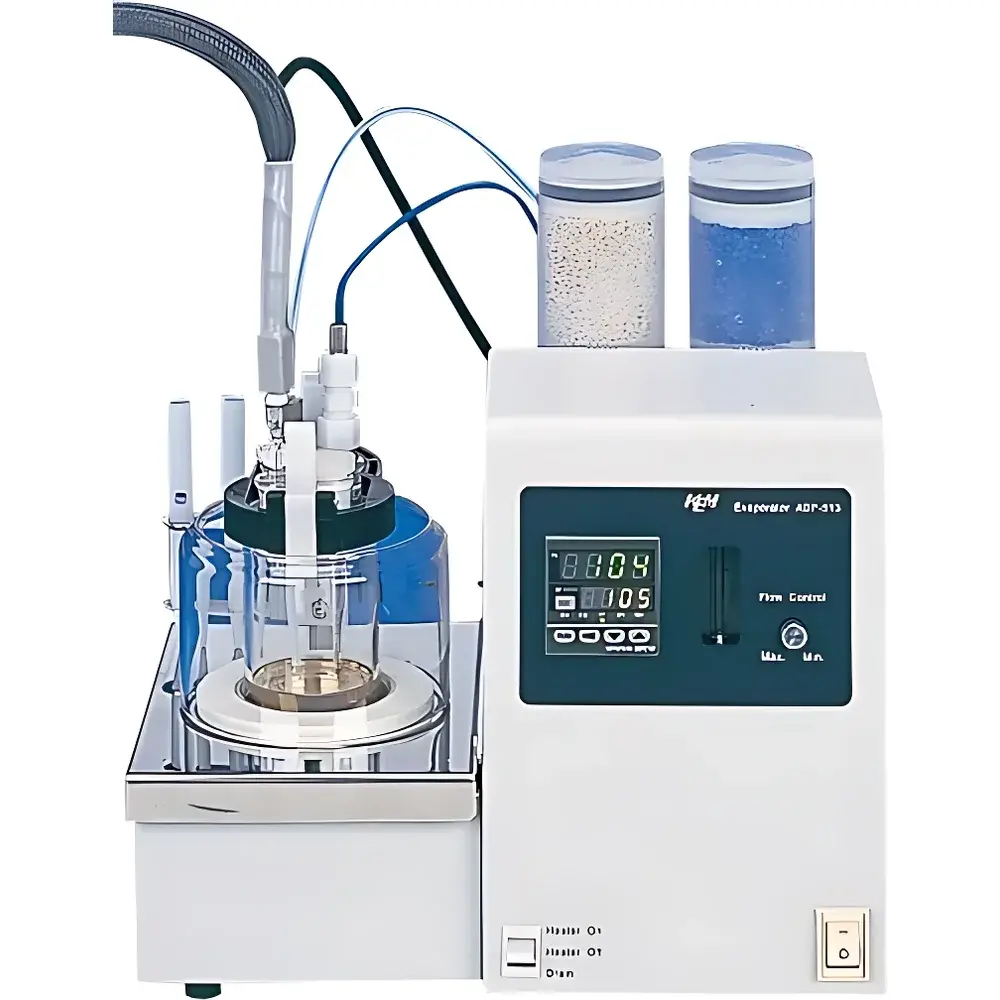
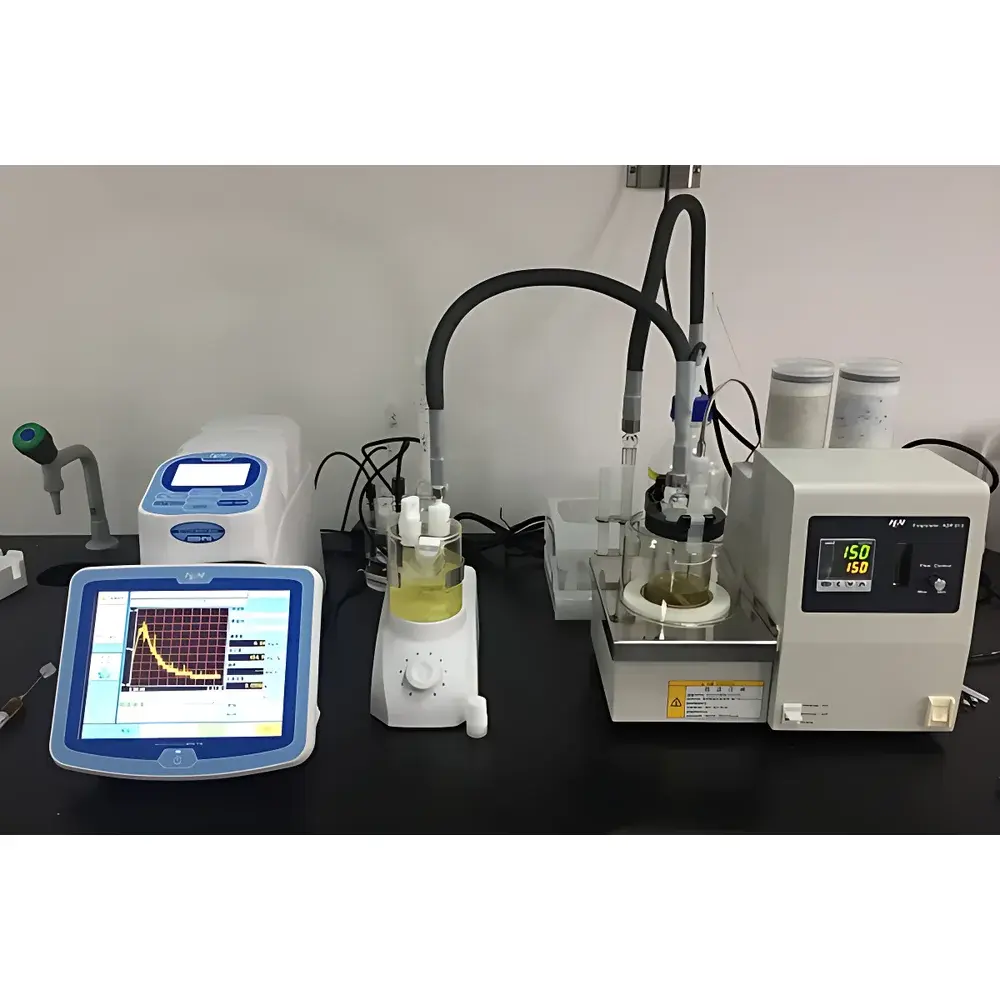
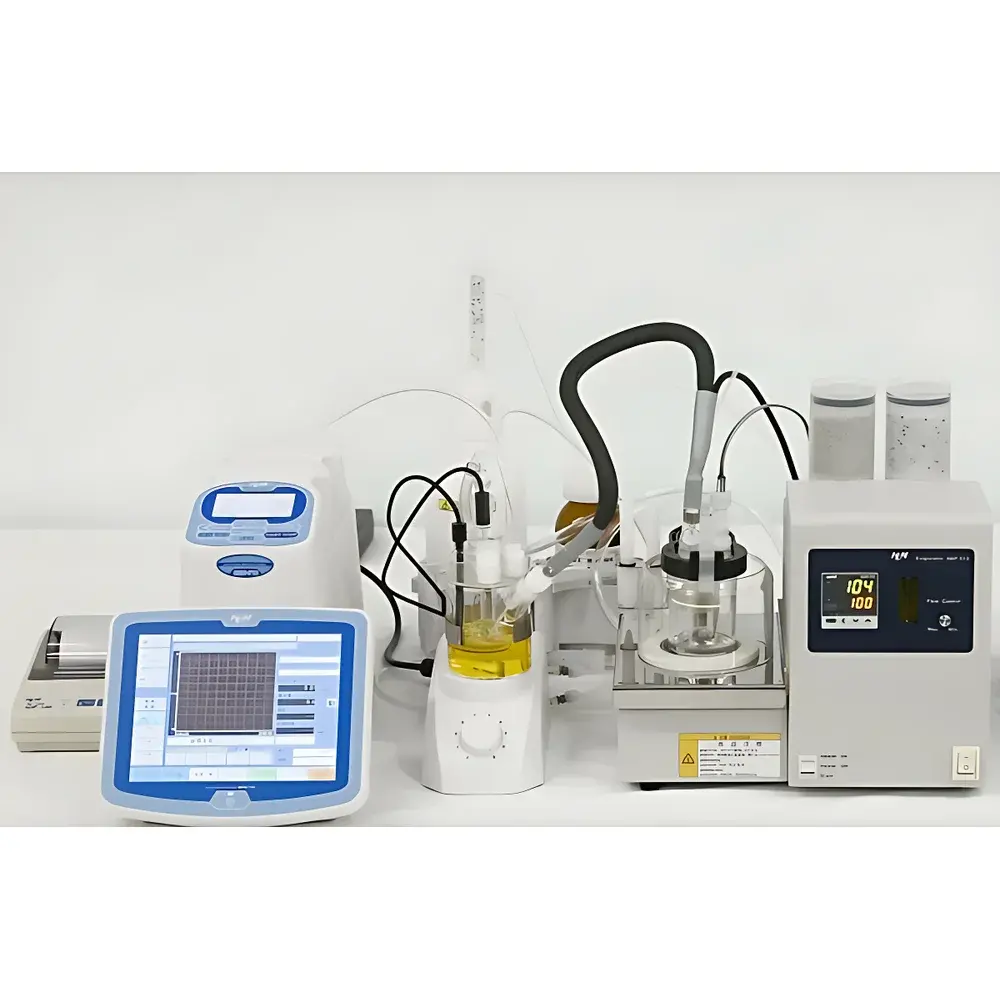
KEM ADP-513 Coulometric Karl Fischer Moisture Analyzer with Oil-Specific Water Evaporator (ASTM D6304 Procedure C Compliant)
| Brand | KEM (Kyoto Electronics Manufacturing) |
|---|---|
| Origin | Japan |
| Manufacturer | Yes |
| Import Status | Imported |
| Model | ADP-513 |
| Titration Mode | Fully Automated Coulometric Titration |
| Instrument Type | Coulometric Karl Fischer Moisture Analyzer |
| Measurement Resolution | 0.1 µg |
| Water Content Range | 10 µg to 300 mg |
| Accuracy | ≤0.3% RSD |
| Titration Control Precision | 0.1 µg |
| Heating Temperature Range | Ambient to 200 °C |
| Evaporator Capacity | 100 mL |
| Evaporator Material | Transparent Heated Borosilicate Glass |
| Power Supply | AC 100–120 V / 200–240 V, 50/60 Hz |
| Dimensions (W×D×H) | 320 × 210 × 330 mm |
| Weight | 6 kg |
Overview
The KEM ADP-513 Coulometric Karl Fischer Moisture Analyzer with Oil-Specific Water Evaporator is an integrated analytical system engineered for the precise and interference-resistant determination of trace water content in challenging petroleum-based matrices—including lubricating oils, crude oil, fuel additives, heavy distillates, and viscous industrial fluids. Unlike conventional volumetric or direct coulometric methods, the ADP-513 implements ASTM D6304 Procedure C (Water Evaporator or Oil Vaporizer Accessory), enabling thermal separation of water from sample matrices prior to coulometric titration in a sealed, anhydrous reaction cell. This two-stage approach—thermal evaporation followed by electrochemical quantification—eliminates matrix-induced side reactions (e.g., oxidation of sulfides, hydrolysis of esters, or solvent incompatibility) that compromise accuracy in direct titration. The system operates on the fundamental principle of coulometric Karl Fischer chemistry: iodine generated electrochemically at the anode reacts stoichiometrically with water (1 mol I₂ ≡ 1 mol H₂O), with water mass calculated from Faraday’s law using charge integration. Designed for laboratories requiring GLP-compliant, auditable moisture data in petrochemical QC/QA, refinery process control, and additive formulation validation, the ADP-513 delivers high reproducibility under ISO/IEC 17025-aligned workflows.
Key Features
- ASTM D6304 Procedure C–compliant evaporator module with PID-controlled heating (ambient to 200 °C), ensuring consistent, programmable thermal desorption without sample decomposition.
- Transparent borosilicate glass evaporator chamber (100 mL capacity) enables real-time visual monitoring of sample heating, vaporization kinetics, and condensation behavior—critical for method development and troubleshooting.
- Coulometric titration cell with dual-platinum electrode configuration and optimized diaphragm design for rapid iodine generation, minimal drift, and long-term baseline stability.
- Automated endpoint detection via dynamic current threshold algorithm, eliminating subjective manual interpretation and supporting unattended operation.
- Rugged, benchtop-integrated architecture with EMI-shielded electronics, isolated power supply, and temperature-compensated current measurement circuitry for metrological integrity in industrial lab environments.
- Compliance-ready firmware architecture supporting audit trails, user access levels, and electronic signature functionality aligned with FDA 21 CFR Part 11 and EU Annex 11 requirements when paired with KEM’s optional compliance software package.
Sample Compatibility & Compliance
The ADP-513 is validated for use with samples exhibiting high viscosity (e.g., SAE 60 engine oils), thermal lability (e.g., amine-based corrosion inhibitors), or chemical reactivity (e.g., sulfur-containing crude fractions). Its evaporator-based workflow mitigates interferences from aldehydes, ketones, and acidic species that consume iodine non-stoichiometrically in direct titration. Method equivalence is documented against ASTM D6304 (Procedure C), GB/T 11133–2015 (Procedure C), and JIS K2275. Each instrument ships with a factory calibration certificate traceable to NIST SRM 2890 (water-in-methanol standard), and includes verification protocols for system suitability testing per USP and EP 2.5.12.
Software & Data Management
Controlled via KEM’s proprietary WinKFP software (Windows OS compatible), the ADP-513 supports method storage, sequence programming, real-time titration curve visualization, and automated report generation (PDF/CSV). Data files include full metadata: operator ID, timestamp, sample ID, evaporator temperature profile, titration current vs. time, calculated water mass (µg), concentration (ppm or wt%), RSD, and system diagnostics. All raw data and audit logs are write-protected and timestamped; modification history is immutably recorded. Optional 21 CFR Part 11 modules provide role-based authentication, electronic signatures, and configurable retention policies.
Applications
- Quantification of water in turbine oils per ASTM D95 and ISO 9199 (using evaporator-assisted adaptation).
- QC release testing of base oils and finished lubricants against OEM specifications (e.g., Caterpillar ECOS, GM 6297M).
- Stability assessment of fuel additives during accelerated aging studies.
- Moisture screening in bitumen emulsions and asphalt binders per AASHTO T 309.
- Research-grade moisture mapping in bio-lubricants and synthetic ester formulations.
FAQ
What distinguishes Procedure C (evaporator method) from Procedures A and B in ASTM D6304?
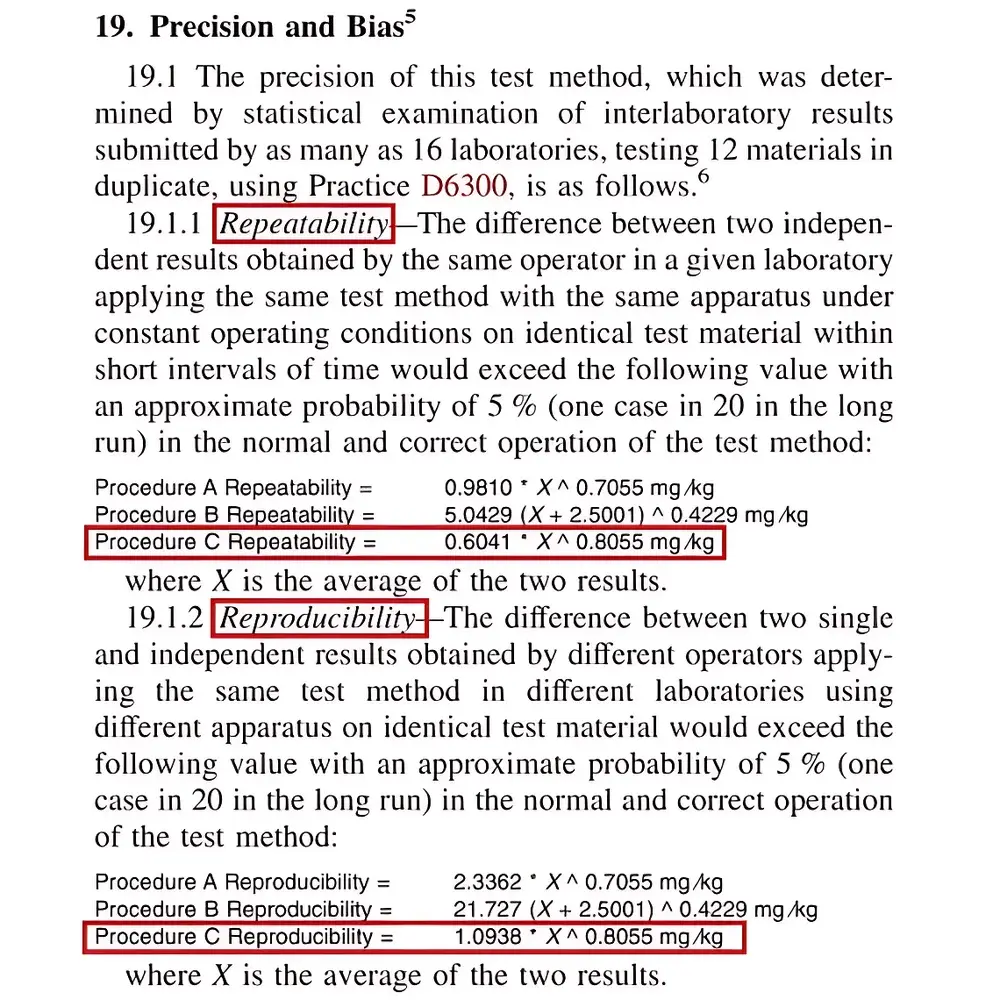
Procedure C thermally liberates water from complex matrices before coulometric detection, whereas Procedures A (direct titration) and B (distillation-titration) lack controlled evaporation and are prone to interference in viscous or reactive samples.
Can the ADP-513 be used for non-petroleum samples such as polymers or pharmaceuticals?
Yes—when paired with appropriate evaporator parameters and KF reagents, it supports moisture analysis in hygroscopic solids (e.g., polyamide resins) and excipients per USP , though method validation is required per ICH Q2(R2).
Is routine maintenance limited to reagent replacement, or does the evaporator require periodic cleaning?
The transparent glass evaporator must be cleaned after each high-boiling-point sample using anhydrous methanol or acetonitrile; residue buildup affects heat transfer uniformity and evaporation efficiency.
Does the system support external sample changers or integration into LIMS?
It interfaces with third-party autosamplers via RS-232/USB-serial emulation and exports structured data (XML/CSV) compatible with major LIMS platforms including LabWare, Thermo Fisher SampleManager, and Siemens Opcenter.
How is measurement uncertainty estimated for low-level water results (e.g., <50 µg)?
Uncertainty is calculated per GUM (JCGM 100:2008) incorporating contributions from balance repeatability (±0.02 mg), titration charge integration (±0.05%), reagent titer drift (±0.1%), and evaporator recovery efficiency (validated at ±2.5% for 10–100 µg range).





