
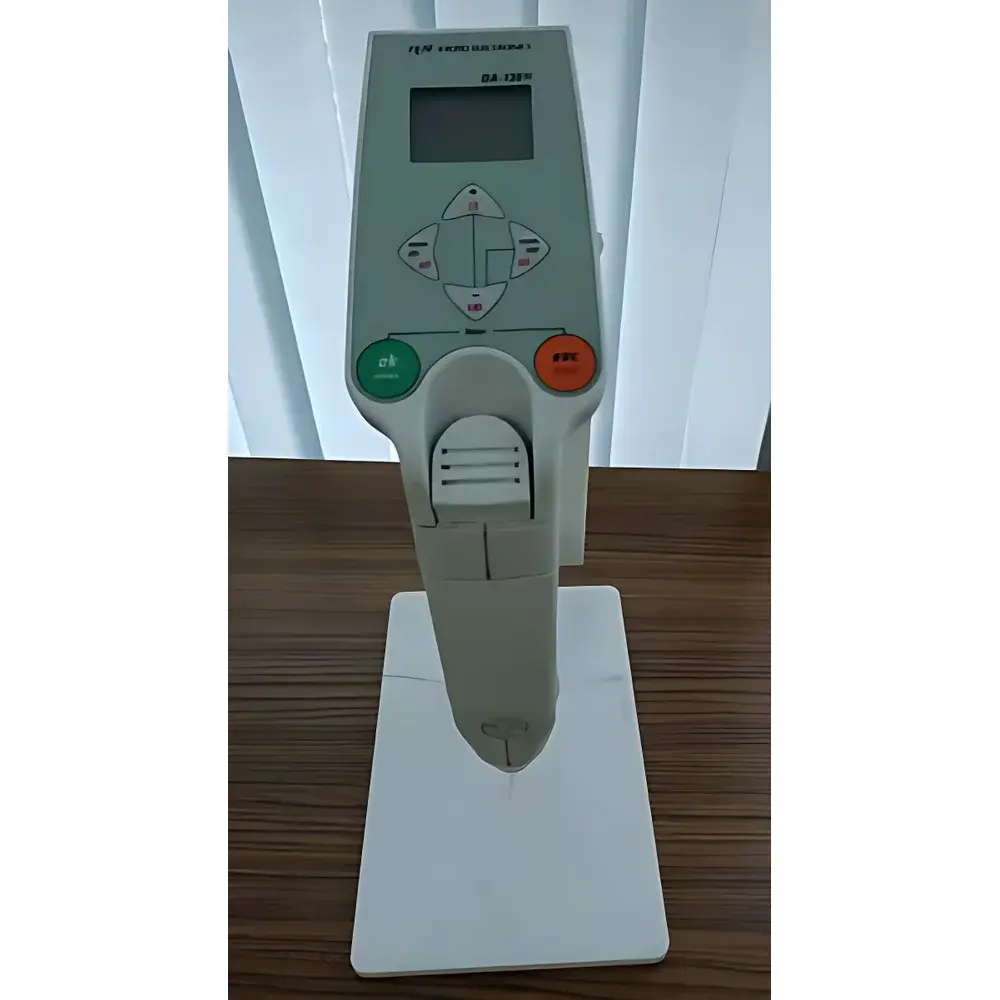
KEM DA-130N Portable Oscillating U-Tube Density Meter
| Brand | KEM (Kyoto Electronics Manufacturing) |
|---|---|
| Origin | Japan |
| Model | DA-130N |
| Instrument Type | Portable Oscillating U-Tube Densimeter |
| Sample Type | Liquids |
| Density Range | 0.0000–2.0000 g/cm³ |
| Density Accuracy | ±0.001 g/cm³ |
| Density Resolution | 0.0001 g/cm³ |
| Temperature Range | 0–40 °C |
| Repeatability | ±0.001 g/cm³ |
| Minimum Sample Volume | 1–2 mL |
| Calibration | Air, distilled water, or certified density standards |
| Viscosity Limit | < 2000 mPa·s |
| Memory Capacity | 1100 measurement records |
| Temperature Compensation | User-defined coefficients for up to 10 substances (e.g., ethanol, toluene, glycerol, acetone, chloroform, cyclohexane) |
Overview
The KEM DA-130N is a handheld oscillating U-tube density meter engineered for high-precision, field-deployable liquid density and related concentration measurements. Based on the fundamental principle of resonant frequency shift in a vibrating U-shaped glass tube filled with sample—governed by the relationship between mass, stiffness, and natural frequency—the instrument delivers traceable, SI-traceable density values in g/cm³ (equivalent to g/mL) under controlled thermal conditions. Its compact, battery-powered architecture enables operation in laboratories, production floors, storage tanks, distilleries, refineries, and quality control checkpoints where benchtop instrumentation is impractical. Designed in compliance with ISO 12058-1 (density determination by oscillating U-tube), ASTM D4052 (standard test method for density of liquids by digital density meter), and aligned with GLP documentation requirements, the DA-130N supports regulatory-ready data integrity when paired with proper procedural controls.
Key Features
- Portable, self-contained design with integrated rechargeable battery and ergonomic grip for extended handheld use
- Oscillating U-tube sensor fabricated from borosilicate glass for chemical resistance and thermal stability
- Automatic temperature compensation using user-programmable coefficients for up to 10 reference substances—including ethanol, methanol, toluene, acetone, glycerol, chloroform, and cyclohexane
- Direct calculation of derived parameters: specific gravity (relative density), Brix (% w/w), alcohol content (wt% and vol%), API gravity, Baumé scale, Plato scale, Proof (US/UK), and custom concentration curves
- Onboard memory stores up to 1100 complete measurement records with timestamp, sample ID, temperature, density, and calculated parameter values
- Manual syringe pump sampling system compatible with liquids up to 2000 mPa·s viscosity; optional external syringe injection support
- Three-point calibration capability: air, distilled water (at user-defined temperature), and certified density standard fluids
- Real-time stability assessment algorithm automatically flags drift or insufficient thermal equilibration before result acceptance
Sample Compatibility & Compliance
The DA-130N is validated for aqueous solutions, organic solvents, hydrocarbons, alcohols, acids (including diluted H₂SO₄), and food-grade liquids within its specified density and viscosity limits. It excludes suspensions, emulsions, highly viscous polymers (>2000 mPa·s), or particulate-laden samples that may clog the capillary pathway. All internal wetted parts are chemically inert (glass, PTFE, stainless steel 316), ensuring compatibility with aggressive media. The instrument meets CE marking requirements and conforms to IEC 61010-1 for electrical safety in laboratory environments. While not inherently 21 CFR Part 11 compliant as a standalone device, audit trails, electronic signatures, and secure data export can be implemented via documented SOPs and external validation protocols required for GMP/GLP-regulated facilities.
Software & Data Management
Data export is supported via USB interface to PC, enabling CSV-formatted output compatible with LIMS, Excel, and statistical process control (SPC) platforms. Each record includes measurement time (YYYY-MM-DD HH:MM:SS), operator ID (manually entered), sample identifier, measured temperature (°C), raw density (g/cm³), compensated density, and all derived values. No proprietary software is required for basic operation or data retrieval; however, KEM provides optional configuration utilities for batch calibration management and coefficient library updates. All stored data retain full metrological traceability to the calibration event and environmental conditions at time of measurement.
Applications
- Quality assurance of incoming raw materials (e.g., ethanol purity, glycerin concentration, solvent lot verification)
- In-process monitoring of fermentation broths, distillation cuts, and blending operations in beverage and biofuel manufacturing
- Field verification of fuel density (diesel, gasoline, biodiesel) per ASTM D1298 or IP 160
- Concentration control in pharmaceutical excipient solutions and cleaning-in-place (CIP) rinse validation
- Educational labs requiring portable, principle-based demonstration of fluid property relationships
- Regulatory submissions supporting density-dependent specifications in USP monographs or European Pharmacopoeia chapters
FAQ
What is the minimum and maximum sample volume required for accurate measurement?
A volume of 1–2 mL is sufficient to fully fill the U-tube sensor chamber and ensure stable oscillation; excess volume is not required and may compromise purge efficiency.
Can the DA-130N measure slurries or suspended particles?
No—only homogeneous, particle-free liquids are suitable. Suspended solids may obstruct the narrow-bore U-tube or introduce damping artifacts affecting resonance detection.
How is temperature control achieved without a Peltier element?
The DA-130N relies on rapid thermal equilibration of the small-volume U-tube sensor and built-in high-resolution Pt100 RTD; users must precondition samples to within ±0.5 °C of target measurement temperature prior to injection.
Is air calibration mandatory before each use?
Air calibration is recommended daily or after significant ambient temperature shifts to correct for atmospheric pressure drift; water calibration is performed per SOP at start-of-shift or after sensor cleaning.
Does the device support password-protected user accounts or role-based access?
No—the DA-130N does not feature multi-user authentication; access control and procedural accountability must be enforced externally through lab workflow policies and electronic record review.



