
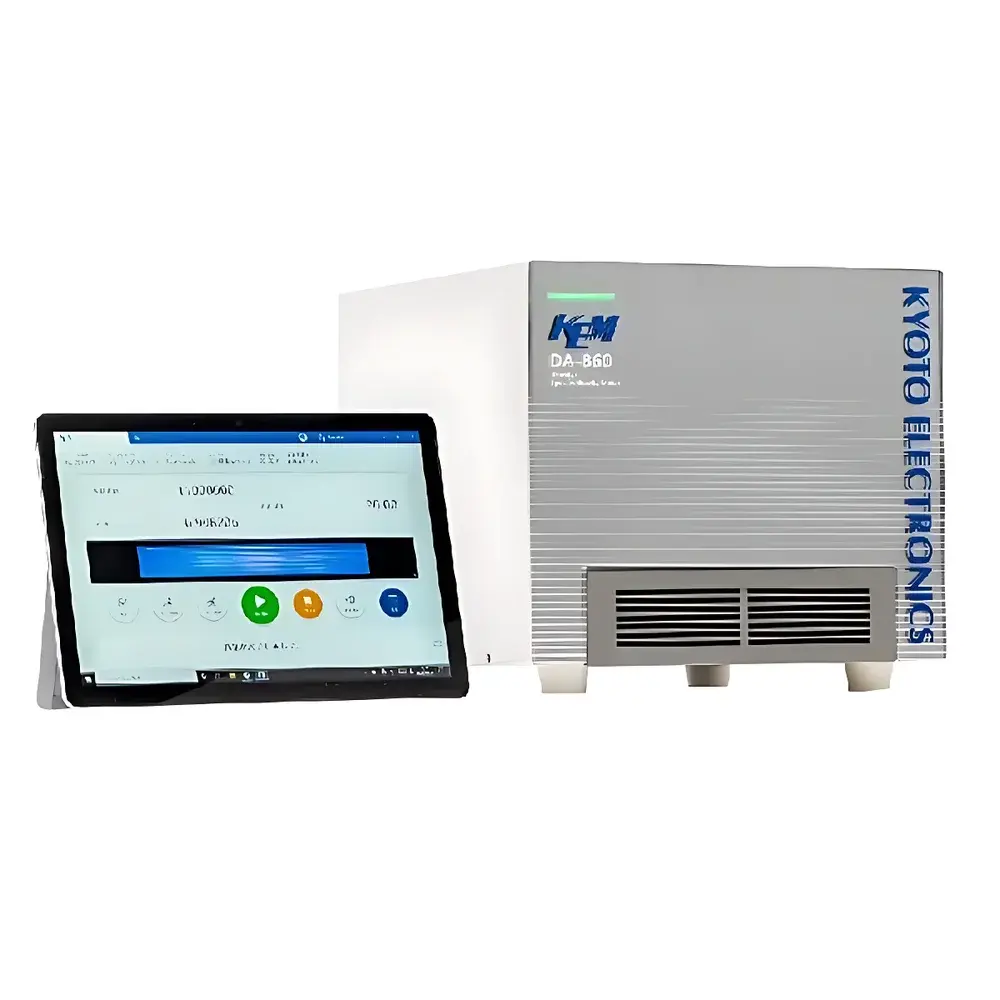
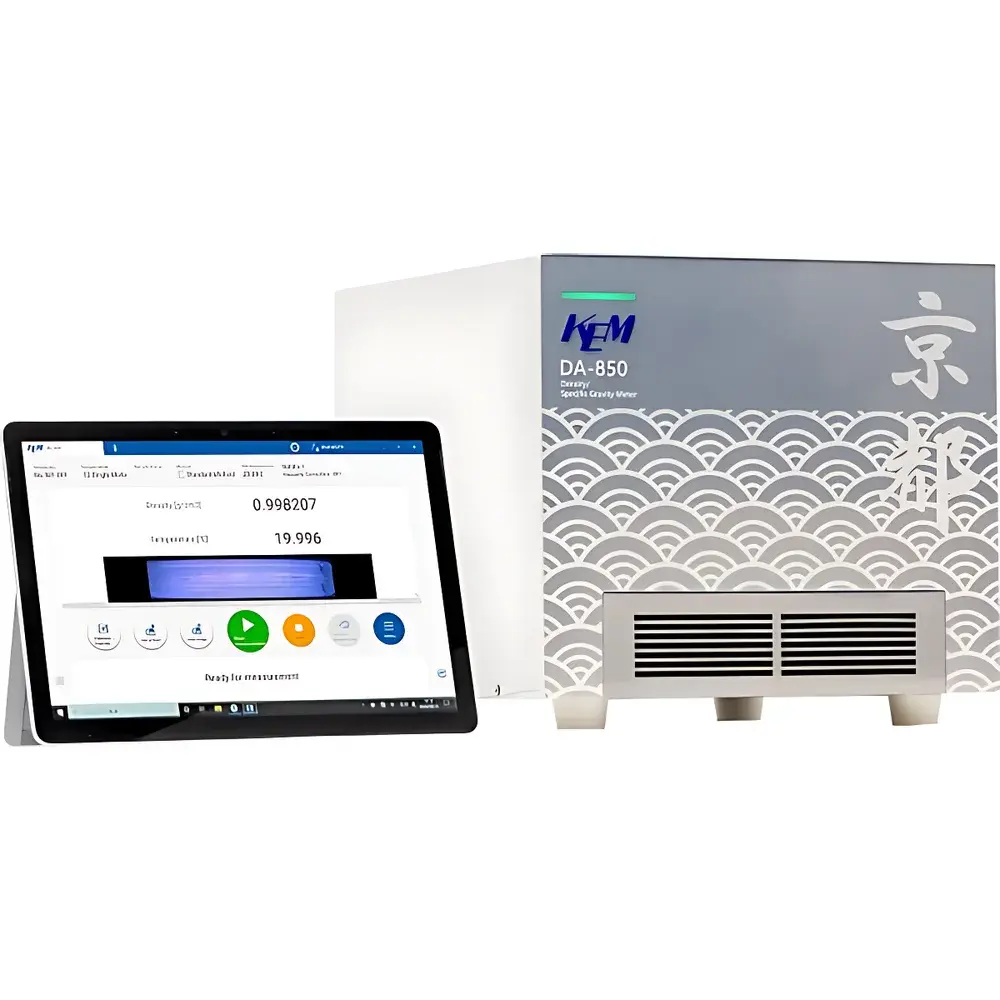
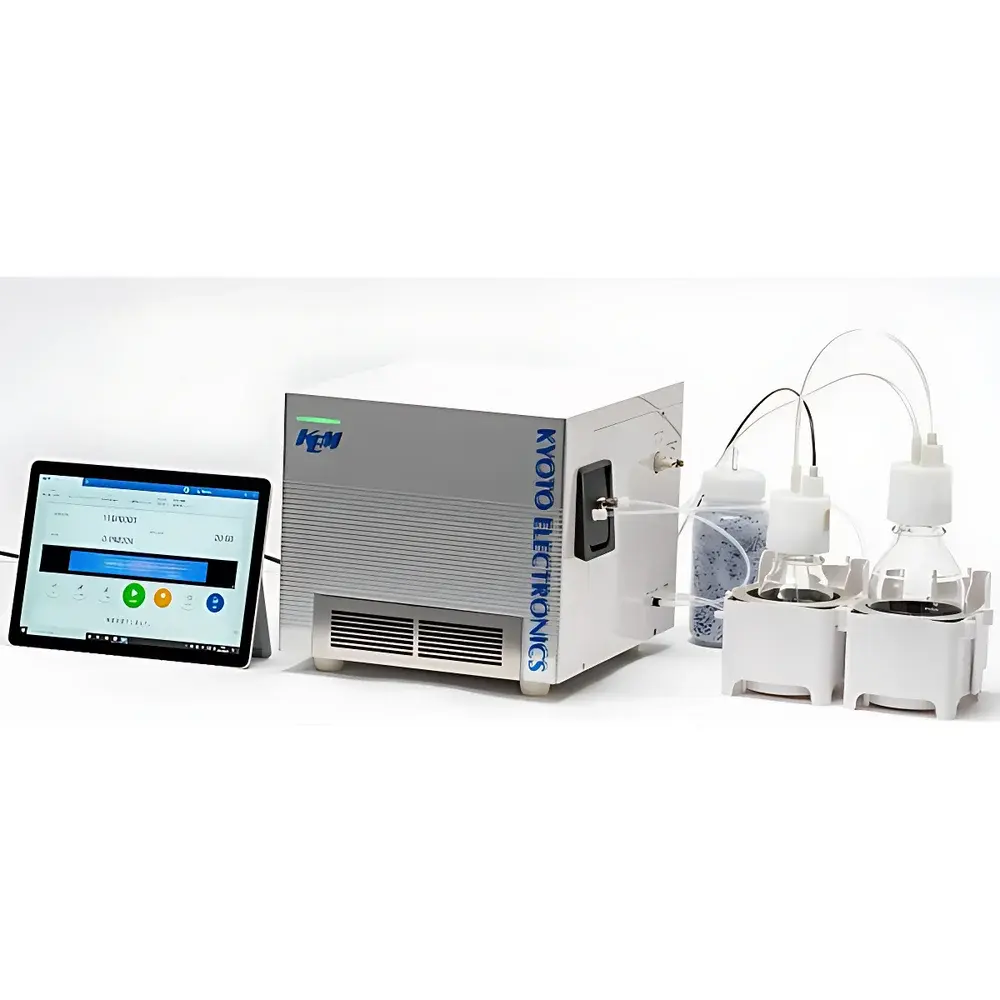
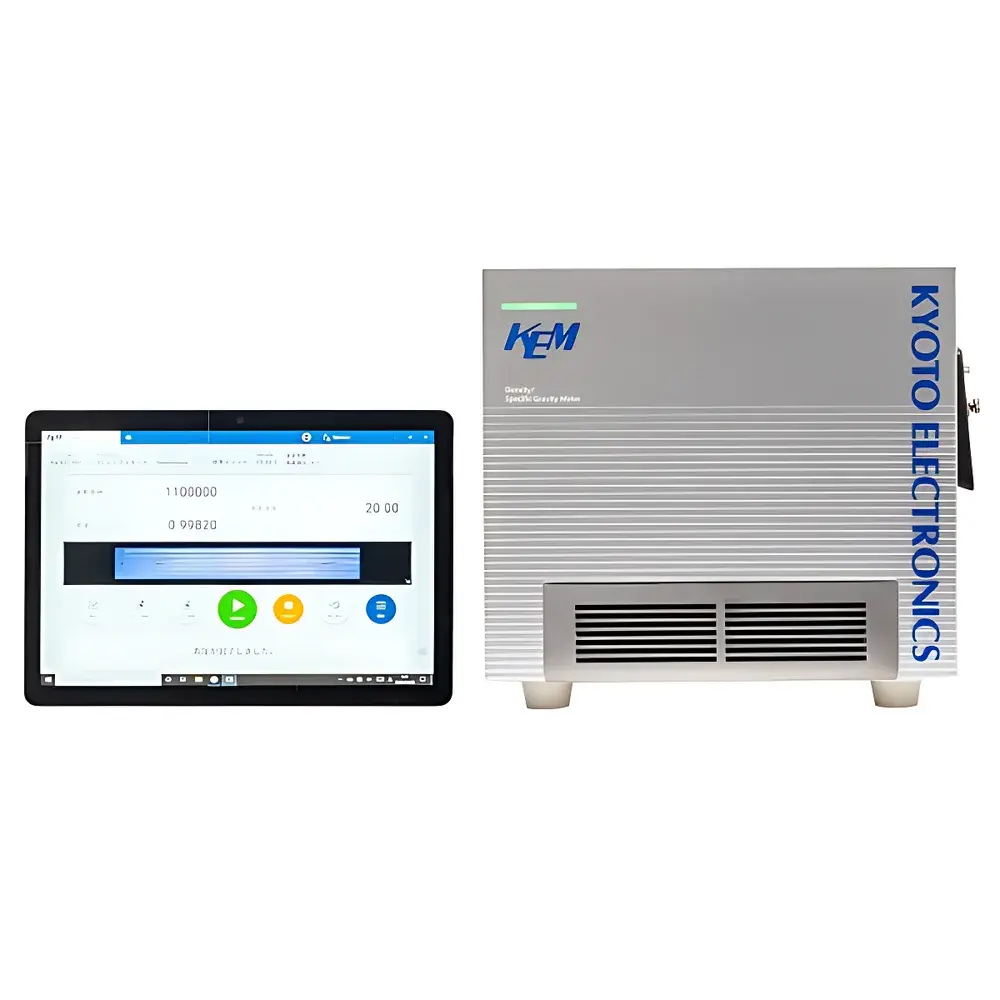
KEM DA-850 Digital Density Meter / Specific Gravity Analyzer
| Brand | KEM (Kyoto Electronics Manufacturing) |
|---|---|
| Origin | Japan |
| Manufacturer | Yes |
| Import Status | Imported |
| Model | DA-850 |
| Instrument Type | Oscillating U-tube Density Meter |
| Form Factor | Benchtop Laboratory Instrument |
| Sample Type | Liquid |
| Density Range | 0–3 g/cm³ |
| Density Accuracy | ±0.00001 g/cm³ |
| Density Repeatability | ±0.000005 g/cm³ |
| Resolution | 0.00001 g/cm³ |
| Temperature Range | 0–100 °C (Peltier-controlled) |
| Temperature Stability | ±0.01 °C |
| Minimum Sample Volume | 1 mL (manual), ~2 mL (auto-pump) |
| Measurement Time | As fast as 10 seconds to 4-digit stability |
| Compliance | ASTM D4052, ISO 12185, IP 365, USP <841>, EP 2.2.5, JIS K 0061, GB/T 29617, GB/T 611, GB/T 2013, GB 5009.2, GB 5009.225, and pharmacopeial methods for relative density |
Overview
The KEM DA-850 Digital Density Meter is a high-precision benchtop laboratory instrument engineered for the accurate, rapid, and traceable determination of liquid density, specific gravity (relative density), and API gravity using the oscillating U-tube principle. Based on fundamental physical relationships between mass, volume, and resonant frequency, the DA-850 measures the natural oscillation period of a precisely machined U-shaped glass tube filled with sample—where frequency shift correlates directly with sample density per the equation: ρ = A·f² + B·f + C (calibrated via certified reference standards). This method delivers exceptional long-term stability and immunity to operator variability, making it suitable for regulated environments requiring GLP/GMP compliance, audit-ready data integrity, and full traceability to SI units. The instrument integrates Peltier-based temperature control with active thermal stabilization, ensuring measurement consistency across the full 0–100 °C range without drift or overshoot.
Key Features
- High-accuracy density measurement with ±0.00001 g/cm³ accuracy and ±0.000005 g/cm³ repeatability—validated against NIST-traceable density standards.
- Real-time imaging module with integrated camera for visual verification of sample fill level, bubble presence, and cell cleanliness—images stored with metadata in audit trail.
- Flexible operator interface: supports local operation via optional tablet PC or remote control via Windows-based software over LAN/USB/RS-232C.
- Adaptive convergence algorithm achieves stable 4-decimal-place readings in ≤10 seconds—optimized for high-throughput QC labs without compromising precision.
- Multi-unit control architecture enables one operator station to manage up to four DA-850 measurement cells, streamlining parallel analysis and centralized data aggregation.
- Comprehensive built-in corrections: automatic viscosity compensation (based on dynamic viscosity input or empirical correlation), atmospheric pressure correction, and full-range temperature compensation using user-defined ρ–T polynomials or lookup tables.
- Automated fluid handling sequence: one-touch execution of auto-sampling, measurement, waste aspiration, multi-stage solvent rinse (SA2/SA3 configurations), and nitrogen-assisted drying—minimizing carryover and cross-contamination.
- Self-diagnostic measurement cell monitoring: real-time detection of residual moisture, air bubbles, and incomplete filling; system halts pump operation when dry-state is confirmed.
Sample Compatibility & Compliance
The DA-850 accommodates a broad spectrum of liquid samples—including aqueous solutions, organic solvents, hydrocarbons, electrolytes, pharmaceutical formulations, food-grade liquids, and high-viscosity fluids (with appropriate viscosity correction). Its U-tube design eliminates capillary effects and avoids contact with moving mechanical parts, preserving sample integrity and enabling measurements of corrosive, volatile, or thermally sensitive materials. The instrument complies with over 30 national and international standards, including ASTM D4052 (Standard Test Method for Density, Relative Density, and API Gravity of Liquids by Digital Density Meter), ISO 12185 (Crude Petroleum and Petroleum Products — Determination of Density — Oscillating U-tube Method), USP (Density and Specific Gravity), European Pharmacopoeia 2.2.5, and Chinese national standards GB/T 29617, GB/T 611, GB 5009.2, and GB 5009.225. It supports 21 CFR Part 11-compliant electronic records when used with KEM’s validated software suite, including role-based access control, electronic signatures, and immutable audit trails.
Software & Data Management
The DA-850 operates with KEM’s proprietary WinCT-Density software (Windows 10/11 compatible), providing full instrument control, method configuration, calibration management, and statistical reporting. Software features include customizable concentration conversion tables (e.g., ethanol % v/v from density), automated temperature compensation profiles, batch processing with pass/fail criteria, and export to CSV, PDF, or LIMS-compatible formats (ASTM E1384, ASTM E1467). All raw data—including frequency, temperature, pressure, timestamp, operator ID, and environmental logs—are time-stamped and cryptographically hashed to ensure data integrity. Audit trail functionality records every user action, parameter change, calibration event, and result modification—fully compliant with FDA, EMA, and NMPA data governance expectations.
Applications
The DA-850 serves critical roles across quality control, R&D, and regulatory testing laboratories. In petrochemical QA, it quantifies crude oil density (SH/T 0604), biodiesel purity (EN 14214), and battery electrolyte formulation (SJ/T 11723, T/CI 236). In pharmaceutical manufacturing, it verifies excipient density (USP ), monitors ethanol concentration in tinctures (GB 5009.225), and supports density-based assay validation per ICH Q5C. Food and beverage labs apply it for sugar content estimation (Brix via density), alcohol titration (beer/wine), and nutritional labeling compliance. Chemical producers rely on it for catalyst solution verification (HG/T 4067), adhesive formulation (GB/T 13354), and electronic-grade chemical certification (T/ICMTIA 2). Additionally, it supports academic research in colloid science, polymer solution behavior, and ionic liquid characterization where sub-μg/cm³ resolution is essential.
FAQ
What density standards are recommended for daily calibration?
Certified density reference liquids traceable to NIST or PTB (e.g., KEM’s own certified water, air, and hydrocarbon standards) are required; calibration intervals follow internal SOPs or regulatory guidance (e.g., daily for GMP labs).
Can the DA-850 measure slurries or suspensions?
No—the oscillating U-tube method requires homogeneous, particle-free liquids; filtration or centrifugation is mandatory prior to analysis.
Is temperature calibration performed automatically?
Yes—the integrated Pt100 sensor is factory-calibrated and verified during instrument qualification; users may perform periodic checks using certified thermometer standards per JJF 2165-2024.
How is viscosity correction applied?
Viscosity correction uses either user-input dynamic viscosity values or an empirical model derived from two-point calibration with low- and high-viscosity standards.
Does the system support LIMS integration?
Yes—via configurable ASCII output over RS-232C or TCP/IP, supporting ASTM E1384 message structures for seamless bidirectional data exchange.



