
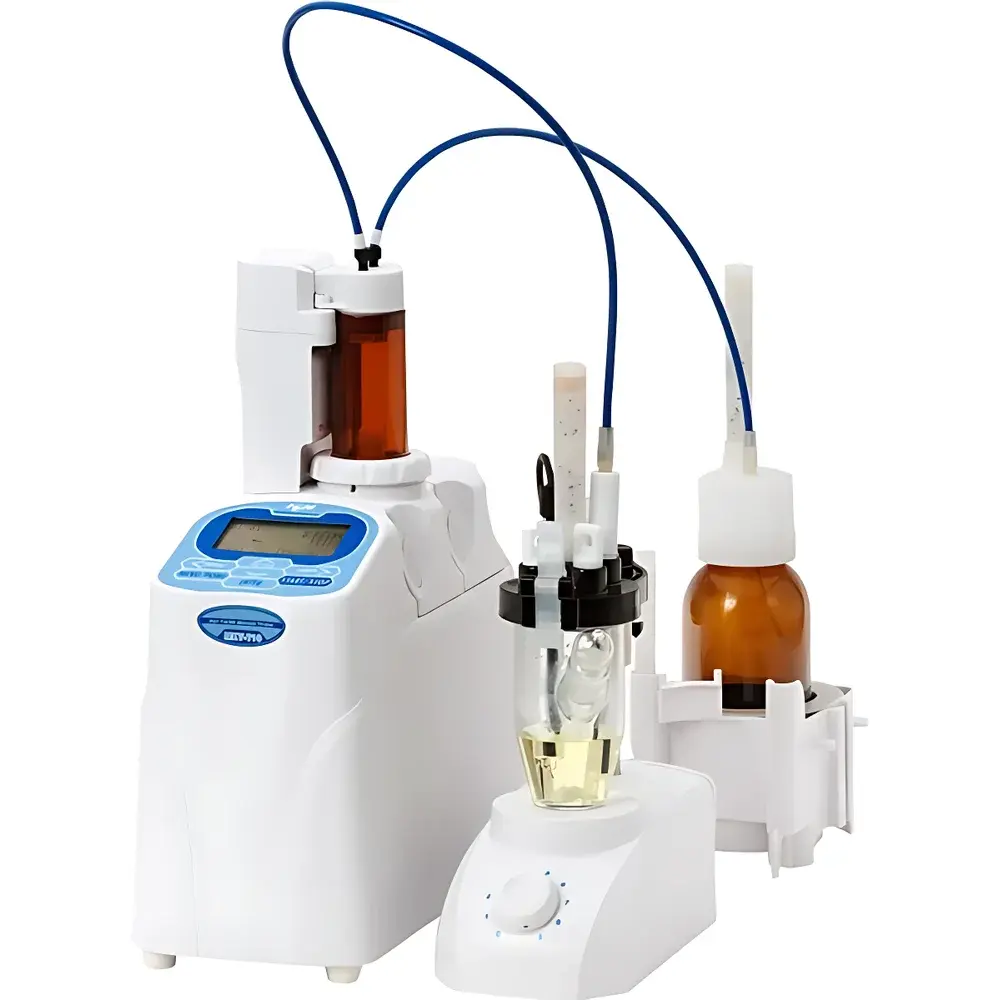
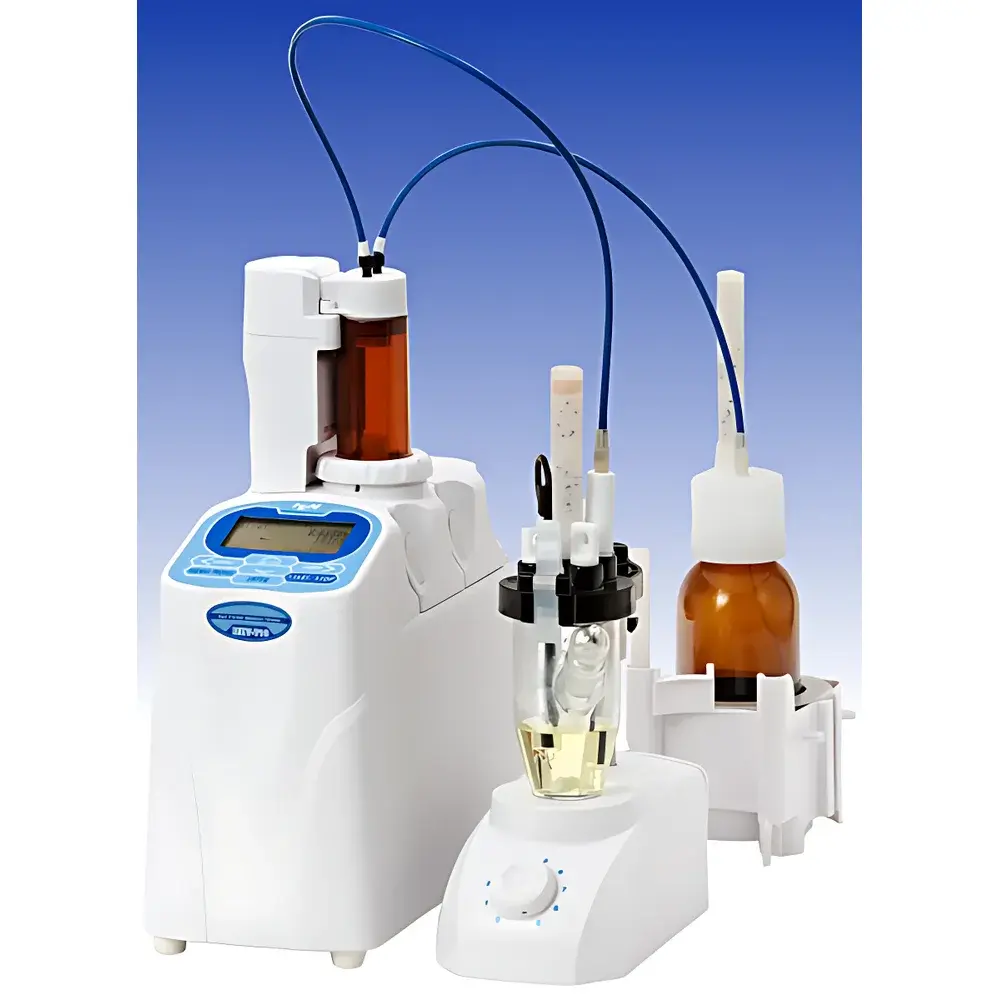
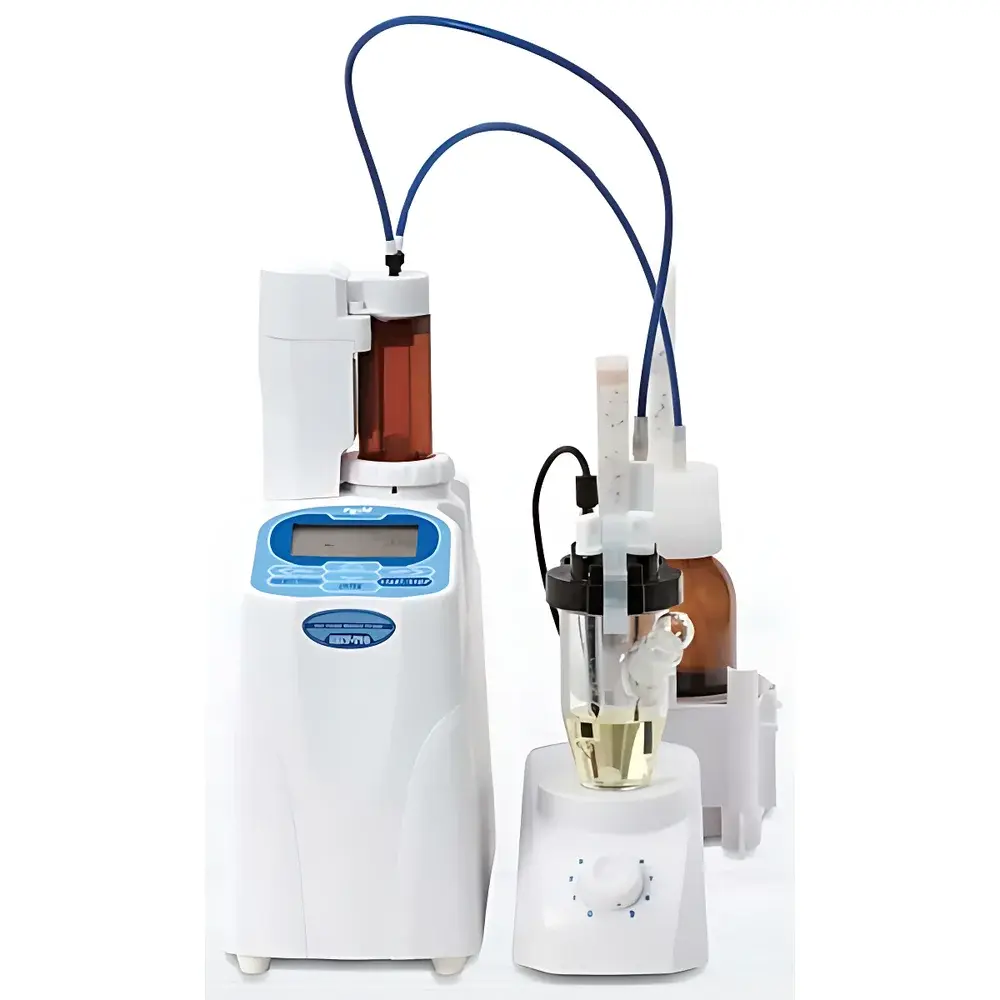
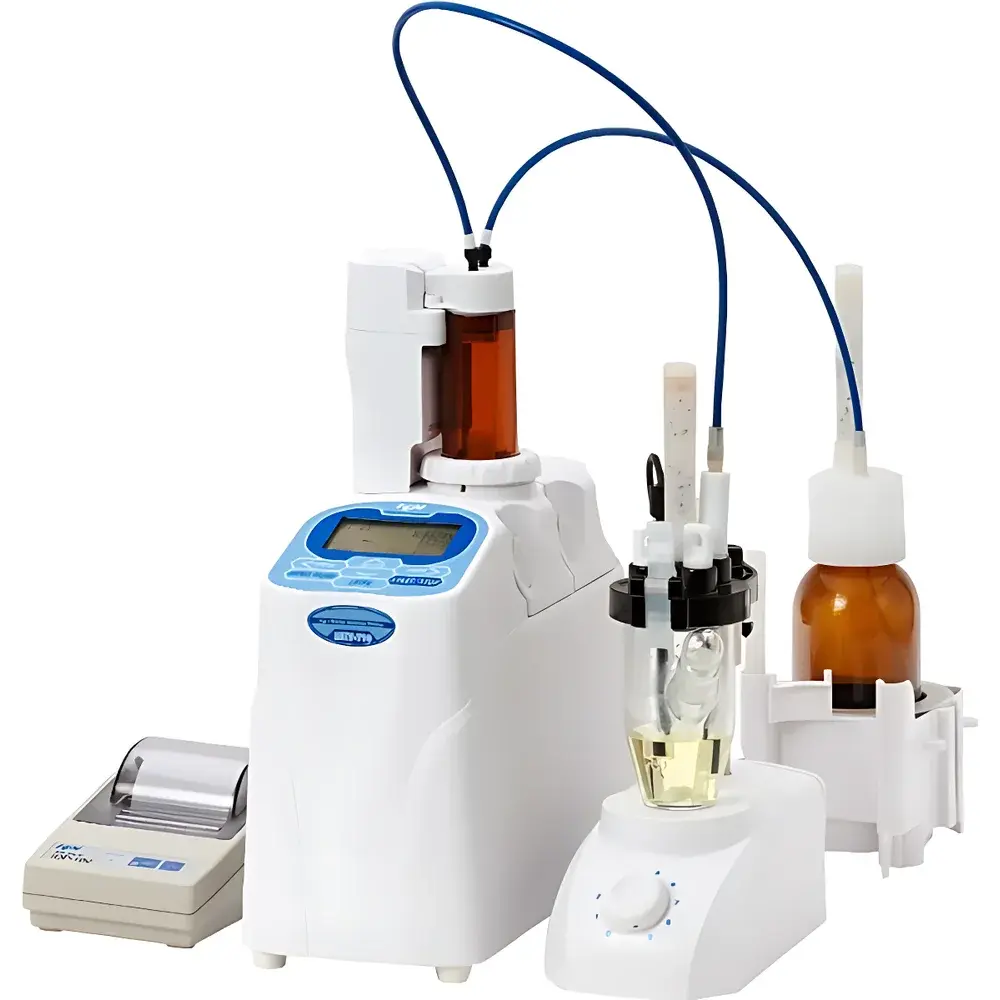
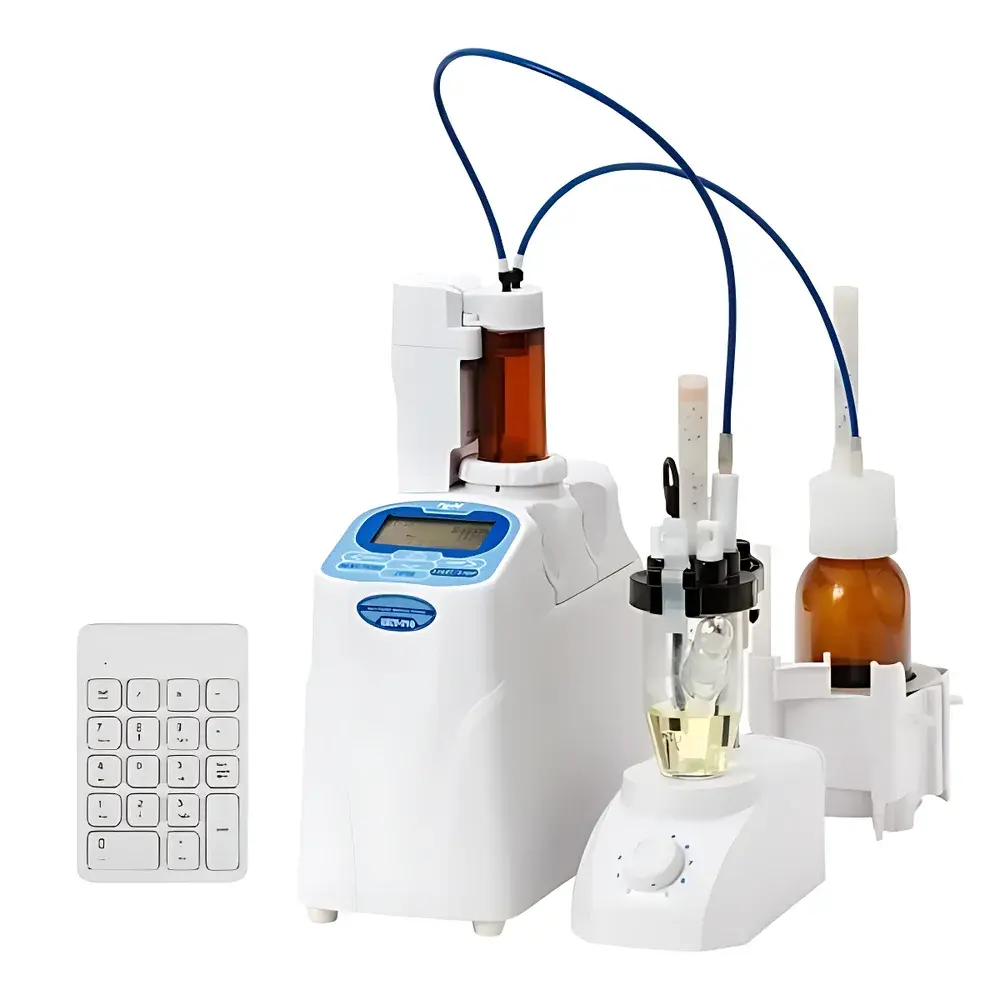
KEM MKV-710B Volumetric Karl Fischer Titrator
| Brand | KEM (Kyoto Electronics Manufacturing) |
|---|---|
| Origin | Japan |
| Manufacturer Type | Original Equipment Manufacturer (OEM) |
| Instrument Type | Volumetric Karl Fischer Moisture Analyzer |
| Model | MKV-710B |
| Measurement Resolution | 0.005 mL |
| Water Content Range | 1 ppm to 100% H₂O |
| Titration Accuracy (10 mL burette) | ±0.015 mL |
| Minimum Dispensing Increment | 1/20,000 |
| Titration Control Precision | 0.015 mL |
Overview
The KEM MKV-710B Volumetric Karl Fischer Titrator is a precision-engineered analytical instrument designed for quantitative determination of water content in solid, liquid, and gaseous samples via volumetric coulometric-free Karl Fischer titration. It operates on the stoichiometric reaction between water and iodine—generated in situ from a standardized Karl Fischer reagent containing iodine, sulfur dioxide, base (e.g., imidazole or pyridine), and solvent (methanol or ethylene glycol monomethyl ether). This method conforms rigorously to internationally recognized standards including ISO 760, ASTM E203, JIS K 0068 and K 0113, and GB/T 6283–2008. The MKV-710B delivers high reproducibility and traceable measurement integrity across pharmaceutical, petrochemical, polymer, battery electrolyte, and fine chemical applications where moisture control is critical to product stability, shelf life, and regulatory compliance.
Key Features
- Compact A4-footprint design with integrated burette drive mechanism—optimized for benchtop efficiency without compromising mechanical stability or reagent handling fidelity.
- Intuitive two-button operation (PRE-TITR. and START) enables rapid method execution with minimal operator training; ideal for routine QC laboratories operating under GLP/GMP frameworks.
- High-resolution 10 mL glass burette with 1/20,000-step motorized drive minimizes bubble adhesion and ensures precise, repeatable dispensing—critical for low-water-content analysis (e.g., <100 ppm).
- Onboard PDF report generation and USB mass storage support enable direct export of fully timestamped, audit-ready experimental records—including titration curves, raw data, and statistical summaries.
- Modular architecture supports seamless expansion: single-burette configuration can be upgraded to dual-burette mode (via optional second drive unit) for simultaneous forward/back-titration or multi-reagent protocols.
- Quick-swap burette module design facilitates maintenance, calibration verification, and reagent-specific optimization—reducing downtime during method transitions or reagent validation cycles.
- Native interoperability with KEM’s MCU-710 Coulometric Moisture Analyzer allows synchronized volumetric–coulometric analysis on a single platform, enhancing cross-method correlation studies and method transfer validation.
Sample Compatibility & Compliance
The MKV-710B accommodates diverse sample matrices—including hygroscopic solids (e.g., APIs, excipients), viscous liquids (lubricants, resins), and volatile solvents—using standardized S-type titration vessels (30–100 mL solvent volume). Its endpoint detection employs dynamic polarization potential monitoring with user-configurable stabilization time (1–99 s), minimizing false endpoints caused by electrode passivation or slow reaction kinetics in aldehydes/ketones. The system meets essential regulatory requirements for analytical instrumentation: full GLP functionality (operator/group registration, reagent lot tracking, performance check logs, time-stamped audit trail), 21 CFR Part 11 readiness (when paired with validated KEM data software), and compatibility with certified reference materials (CRMs) for traceable calibration. All firmware and hardware design align with IEC 61010-1 safety standards and electromagnetic compatibility (EMC) directives.
Software & Data Management
The MKV-710B features an embedded 6-language LCD interface (English, Japanese, Chinese, Korean, Russian, Spanish) with tactile keypad input and real-time graphical display of titration progress. Up to 20 user-defined methods can be stored onboard, each supporting automatic blank subtraction, titer calibration recall, concentration calculation (mg H₂O, % w/w, ppm), and statistical reporting (mean, SD, RSD). Data storage includes 100 complete sample records with metadata (date/time, operator ID, method name, reagent batch). External connectivity includes RS-232C (for balance integration, thermal printers, or legacy LIMS), USB host (supporting flash drives, thermal printers, barcode scanners, foot switches, and USB hubs), and SS-BUS (APB) for daisy-chained KEM peripheral synchronization. Exported PDF reports embed digital signatures, instrument ID, and calibration status—satisfying documentation requirements for ISO/IEC 17025-accredited labs.
Applications
- Pharmaceutical manufacturing: Residual moisture quantification in lyophilized powders, tablet granules, and active pharmaceutical ingredients per USP & EP monographs.
- Lithium-ion battery production: Trace water analysis in electrolytes and separator films—where sub-20 ppm levels directly impact cell impedance and cycle life.
- Polymer synthesis: Monitoring moisture in polyamide, polyurethane, and silicone precursors to prevent premature chain termination or gelation.
- Fuel and lubricant quality control: Detection of free water in aviation turbine fuels (ASTM D6304) and engine oils per ASTM D1744.
- Food & beverage R&D: Quantifying bound vs. free water in dairy powders, starches, and dehydrated ingredients affecting texture and microbial stability.
- Chemical intermediates: Validation of drying efficacy for sulfonyl chlorides, acid chlorides, and organometallic reagents highly sensitive to hydrolysis.
FAQ
What standards does the MKV-710B comply with for moisture analysis?
It supports ISO 760, ASTM E203, JIS K 0068/K 0113, and GB/T 6283–2008—ensuring method equivalence across global regulatory submissions.
Can the MKV-710B perform back-titration?
Yes—when equipped with the optional second burette drive unit, it supports reverse titration for samples that react slowly or interfere with standard endpoint detection.
Is GLP documentation fully supported?
Yes—the system provides operator/group management, reagent tracking, performance verification logs, and time-stamped audit trails compliant with GLP and FDA expectations.
What is the minimum detectable water mass?
At 1 ppm in a 10 g sample, the instrument resolves 0.01 mg H₂O; actual detection limit depends on sample size, solvent volume, and reagent titer (typically 1–5 mg H₂O absolute).
How is electrode maintenance handled?
The platinum double-pin electrode is removable and cleanable with ethanol or acetone; periodic calibration using certified water standards (e.g., 1.00 ± 0.02 mg H₂O) is recommended per ISO 760 Annex B.





