
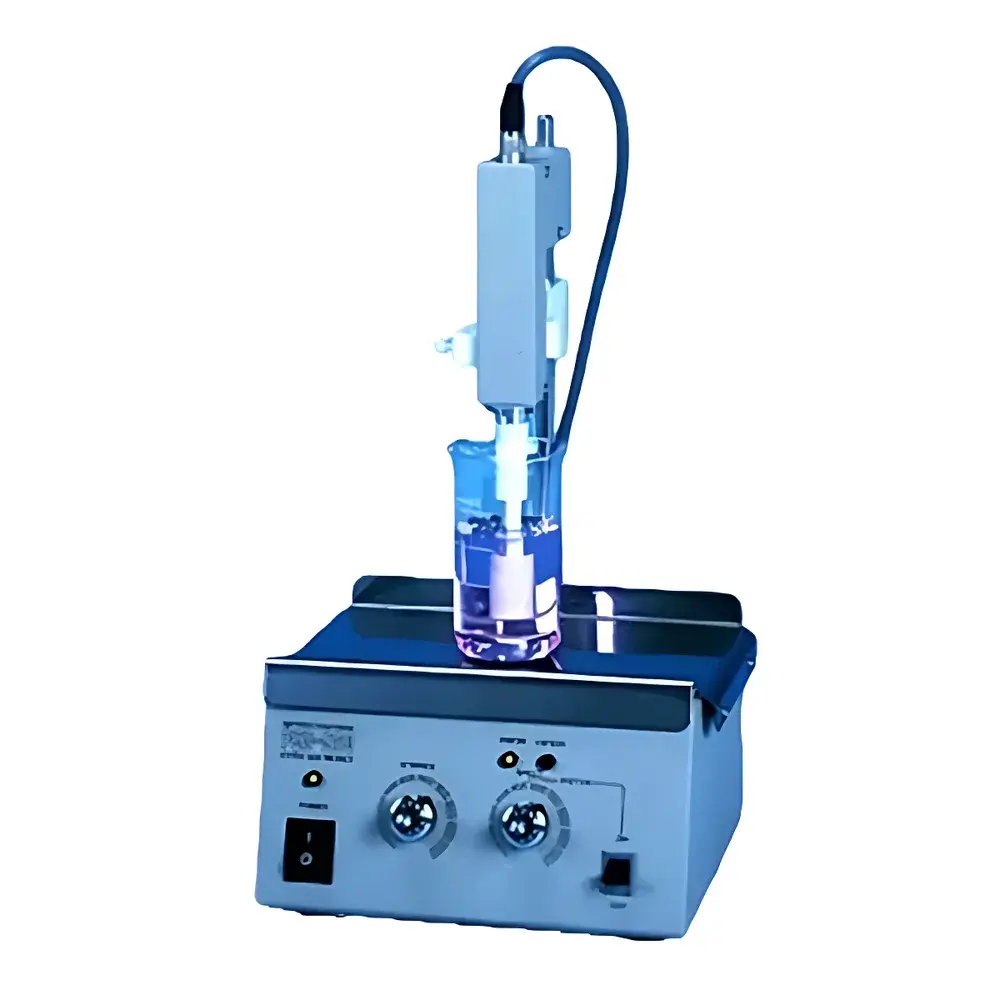
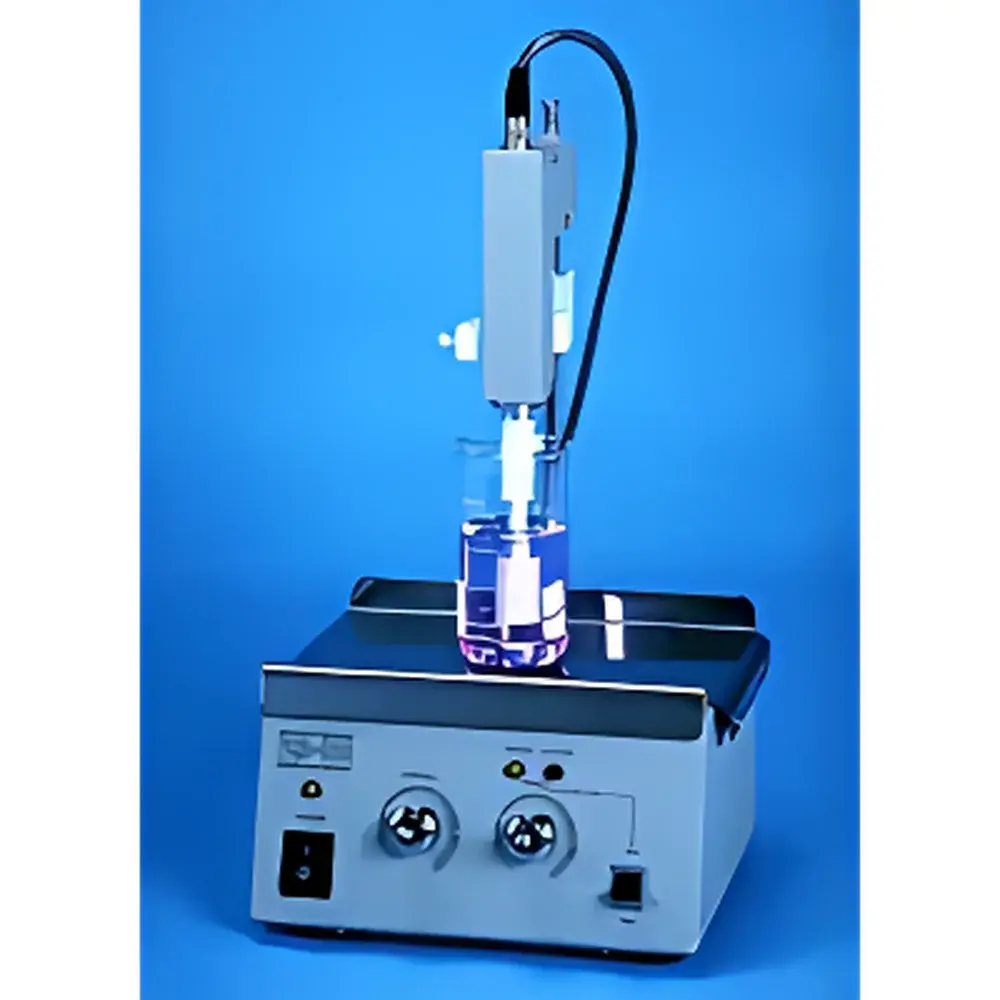
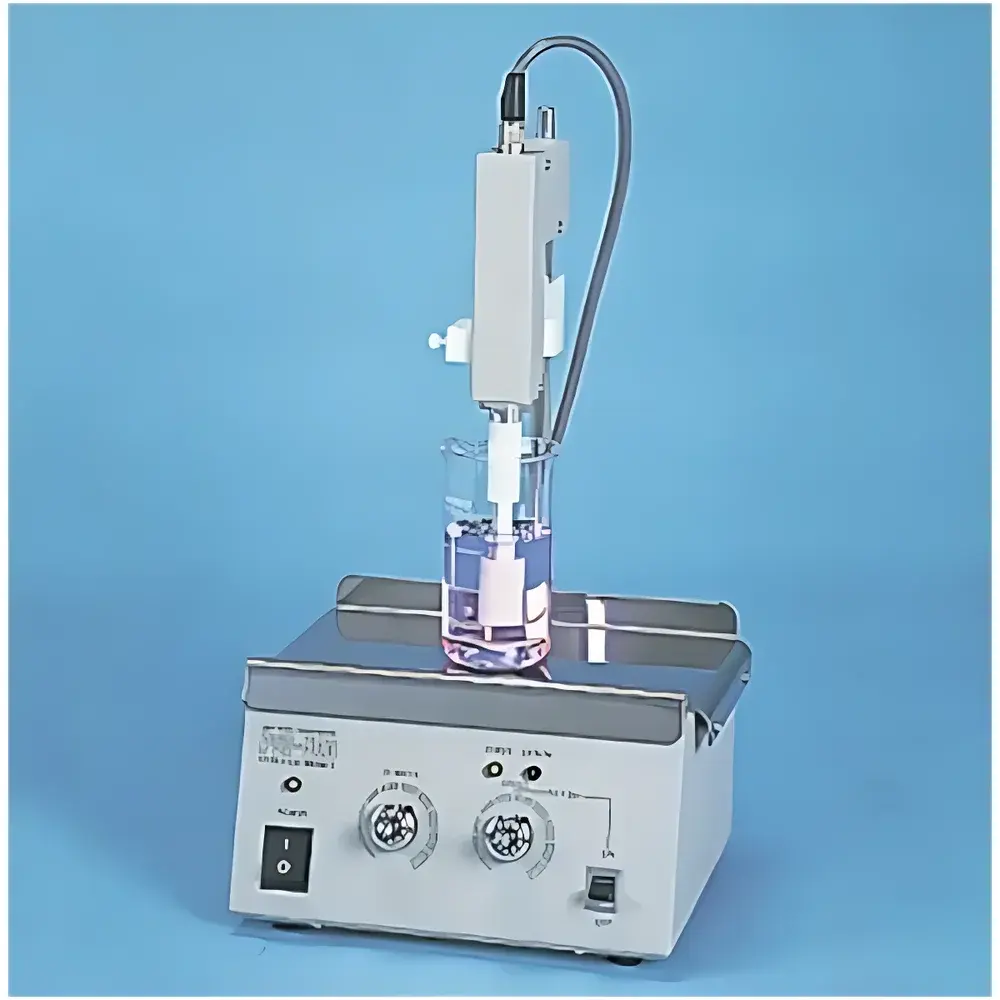
KEM PCD-500 Automatic Potentiometric Titrator with Streaming Potential Detection Unit
| Brand | KEM (Kyoto Electronics Manufacturing) |
|---|---|
| Origin | Japan |
| Manufacturer | Kyoto Electronics Manufacturing Co., Ltd. |
| Type | Imported Instrument |
| Model | PCD-500 |
| Instrument Category | General-Purpose Automatic Potentiometric Titrator |
| Application Scope | Universal |
| Measurement Principle | Streaming Potential Detection |
| Electrode Output Range | ±2 V DC |
| Power Supply | AC 100–240 V ±10%, 50/60 Hz |
| Power Consumption | ~10 W |
| Dimensions (W×D×H) | 250 × 210 × 400 mm |
| Weight | ~4.5 kg |
| Sample Handling | Stirred beaker-based immersion configuration |
| Piston Actuation | Continuously variable vertical reciprocation |
| Minimum Detectable Charge Concentration | ≥1 × 10⁻⁵ mol/L (dilution required for high-concentration samples) |
Overview
The KEM PCD-500 Automatic Potentiometric Titrator with Streaming Potential Detection Unit is a specialized electrochemical measurement system engineered for the quantitative determination of surface charge characteristics in colloidal and dispersed particulate systems. Unlike conventional potentiometric titrators that rely solely on ion-selective electrode potential shifts, the PCD-500 integrates streaming potential detection—a technique grounded in electrokinetic theory—to directly assess the electrophoretic behavior of charged particles under controlled fluid shear. When an electrolyte solution flows past a solid–liquid interface (e.g., particle surface or capillary wall), the displacement of the diffuse double layer generates a measurable streaming potential. The PCD-500 captures this voltage signal (±2 V DC) as a function of titrant addition, enabling precise endpoint identification and charge density profiling across a wide range of industrial dispersions. Designed for laboratory environments requiring trace-level charge characterization—particularly where zeta potential estimation is impractical due to high solids content or non-aqueous media—the instrument serves as a robust alternative to laser Doppler electrophoresis for routine quality control and formulation development.
Key Features
- Integrated streaming potential detection module with calibrated DC output (±2 V), optimized for high signal-to-noise ratio in low-conductivity colloidal suspensions.
- Motor-driven, continuously variable piston actuator enabling precise, programmable titrant delivery with reproducible flow dynamics during shear-induced potential generation.
- Dedicated sample handling configuration: includes magnetic stirrer base and standardized glass beaker setup, ensuring consistent hydrodynamic conditions for reliable interfacial charge response.
- Compact benchtop architecture (250 × 210 × 400 mm; ~4.5 kg) with universal AC input (100–240 V, 50/60 Hz) and low power consumption (~10 W), suitable for regulated QC laboratories and R&D spaces with limited utility infrastructure.
- Compliance-ready design: supports audit-trail-capable data logging when interfaced with KEM’s optional TitraMaster software (v9.0+), facilitating alignment with GLP and GMP documentation requirements.
Sample Compatibility & Compliance
The PCD-500 is validated for use with aqueous and polar organic dispersions containing surfactants, polyelectrolytes, coagulants, pigment slurries, food-grade emulsions, and polymer latexes. It accommodates samples with solids concentrations up to 30% w/w—provided appropriate dilution (≥1 × 10⁻⁵ mol/L effective charge carrier concentration) is performed prior to analysis. The system adheres to fundamental electrochemical measurement principles outlined in ASTM D4187 (Standard Test Method for Streaming Current/Potential of Colloidal Dispersions) and ISO 13099-2 (Nanotechnologies — Characterization of Particles in Dispersed Systems — Part 2: Determination of Particle Size Distribution by Electron Microscopy). While not a standalone regulatory device, its output is compatible with FDA 21 CFR Part 11-compliant data acquisition platforms when deployed with validated software and electronic signature protocols.
Software & Data Management
The PCD-500 operates as a hardware sensor node within KEM’s TitraMaster ecosystem. Raw streaming potential signals are acquired via analog-to-digital conversion at 10 Hz sampling rate and synchronized with titrant volume increments. TitraMaster v9.2+ provides real-time curve visualization (potential vs. titrant volume), automatic inflection point detection using second-derivative algorithms, and export of ASCII-tabulated datasets for post-processing in MATLAB, Python (SciPy), or statistical packages. All measurement sessions include embedded metadata: date/time stamp, operator ID, method file hash, and hardware calibration status—enabling full traceability per ISO/IEC 17025 clause 7.7. Data integrity is preserved through write-once storage options and optional encrypted database archiving.
Applications
- Optimization of flocculant dosage in wastewater treatment plants by correlating charge neutralization endpoints with turbidity reduction efficiency.
- Stability assessment of pigment dispersions in automotive coatings, where residual anionic charge influences rheology and film formation.
- Quality release testing of cationic starch additives in papermaking, verifying batch-to-batch consistency in surface charge density.
- Formulation screening of food-grade emulsifiers (e.g., lecithin, DATEM) to quantify adsorption efficiency onto protein or lipid interfaces.
- Academic research into polyelectrolyte multilayer assembly kinetics, leveraging streaming potential transients to infer interfacial binding stoichiometry.
FAQ
What types of electrodes are used in the PCD-500 system?
The PCD-500 employs a pair of identical Ag/AgCl reference electrodes positioned symmetrically within the stirred beaker to eliminate junction potential drift and ensure differential streaming potential measurement.
Can the PCD-500 measure zeta potential directly?
No—it measures streaming potential, which requires complementary parameters (e.g., solution conductivity, viscosity, capillary geometry) for zeta potential calculation. It is not a substitute for dedicated electrophoretic light scattering instruments.
Is method validation support available from KEM?
Yes—KEM provides application notes, SOP templates, and IQ/OQ documentation packages aligned with ISO 8655 and USP for pharmaceutical and biotech users.
Does the system require external pH or conductivity monitoring?
Not inherently; however, concurrent pH or conductivity titration can be performed using optional auxiliary electrode inputs on TitraMaster-enabled configurations.
How often must the detection unit be recalibrated?
Calibration verification is recommended before each analytical campaign using standardized KCl solutions (10⁻⁴ to 10⁻² mol/L); full recalibration is required after electrode replacement or mechanical maintenance.





