
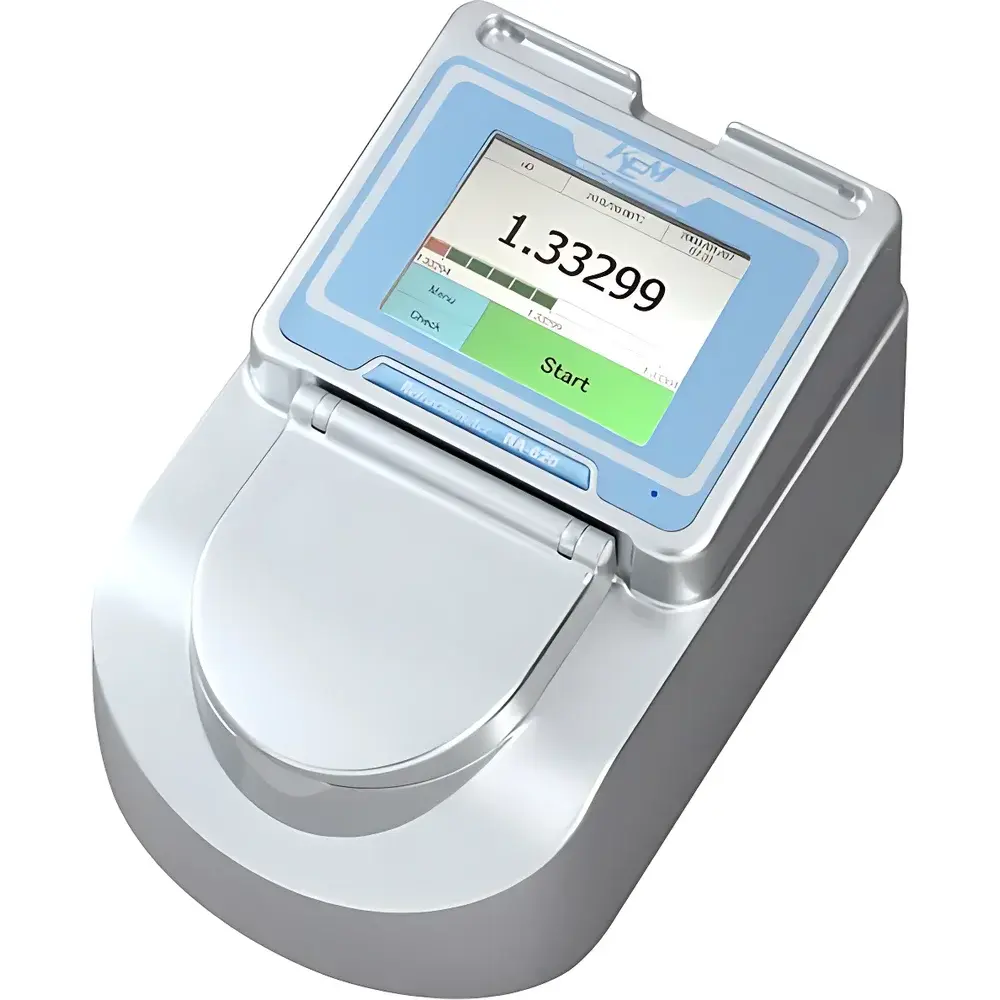
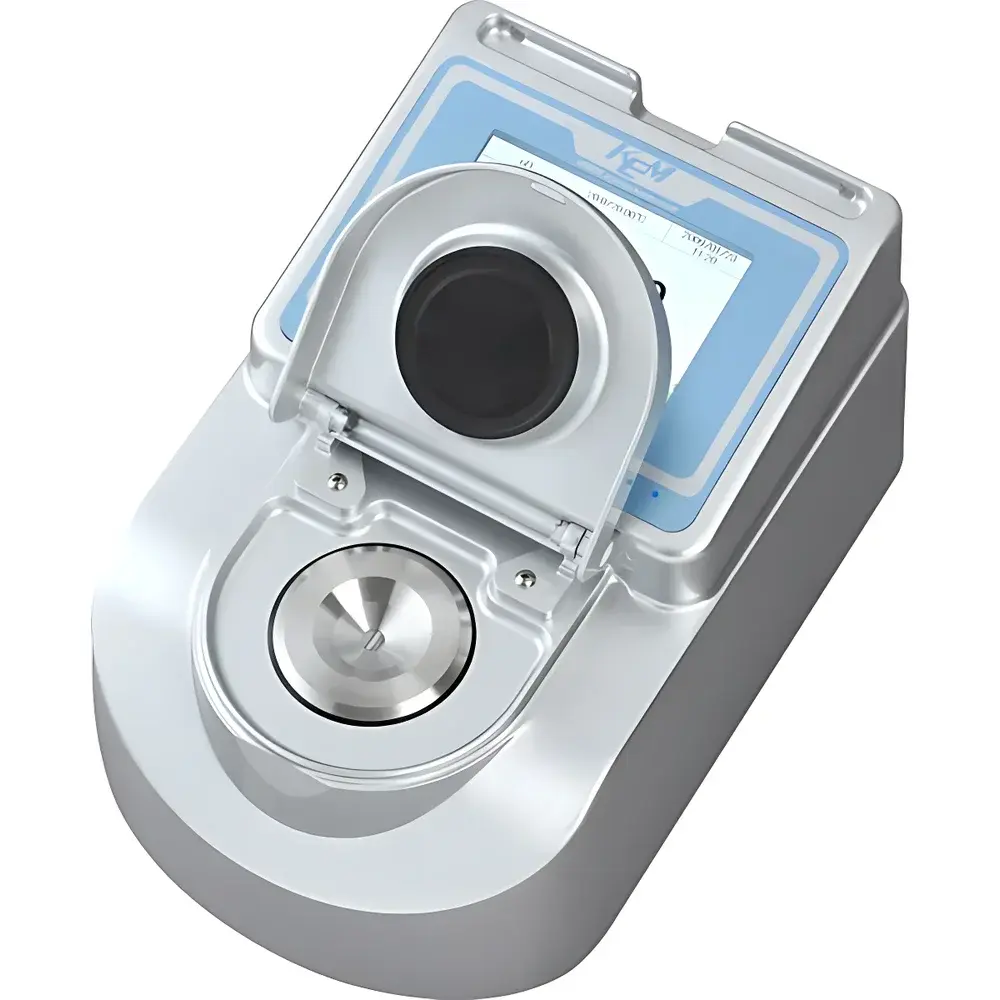
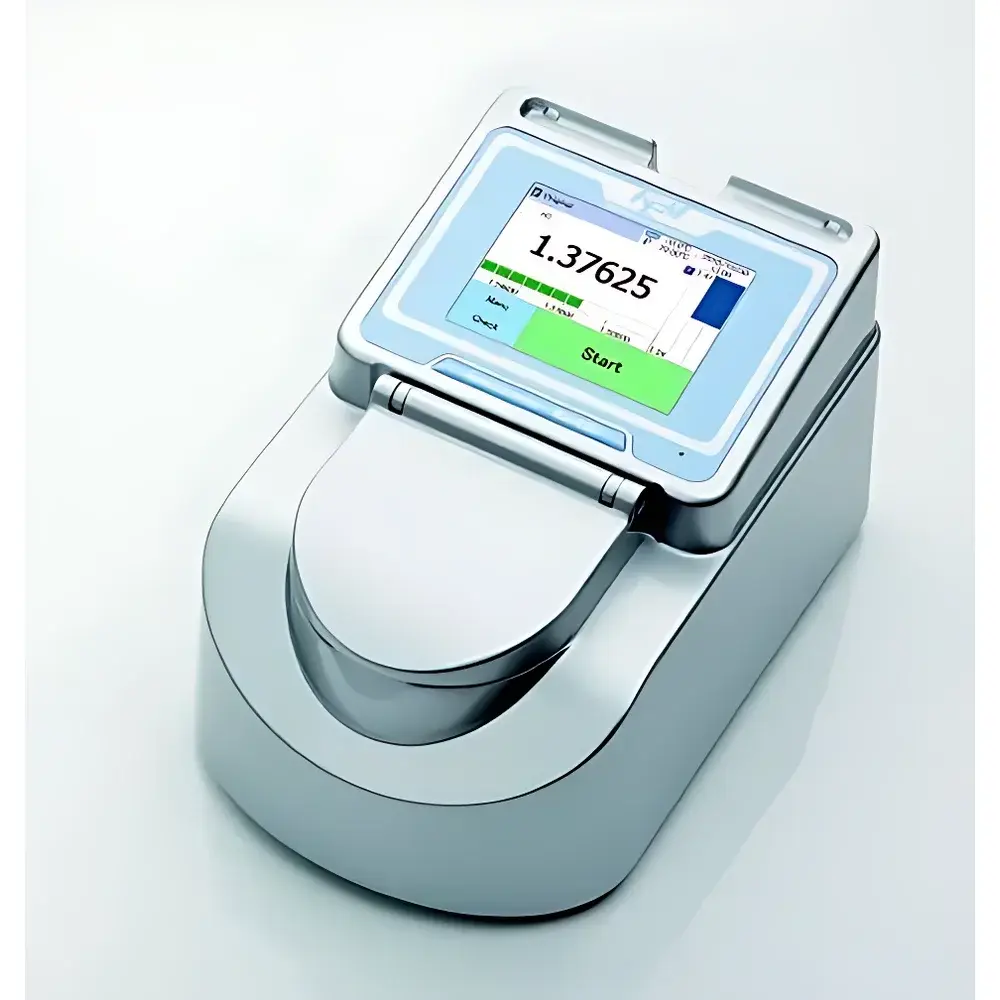
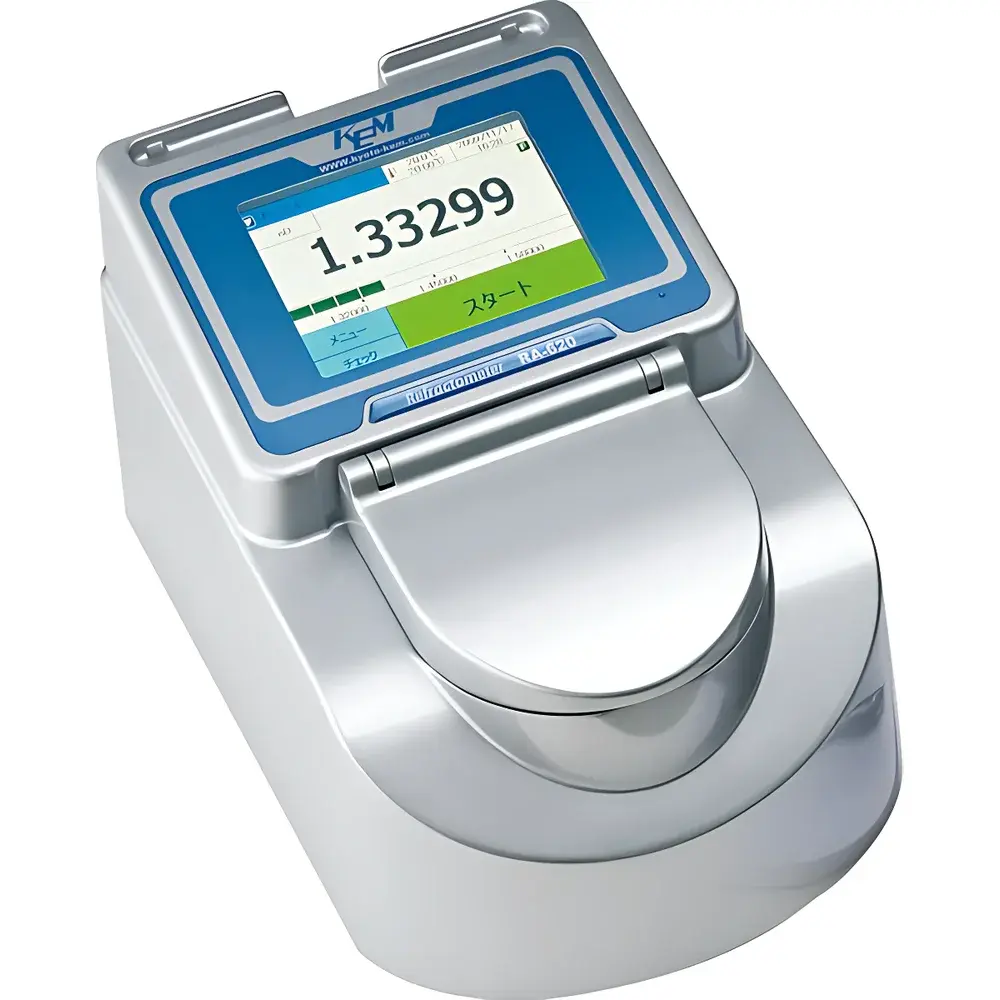
KEM RA-620 High-Precision Digital Refractometer
| Brand | KEM (Kyoto Electronics Manufacturing) |
|---|---|
| Origin | Japan |
| Manufacturer Type | Original Equipment Manufacturer (OEM) |
| Instrument Class | Benchtop Refractometer |
| Temperature Control | Peltier-based, 5–75 °C |
| Digital Display | Yes |
| Measurement Range | Refractive Index (nD): 1.32000–1.58000 |
| Brix | 0.00–100.00% |
| Accuracy | Refractive Index: ±0.00002 nD |
| Brix | ±0.014% (0–85%) |
| Repeatability | Refractive Index: ±0.00001 nD |
| Brix | ±0.007% (<5%), ±0.01% (≥5%) |
| Resolution | Refractive Index: 0.00001 nD |
| Brix | 0.001% (<5%), 0.01% (≥5%) |
| Sample Volume | 0.2 mL |
| Prism Material | Sapphire |
| Temperature Resolution | 0.01 °C |
| Interface | LAN, USB, RS-232C |
| Compliance | ASTM D1218-21, ISO 1743:1982, GB/T 614-2021, GB/T 5527-2024, ICUMSA GS 4/3-13, OIML R 124 |
Overview
The KEM RA-620 High-Precision Digital Refractometer is an advanced benchtop instrument engineered for traceable, temperature-controlled measurement of refractive index (nD) and related derived parameters—including Brix, dry matter content, and concentration—across a broad spectrum of liquid and semi-liquid samples. It operates on the principle of critical-angle refraction: when collimated monochromatic light (589.3 nm, sodium D-line equivalent) passes from a high-refractive-index sapphire prism into a sample, the critical angle of total internal reflection is detected with photodiode array precision. This angle is directly correlated to the sample’s refractive index via Snell’s law (n = N·sin r), where N is the precisely known refractive index of the sapphire prism (n ≈ 1.76 at 20 °C). The RA-620 integrates a Peltier thermoelectric module to maintain sample temperature within ±0.01 °C across a 5–75 °C range, eliminating thermal drift and enabling compliance with standardized test conditions specified in ASTM, ISO, GB/T, and ICUMSA methods.
Key Features
- High-stability sapphire prism (Mohs hardness 9) and SUS316 stainless steel sample stage ensure long-term mechanical integrity and chemical resistance to aggressive solvents, acids, and viscous matrices.
- LED-based 589.3 nm light source delivers stable spectral output over >50,000 hours—eliminating lamp replacement cycles and spectral drift common in halogen or sodium-vapor sources.
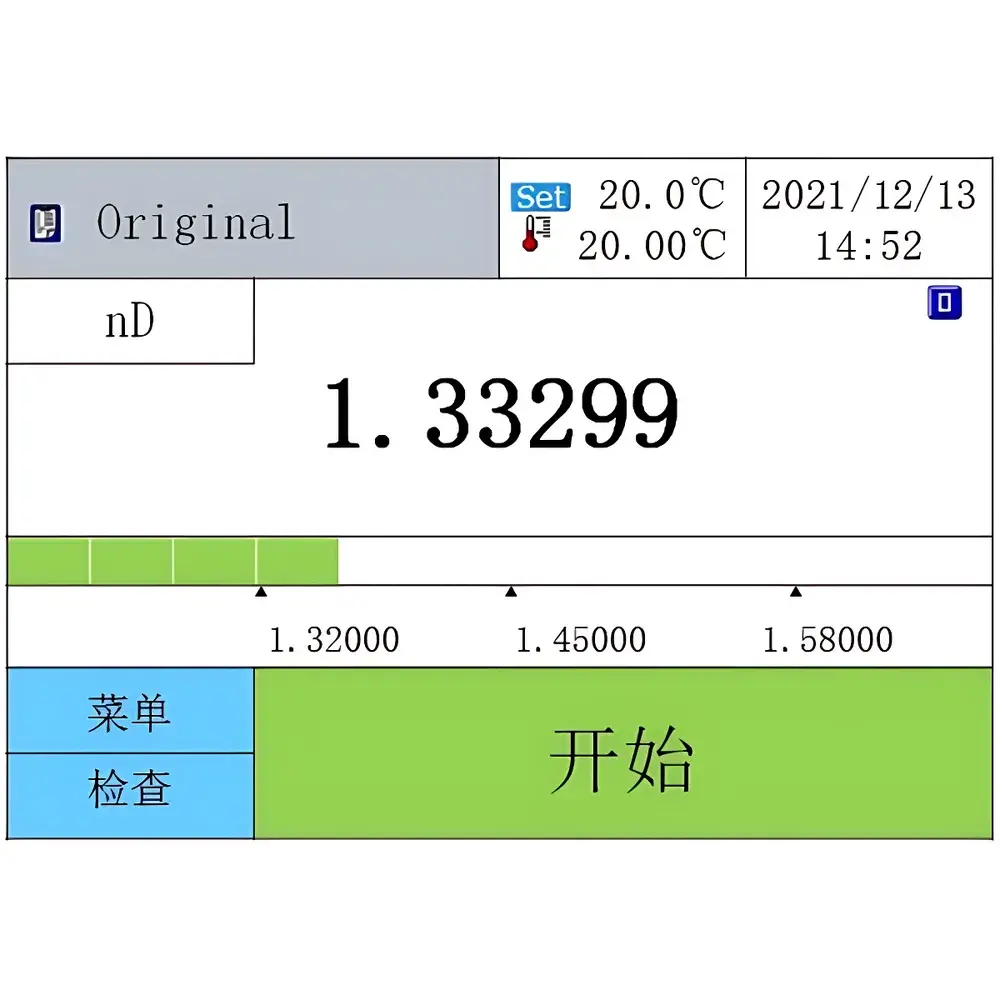
- 4.7-inch color TFT-LCD touchscreen with multilingual OS (English, Chinese, Japanese) supports intuitive method-driven operation, real-time dual-parameter display (e.g., nD + Brix), and on-screen calibration verification.
- GLP-compliant data architecture stores up to 100 user-defined measurement methods, 300 result records, and 20 calibration/maintenance logs—with full audit trail capability including operator ID, timestamp, temperature, and environmental metadata.
- Temperature compensation engine accepts user-defined polynomial coefficients or tabular nD vs. T look-up tables per ISO 1743 and ASTM D1218 Annex A, enabling automatic correction to reference temperatures (e.g., 20 °C or 25 °C).
- Concentration conversion module supports up to 100 custom nD–concentration correlation sets, plus built-in ICUMSA-compliant Brix-to-dry-matter tables and HFCS (42/55/90) conversion algorithms.
- Integrated vapor suppression cover minimizes evaporation artifacts for volatile solvents (e.g., ethanol, acetone, low-boiling hydrocarbons) during measurement.
Sample Compatibility & Compliance
The RA-620 accommodates aqueous solutions, organic solvents, edible oils, syrups, pharmaceutical formulations, and industrial fluids with viscosities up to 10,000 mPa·s. Its 0.2 mL minimum sample volume enables efficient analysis of precious or limited-availability materials. Regulatory alignment includes full support for pharmacopeial and food-grade testing protocols: USP , EP 2.2.6, JP 2.05, and FDA-referenced methods for quality control of excipients, APIs, and finished dosage forms. Instrument validation documentation meets IQ/OQ/PQ requirements under GMP Annex 15 and 21 CFR Part 11 when paired with KEM’s optional PC software (RA-Win Pro). All measurements are traceable to NIST-certified refractive index standards (SRM 1751, SRM 1752) and calibrated using certified sucrose solutions per ICUMSA Method GS 4/3-13.
Software & Data Management
RA-Win Pro software (optional) provides secure, networked data acquisition, statistical process control (SPC) charting, and electronic signature workflows compliant with 21 CFR Part 11. Raw data export supports CSV, PDF, and XML formats; all files include embedded instrument ID, firmware version, calibration status flags, and digital signatures. Local storage via USB flash drive allows offline archiving without network dependency. LAN and RS-232C interfaces enable integration into LIMS environments and automated QA/QC workflows—particularly valuable in beverage, biofuel, and fine chemical production lines requiring concurrent density–refractometry correlation (when interfaced with KEM DA-6XX series densimeters).
Applications
- Food & Beverage: Brix quantification in fruit juices, soft drinks, honey, and confectionery syrups per AOAC 932.12 and ICUMSA guidelines.
- Pharmaceuticals: Excipient concentration verification (e.g., glycerol, propylene glycol), osmolality estimation, and API solution strength monitoring.
- Chemicals & Petrochemicals: Hydrocarbon purity assessment (ASTM D1218), solvent water content screening, and polymer solution concentration profiling.
- Agriculture & Biotechnology: Plant extract solids content, fermentation broth monitoring, and enzyme activity assay buffer composition control.
- Academic Research: Fundamental optical property characterization of nanofluids, ionic liquids, and stimuli-responsive polymers under controlled thermal conditions.
FAQ
What is the refractive index measurement principle used in the RA-620?
It employs critical-angle detection based on total internal reflection at the sapphire prism–sample interface, using monochromatic 589.3 nm LED illumination and high-resolution angular photodetection.
Does the RA-620 comply with 21 CFR Part 11 requirements?
Yes—when operated with RA-Win Pro software and configured with electronic signatures, audit trails, and role-based access control, it satisfies electronic record and signature criteria.
Can the RA-620 measure samples below 5 °C or above 75 °C?
No—the Peltier system is rated for 5–75 °C operational range; external thermostatted cells are required for measurements outside this interval.
How is calibration verified and documented?
Calibration uses certified sucrose standards traceable to NIST; results, date, operator, and standard lot number are stored automatically with time-stamped entries in the GLP log.
Is the sapphire prism susceptible to scratching by abrasive particles?
While sapphire resists most chemical and mechanical wear, particulate-laden samples must be filtered (≤5 µm) prior to analysis to prevent micro-scratching and maintain long-term accuracy.



