
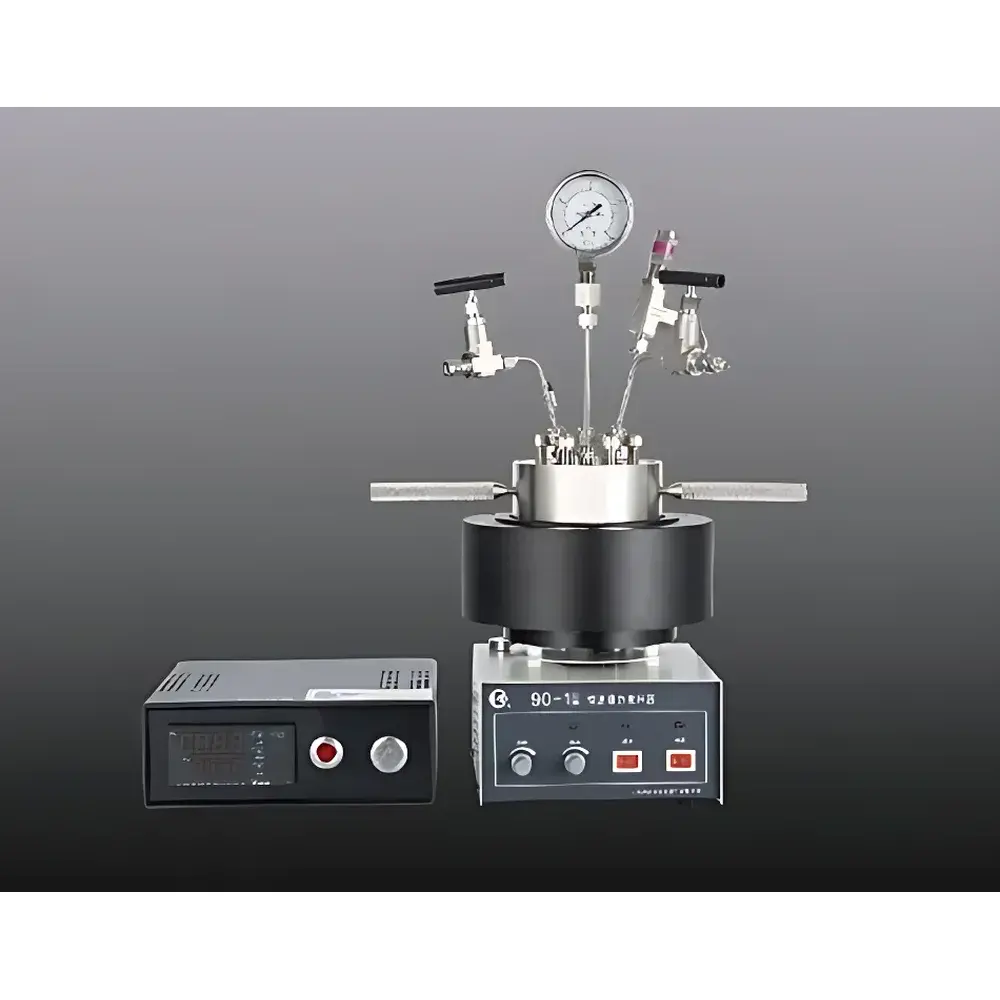
Kemi NSG Quick-Release Magnetic Stirring Reactor
| Origin | Anhui, China |
|---|---|
| Manufacturer Type | Authorized Distributor |
| Origin Category | Domestic (China) |
| Model | NSG |
| Price Range | USD 2,800 – 7,000 |
| Vessel Volume Options | 25 mL, 50 mL, 100 mL, 300 mL |
| Construction Material | 316L Stainless Steel (standard) |
| Operating Pressure | Up to 207 bar (standard configuration) |
| Maximum Operating Temperature | 300 °C |
| Heating Method | Embedded stainless steel heating module |
| Heating Power | 0.8 kW |
| Stirring Speed Range | 400–1400 rpm (infinitely variable, digital control) |
| Stirring Mechanism | Internal magnetic stir bar drive |
| Temperature Control | Intelligent PID algorithm with digital display and overtemperature auto-shutdown |
| Sealing Design | Monolithic machined tongue-and-groove main seal |
| Safety Features | Dual-pressure protection — FITOK precision needle valves + custom rupture disc |
| Optional Accessories | Sampling ports, condenser reflux kits, cooling jackets, solid reagent baskets, alternative alloy vessels, auxiliary agitation configurations |
Overview
The Kemi NSG Quick-Release Magnetic Stirring Reactor is an engineered laboratory-scale pressure reactor designed for controlled synthesis, catalytic screening, hydrogenation, oxidation, and high-temperature/pressure kinetic studies under inert or reactive atmospheres. It operates on the principle of sealed batch reaction with contactless magnetic stirring—eliminating rotating shaft seals and associated leakage risks—while maintaining full integrity at elevated pressures and temperatures. The reactor integrates a precision magnetic coupling system, monolithic 316L stainless steel vessel construction, and a robust tongue-and-groove sealing architecture to ensure repeatable leak-tight performance up to 207 bar and 300 °C. Its quick-release flange mechanism enables tool-free disassembly in under 60 seconds without compromising structural or pressure containment integrity—a critical advantage for iterative experimentation and multi-condition screening workflows in academic labs, R&D centers, and process development units.
Key Features
- Quick-release flange system with integrated alignment pins and torque-limited clamping—enables rapid, repeatable opening/closing without tools or gasket realignment
- Monolithic 316L stainless steel reactor body with CNC-machined tongue-and-groove primary seal; optional Hastelloy C-276 construction available for highly corrosive media (e.g., HF, hot chlorides, strong acids)
- Dual-pressure safety architecture: precision FITOK stainless steel needle valves for fine gas regulation + certified rupture disc with calibrated burst pressure (ASME BPVC Section VIII compliant)
- Embedded heating module with uniform thermal distribution and maximum ramp rate of 20 °C/min; thermocouple feedback loop integrated directly into vessel wall for minimized lag
- Digital PID temperature controller with overtemperature cutoff (setpoint-based auto-shutdown), ±0.5 °C stability at steady state
- Infinitely variable magnetic stirring (400–1400 rpm), digitally displayed and programmable via front-panel interface; torque-compensated drive maintains consistent rotation across viscosity changes
- Standardized 1/4″ NPT and Swagelok-compatible ports for gas inlet/outlet, pressure transducer, thermocouple, sampling, and optional condenser/reflux integration
Sample Compatibility & Compliance
The NSG reactor accommodates heterogeneous and homogeneous liquid-phase reactions, slurry-based catalysis, gas–liquid absorption (e.g., CO₂ capture screening), and solid-in-liquid dissolution kinetics. Compatible with organic solvents (THF, DMF, dioxane), aqueous electrolytes, supercritical CO₂, H₂, O₂, NH₃, and Cl₂—subject to material compatibility verification per ASTM G15/G15M and NACE MR0175/ISO 15156. All standard configurations comply with CE machinery directive 2006/42/EC and PED 2014/68/EU for Group 2 fluid service. Pressure components are traceably heat-treated and hydrostatically tested at 1.5× MAWP prior to shipment. Documentation includes material test reports (MTRs), ASME U-1 data sheets, and conformity declarations for GLP and ISO/IEC 17025-aligned laboratories.
Software & Data Management
While the base NSG model operates via standalone digital controller, optional RS485/Modbus RTU interface enables integration with LabVIEW, MATLAB, or third-party SCADA systems for time-stamped parameter logging (temperature, pressure, rpm, power). The controller supports up to 10 user-defined ramp-soak programs with event-triggered outputs (e.g., initiate sampling upon reaching target T/P). Audit trail functionality—including operator ID tagging, parameter change history, and timestamped alarm logs—is available with the optional FDA 21 CFR Part 11-compliant firmware upgrade, supporting electronic records retention for regulated environments.
Applications
- Catalyst evaluation under realistic process conditions (e.g., Fischer–Tropsch, hydrodesulfurization, asymmetric hydrogenation)
- Solvothermal nanomaterial synthesis (MOFs, perovskites, quantum dots) with precise thermal ramp control
- Reaction calorimetry via temperature profiling during exothermic addition protocols
- Corrosion testing of alloys in high-T/pH environments with in situ pH and redox monitoring ports
- Green chemistry process intensification—e.g., continuous-flow precursor injection into static batch reactors
- Pharmaceutical intermediate synthesis requiring strict moisture/oxygen exclusion and reproducible thermal profiles
FAQ
What pressure ratings are certified for the standard NSG configuration?
The base NSG reactor is rated for 207 bar (3000 psi) maximum allowable working pressure (MAWP) at 300 °C, validated per ASME Section VIII Div. 1 requirements.
Can the reactor be used with aggressive halogen-containing reagents?
Yes—when configured with Hastelloy C-276 wetted parts, it withstands prolonged exposure to HCl, HF, and brominated solvents at elevated temperatures; consult the corrosion resistance guide for specific concentration/temperature limits.
Is the magnetic stirring system suitable for viscous reaction mixtures?
The high-torque magnetic coupling sustains stable rotation up to ~10,000 cP; for higher viscosities or particle-laden slurries, optional anchor or paddle agitators are available as mechanical retrofit kits.
How is temperature uniformity verified across the reaction volume?
Each unit undergoes thermal mapping per ASTM E2251 using three calibrated PT100 probes at top/mid/bottom positions; axial gradient remains ≤±1.2 °C at 250 °C steady state.
Are spare parts and calibration services available internationally?
Yes—Kemi maintains authorized service partners in EU, North America, and APAC regions; all pressure-retaining components carry serialized traceability and 24-month warranty against manufacturing defects.



