
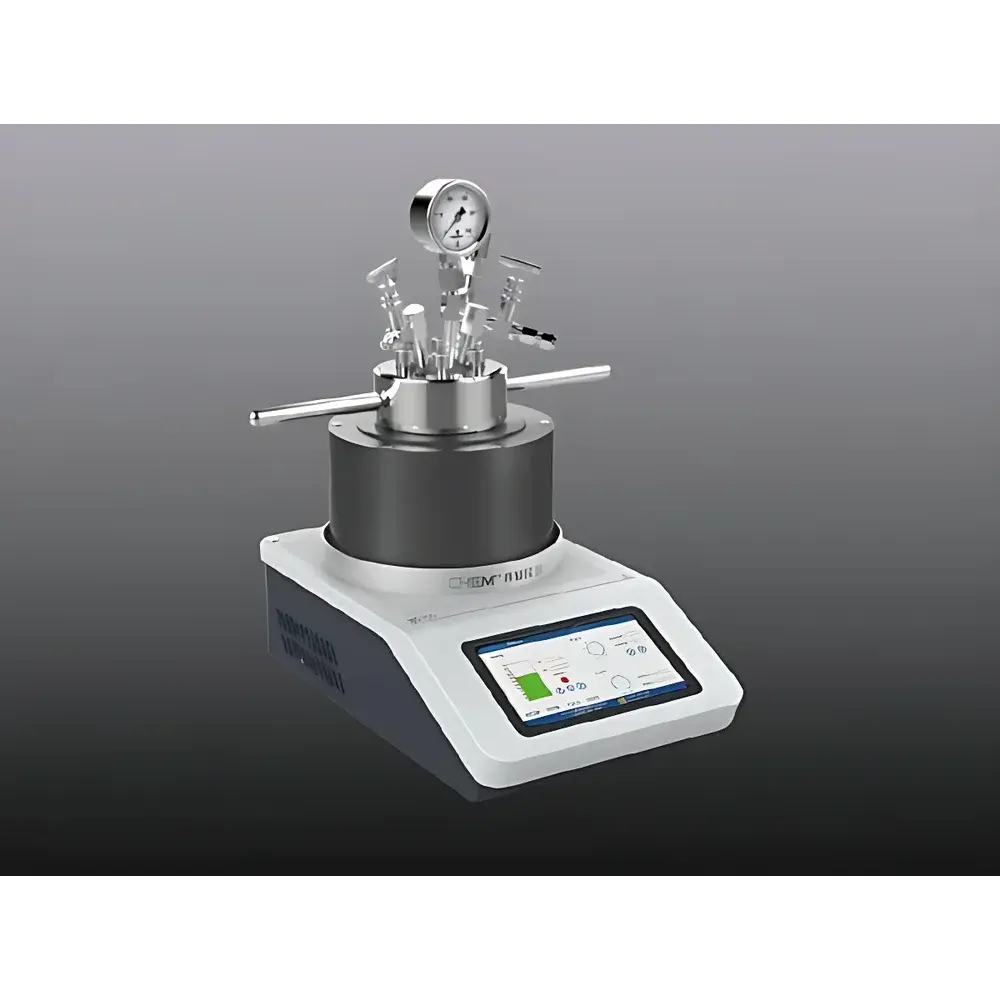
Kemi NSI Magnetic Stirring Quick-Release Reactor
| Origin | Anhui, China |
|---|---|
| Manufacturer Type | Distributor |
| Origin Category | Domestic |
| Model | NSI |
| Price Range | USD 2,800 – 7,000 |
| Vessel Capacity | 25 mL, 50 mL, 100 mL, 300 mL |
| Material | 316L Stainless Steel (optional Hastelloy C-276) |
| Max Operating Pressure | 345 bar |
| Max Operating Temperature | 300 °C |
| Heating Method | Embedded stainless steel heating module |
| Heating Power | 0.8 kW |
| Stirring Speed | 400–1400 rpm (infinitely variable) |
| Stirring Mechanism | Internal magnetic stir bar |
| Control Interface | 7-inch high-resolution touchscreen |
| Data Logging | Real-time temperature, pressure, and speed recording via USB export |
| Safety Features | Over-temperature auto-shutdown, over-pressure audible alarm, Swagelok inlet/outlet needle valves, Fitok-certified safety valve + custom rupture disc |
| Sealing | Tongue-and-groove main seal |
| Compliance | Designed for GLP-compliant lab environments |
| Power Supply | 200–240 V AC, 50–60 Hz |
| Dimensions (W×H×L) | ≈250 × 300 × 410 mm |
| Optional Configurations | Catalyst baskets, sampling ports, reflux condensers, cooling jackets, UV-transparent quartz windows (for photocatalysis) |
Overview
The Kemi NSI Magnetic Stirring Quick-Release Reactor is an integrated benchtop synthesis platform engineered for precision-controlled, small-scale chemical reactions under elevated temperature and pressure. It operates on the principle of sealed-vessel batch synthesis, where reaction kinetics, thermodynamics, and mass transfer are rigorously managed through active magnetic stirring, uniform conductive heating, and real-time process parameter monitoring. Unlike conventional jacketed or oil-bath reactors, the NSI series employs an embedded stainless steel heating module delivering rapid thermal response (up to 20 °C/min), minimizing thermal lag and enabling accurate kinetic profiling. Its quick-release mechanical coupling—based on a precision-machined tongue-and-groove sealing interface—eliminates threaded assembly, reducing setup time by >60% while maintaining leak-tight integrity up to 345 bar. The reactor is widely deployed in academic catalysis labs, pharmaceutical process R&D, and materials science for hydrogenation, oxidation, hydrothermal synthesis, and photocatalytic studies (when equipped with optional quartz windows).
Key Features
- Quick-release mechanical coupling with CNC-machined tongue-and-groove main seal for repeatable, tool-assisted opening/closing in <15 seconds
- Integrated 7-inch capacitive touchscreen controller displaying real-time temperature, pressure, stirring speed, and elapsed time with intuitive icon-based navigation
- Embedded 0.8 kW stainless steel heating module ensuring uniform thermal distribution and eliminating hot spots common in external heating mantles
- Infinitely variable magnetic stirring (400–1400 rpm) with digital PID feedback control to prevent vortexing or splashing in low-volume vessels (25–300 mL)
- Dual-stage pressure protection: certified Fitok safety relief valve plus user-configurable rupture disc for fail-safe overpressure mitigation
- Swagelok 1/4″ NPT stainless steel needle valves for precise gas/liquid introduction and venting, rated to full system pressure
- Comprehensive safety logic: automatic power cutoff at preset temperature limit, audible alarm activation upon pressure excursion, and hardware-enforced interlock during lid actuation
Sample Compatibility & Compliance
The NSI reactor accommodates homogeneous and heterogeneous reaction mixtures—including slurries, suspensions, and gas-liquid systems—across a broad chemical compatibility spectrum. Standard 316L stainless steel construction resists corrosion from organic solvents, dilute acids, and alkaline media; Hastelloy C-276 variants extend compatibility to hydrochloric acid, sulfuric acid, and oxidizing halogen environments. All wetted surfaces are electropolished to Ra < 0.4 µm, minimizing surface adsorption and easing cleaning validation. The system conforms to ISO 10297 (portable gas cylinder valves) for valve components and meets mechanical design requirements per ASME BPVC Section VIII Div. 1 for pressure containment. When operated with validated firmware and external data management software, it supports audit-ready operation under FDA 21 CFR Part 11 and EU Annex 11 guidelines.
Software & Data Management
The onboard controller logs timestamped temperature, pressure, and rotational speed at user-selectable intervals (1–60 s). Data is stored internally and exported via USB 2.0 to standard CSV format, enabling direct import into MATLAB, OriginLab, or LIMS platforms. No proprietary drivers or cloud dependencies are required. For regulated environments, the system supports integration with third-party electronic lab notebooks (ELNs) that enforce electronic signatures, change control, and audit trails. Firmware updates are performed offline via USB stick, preserving data integrity and avoiding network exposure.
Applications
- Catalytic screening: evaluation of heterogeneous catalysts (e.g., Pd/C, Ru complexes) under controlled H₂ or CO atmospheres
- Pharmaceutical intermediate synthesis: optimization of nitration, amidation, and Suzuki coupling under inert conditions
- Hydrothermal and solvothermal nanomaterial synthesis: reproducible crystallization of MOFs, perovskites, and quantum dots
- Photocatalytic reaction studies: enabled by optional quartz viewport kits compatible with 365 nm UV LED arrays
- Reaction calorimetry proxy: comparative exotherm profiling via temperature ramp rate analysis under constant stirring
- Green chemistry development: solvent-free esterification, transesterification, and mechanochemical-assisted reactions
FAQ
What pressure ratings are certified for the NSI reactor?
The NSI model is fully rated to 345 bar at 300 °C using 316L stainless steel construction; pressure certification includes burst testing per ISO 11119-2 and documentation traceable to third-party calibration labs.
Can the reactor be used for air-sensitive chemistry?
Yes—equipped with Swagelok needle valves and helium-leak-tested seals (<1×10⁻⁹ mbar·L/s), it supports Schlenk-line purging and inert-atmosphere operation with <1 ppm O₂ residual after three vacuum-refill cycles.
Is remote monitoring supported?
The USB data export enables post-run analysis only; Ethernet or Wi-Fi connectivity is not embedded but can be added via external industrial PLC gateways compliant with Modbus TCP.
How is temperature uniformity verified across the vessel volume?
Kemi provides factory calibration reports showing ±1.2 °C axial/radial gradient across the 100 mL vessel at 250 °C, measured using NIST-traceable miniature PT100 probes at five spatial points.
Are replacement parts such as seals and stir bars available separately?
Yes—standard Kalrez® 6375 O-rings, PTFE-coated magnetic stir bars (8 mm × 3 mm), and custom gasket kits are stocked globally and shipped with material compliance certificates (RoHS, REACH, USP Class VI).



